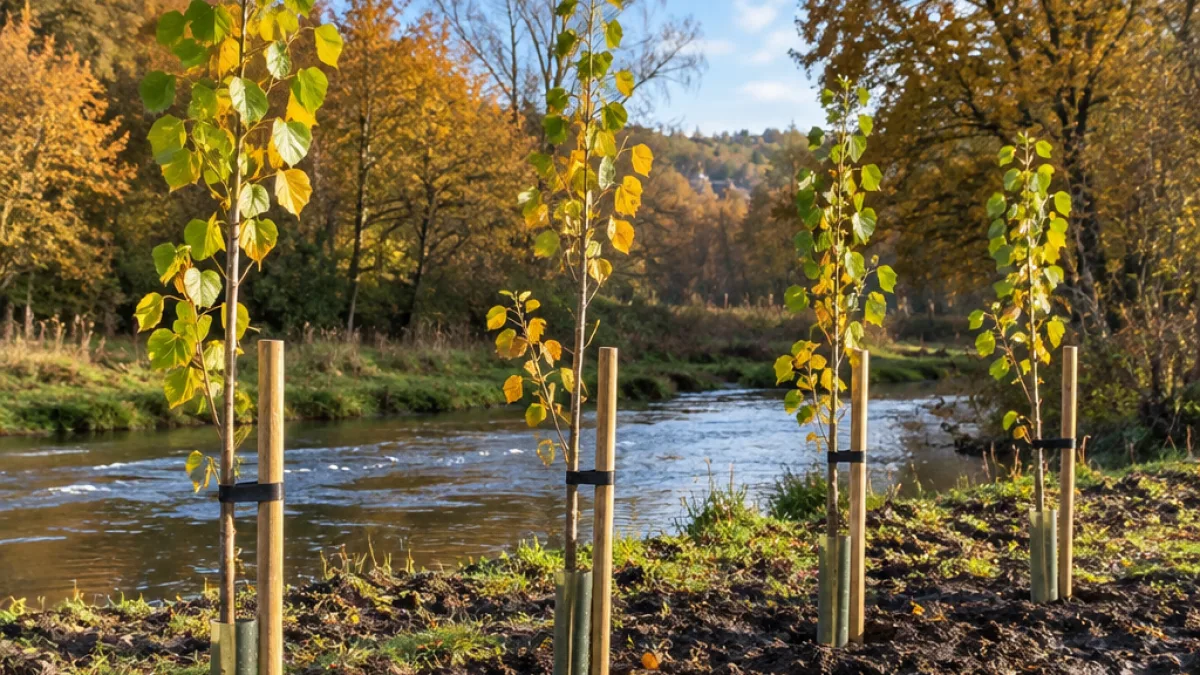
Four rare native black poplar trees have been planted at a Stoke-on-Trent nature reserve in an effort to help rebuild one of Britain’s most threatened tree populations.
The planting, carried out during National Tree Week, forms part of the Staffordshire and Stoke-on-Trent Local Nature Recovery Strategy. The project brings together Stoke-on-Trent City Council and Staffordshire Wildlife Trust, with the aim of establishing new growth from a species that has become increasingly scarce across the country.
A male tree and three female trees have been placed together. That balance is significant because the council says the shortage of female black poplars has been one of the factors behind the species’ decline. In Staffordshire, there are estimated to be about 80 native black poplars, but only a small number are female.
A rare tree with a wider role
The black poplar is not simply being protected for its rarity. According to the council, the species supports more than 100 types of insects and invertebrates, as well as moths, bees, birds and bats. Its roots can also help hold riverbanks together and contribute to the management of floodwater, giving the planting an importance beyond the trees themselves.
| Black poplar figures | Estimated number |
|---|---|
| Across England, Wales and Ireland | 7,000 |
| Female trees across those areas | Around 600 |
| Native trees estimated in Staffordshire | Around 80 |
The national picture underlines the scale of the challenge. The council estimates that around 7,000 black poplars remain across England, Wales and Ireland, with only about 600 females. The loss of suitable habitat, combined with the limited number of female trees, has restricted the species’ ability to reproduce and spread naturally.
Growing trees from Staffordshire cuttings
Staffordshire Wildlife Trust has developed the project by raising young native black poplars at its nursery at the Wolseley Centre. The saplings have been grown from cuttings taken from existing male and female trees in Staffordshire, allowing the new planting to retain a connection with the area’s remaining native population.
- A male and three female black poplars have been planted together.
- The trees were raised from local cuttings at the Staffordshire Wildlife Trust nursery.
- The species is listed as a priority within the local nature recovery strategy.
That approach offers a practical response to a problem that cannot be solved by planting trees indiscriminately. The absence of female specimens is a particular weakness in the existing population, so establishing several females alongside a male could help create the conditions for a new generation. The source material does not give a timetable for when the trees might reproduce, but the planting is intended to support the species’ long-term recovery.
“Protecting and improving nature across Stoke-on-Trent is an important part of our commitment to creating a greener, more biodiverse city.”
Councillor Jane Ashworth, leader of Stoke-on-Trent City Council, said the local nature recovery strategy was helping identify habitats and species requiring attention. The black poplar has been named as a priority species within that strategy, placing the planting within a broader programme of work rather than treating it as an isolated environmental gesture.
For Stoke-on-Trent, the project links biodiversity protection with practical land management. The trees may eventually provide habitat for a wide range of wildlife while their root systems can assist with riverbank stability and floodwater control. The immediate planting is modest in scale, but the choice of three female trees reflects the specific conservation problem facing the species. Its success will depend on the trees becoming established and contributing to the recovery of a native population that remains rare both locally and across the UK.