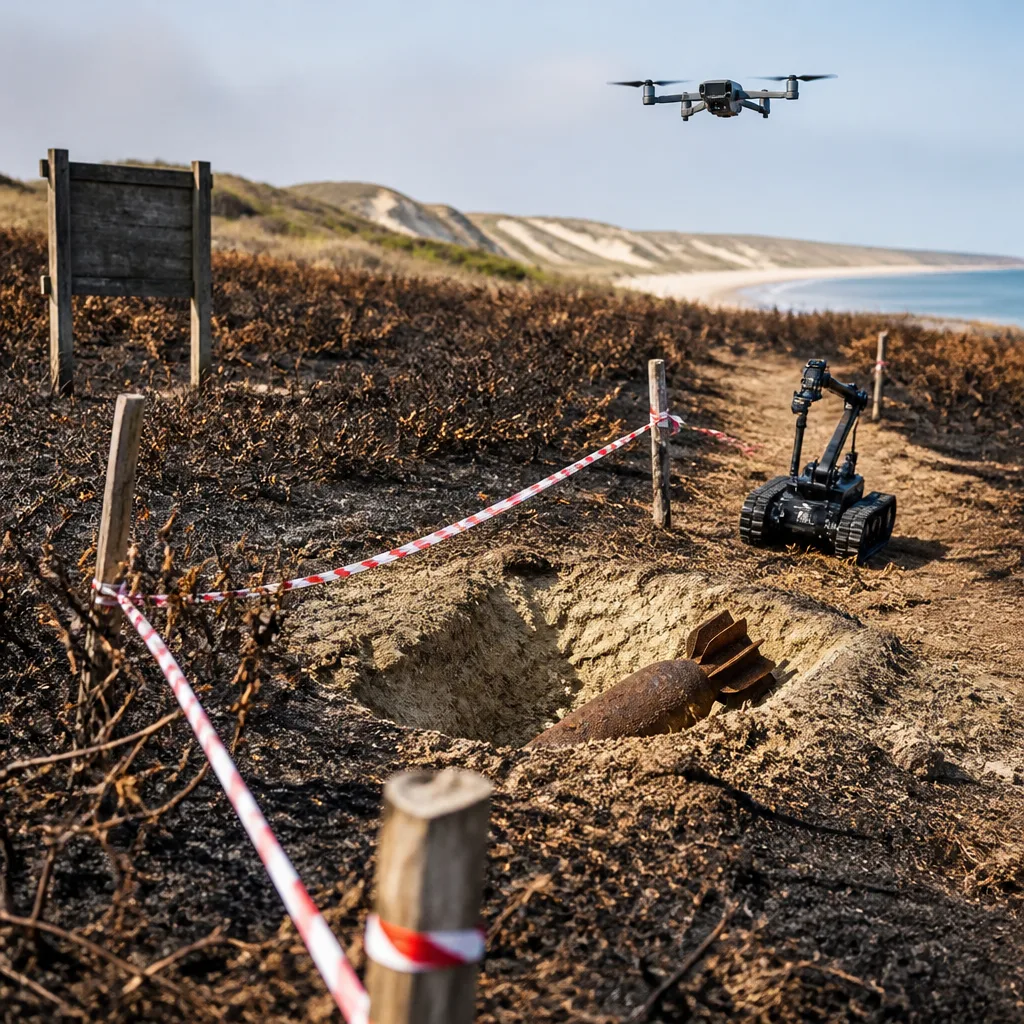
The National Trust has suspended public access to Dunwich Heath in Suffolk after a wildfire that began around two weeks ago destroyed extensive heathland and appears to have exposed Second World War unexploded ordnance.
Fire, damage and safety concerns
Conservation managers say the blaze has burned more than 100 hectares of habitat at the coastal reserve. Fire crews have stood the incident down as a major incident but remain on site to damp down hotspots and support safety operations. The charity has warned the area is currently “dangerous”.
“There’s no right for people to access this site at the moment because it’s dangerous.”
Matt Wilson, the National Trust’s coast and countryside manager for its Suffolk and Essex Coast portfolio, said Dunwich Heath had been used during the Second World War for training connected to what the charity described as Operation Kruschen, work that recreated features similar to German fortifications for Allied troops to practise assault techniques.
“During this fire event, at least two unexploded ordnance have been found and they’ve had to be remote detonated,”
One incident earlier in the response led fire crews to call in the bomb disposal team to deal with a phosphorus mortar discovered just over the reserve boundary near Minsmere. A separate item recovered by teams was described as a mortar fuse. The National Trust said it was likely that other items could be uncovered as the landscape — long covered by vegetation — has been stripped back by flames.
Survey work and next steps
The charity plans to deploy drones to survey the fire-damaged terrain. Officials said remote sensing will help identify hazards and guide safe access for specialists clearing ordnance and for ecological teams starting assessments of habitat loss.
Local fire commanders and National Trust staff stressed the need for the public to abide by the closure. The reserve remains under close observation while teams work to identify and neutralise any further explosive remnants and to evaluate the environmental impact.
- Area affected: more than 100 hectares of heathland
- Timeframe: fire took hold around two weeks before 12 August 2026
- UXO discovered: at least two items (phosphorus mortar and a mortar fuse), remotely detonated
- Current actions: drone survey planned; bomb squad involvement; on-site damping down and hotspot monitoring
| Location | Approximate area affected | Incident status | Known ordnance |
|---|---|---|---|
| Dunwich Heath, Suffolk | 100+ hectares | Fire stood down as a major incident; damping down ongoing | Phosphorus mortar (remote detonation); mortar fuse |
Wider context and uncertainties
Heathland and coastal habitats in East Anglia contain traces of wartime activity because much of the area was used for training in preparation for the D‑Day landings. Vegetation over decades can conceal ordnance, and disturbance by fire, erosion or human activity increases the chance that dangerous items will be exposed.
National Trust officials have said it is likely further unexploded devices will be found, but the exact scale of the risk remains unclear until comprehensive surveys are completed. The use of drones is intended to accelerate that assessment while reducing danger to staff and the public.
Beyond immediate safety concerns, the fire raises environmental and conservation questions. Heathland is a priority habitat for a range of species; loss on this scale will require prolonged restoration work. The discovery of historical munitions complicates recovery because remediation must balance ordnance clearance with ecological rehabilitation.
At present, authorities are focusing on cordoning the site, completing the ordnance survey and allowing experts to start longer-term ecological assessments. The National Trust has urged the public to heed closure notices and stay away from the affected areas while work continues.