
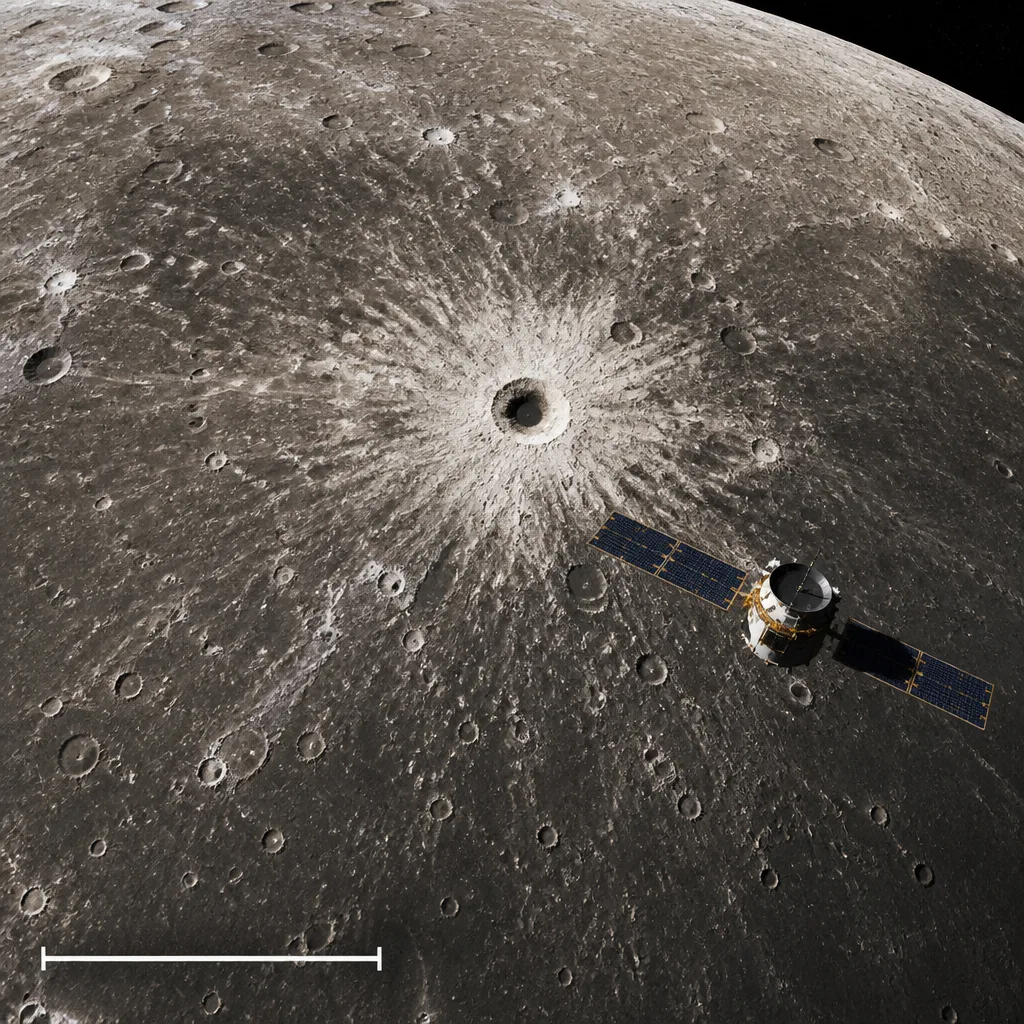
A routine survey of long‑term lunar imagery has uncovered what researchers say is the largest crater known to have formed recently anywhere in the solar system. Analysis of images from NASA’s Lunar Reconnaissance Orbiter (LRO) shows a new impact feature 728 feet across and 141 feet deep that appeared on the Moon between 11 April and 22 May 2024.
The feature has been officially named McGetchin, in recognition of lunar scientist Tom McGetchin, and was detected when an image‑processing specialist noticed an unusually bright patch encircled by a darker halo – a classic signature of fresh ejecta on the lunar surface. The specialist, Robert Wagner of Intuitive Machines who works with the LRO Camera (LROC) team, said the contrast prompted immediate follow‑up.
"I just stopped, dropped everything, and started looking into what that spot was," Wagner said, describing his first impression on seeing the anomaly.
What the impact tells us
Researchers estimate the impactor was roughly the size of a three‑ to six‑storey building — compact enough to reach the Moon without burning up in an atmosphere it does not possess. The collision excavated a basin whose diameter is roughly equivalent to two football fields laid end to end, and whose depth would accept three typical yellow school buses stacked vertically.
Scientists reporting in Science Advances on 16 September emphasised that such a large fresh impact on the Moon is uncommon. Current estimates suggest events of this magnitude occur on the Moon on the order of once per century, or perhaps even less frequently. The discovery therefore represents an unusual, high‑energy example of the steady rain of small bodies that continually reshapes airless surfaces across the Solar System.
Long‑running observations pay dividends
The finding underlines the value of sustained orbital monitoring. LRO has surveyed the Moon for more than 17 years with a suite of seven instruments that map topography, composition, thermal properties and radiation. Over that programme, researchers have catalogued at least 1,000 newly formed impact craters and recorded around 100,000 additional changes on the surface — alterations caused either by primary strikes or by secondary debris thrown outward during impacts.
Those data sets are becoming increasingly relevant as agencies and companies plan returning people to the lunar surface and establishing longer‑term operations. Fresh craters expose subsurface material, alter local temperatures and affect the distribution of regolith — all factors that matter for landing safety, resource prospecting and scientific sampling.
- Crater name: McGetchin
- Diameter: 728 feet (approximately 222 metres)
- Depth: 141 feet (approximately 43 metres)
- Formation window: Between 11 April and 22 May 2024
- Estimated impactor size: comparable to a three‑ to six‑storey building
| Parameter | Value |
|---|---|
| Diameter | 728 ft |
| Depth | 141 ft |
| Discovery reported | 16 September (Science Advances) |
Implications and follow‑up
Fresh impacts act as natural excavation tools, bringing deeper material to the surface and producing thermal anomalies that can persist for months. The McGetchin impact also created a surprisingly extensive cold zone in the surrounding regolith, signalling an alteration of the local thermal environment that remote sensors can track. Continued LRO observations will permit measurement of how the crater and its ejecta evolve with time — information that refines models of impact processes and surface ageing.
For scientists, each newly formed crater is a laboratory. It allows precise constraints on the timing and mechanics of impacts, offers comparisons with terrestrial craters formed under very different conditions, and helps calibrate rates at which the Moon’s surface accumulates damage. For mission planners, knowledge of where recent impacts have struck aids hazard assessment and may flag sites with freshly exposed material of scientific interest.
The discovery was the product of meticulous image analysis applied to a long‑duration dataset: a reminder that even well‑surveyed celestial neighbours continue to yield surprises when observations are scrutinised afresh.









