Scientists have identified a biochemical explanation for a long‑standing archaeological puzzle: in thousands of cases worldwide human brains have survived where other soft tissues have vanished. The new study, published in the Journal of Proteome Research, links preservation to the unusual chemistry that ensues when brain tissue is buried in waterlogged, hypoxic conditions.
Why the brain should rot — but often does not
The human brain is famously delicate after death. Composed mostly of water, proteins, carbohydrates and lipids, it is roughly 60 per cent fat, making it the fattiest organ in the body. That fatty composition, combined with an absence of mineralised structure, ordinarily makes the brain prone to rapid decay before any post‑mortem mineralisation can stabilise soft tissues.
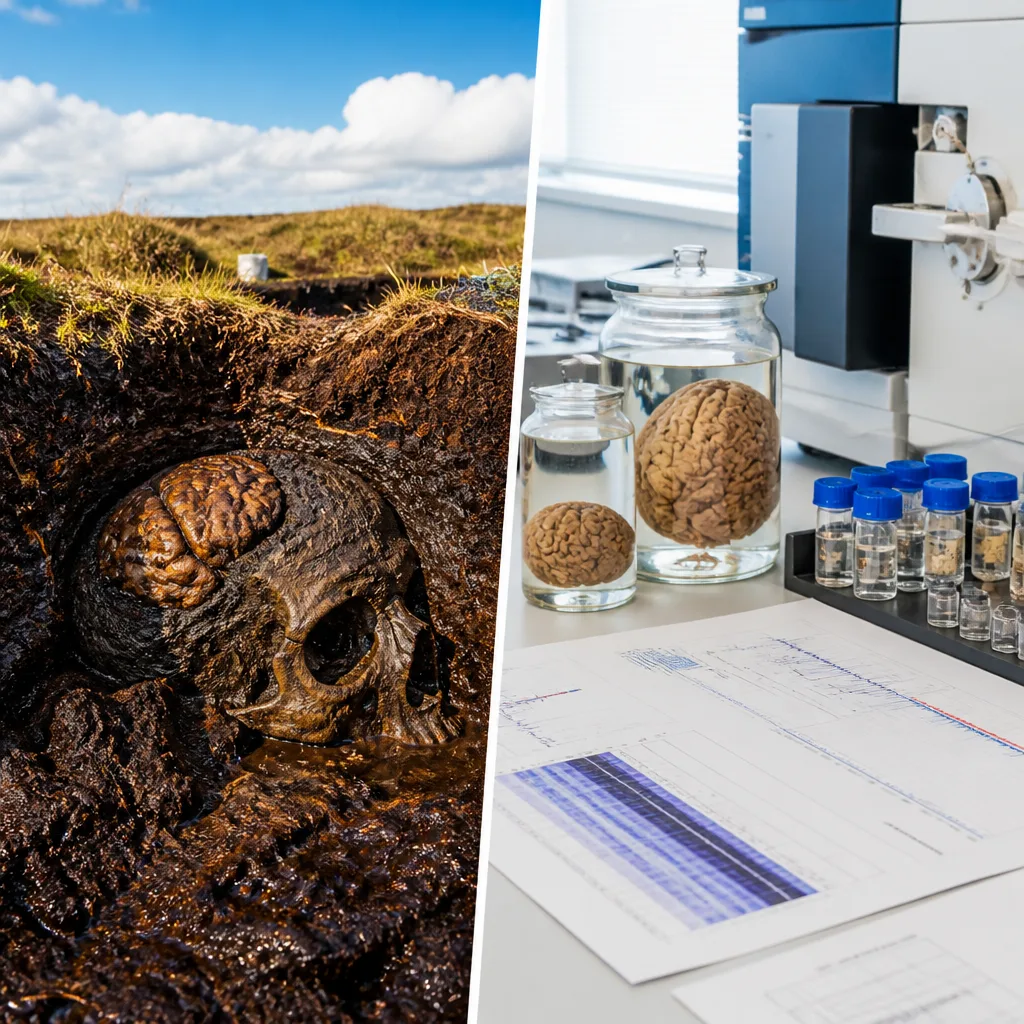
Yet archaeologists have catalogued more than 4,400 preserved human brains from burials and other contexts worldwide, some approaching 12,000 years of age. In over 1,300 of those instances the brain was the only soft organ to remain intact after all other soft tissues had decomposed. The apparent contradiction — labile biochemistry versus millennia of persistence — prompted the proteomic investigation.
What the researchers found
Analysing preserved brain material from waterlogged sites, the team found that the absence of oxygen changes the pathways by which brain proteins react after death. Under normal, oxygen‑rich decay, free radicals drive crosslinking reactions that accelerate breakdown; in hypoxic settings, those free‑radical pathways are disrupted. Instead, molecules form alternative links with neighbouring brain proteins, producing crosslinks that are mechanically stronger and more resistant to enzymatic decomposition.
“This contradiction between the brain’s persistence over millennia and its biochemical lability post‑mortem suggests that the central nervous system follows a taphonomic trajectory─a pathway by which biological tissues are altered, degraded, or preserved from the moment of death to their eventual recovery─that is both organ‑specific and mechanistically distinct from those stabilising other soft tissues,”
The study therefore redefines preservation not as an accidental by‑product but as a chemical outcome governed by environment and tissue composition. Waterlogged, oxygen‑poor sediments slow the usual oxidative chemistry and favour the formation of stabilising protein networks within the brain itself.
- Environments linked to preservation: waterlogged, hypoxic burial contexts.
- Key mechanism: suppression of oxygen‑driven free‑radical crosslinking and promotion of alternative protein crosslinks.
- Scale of phenomenon: >4,400 preserved brains recorded worldwide, >1,300 where brain was the sole surviving soft tissue.
The authors deployed proteomic techniques — the comprehensive analysis of protein composition and modifications — to read the molecular signatures left by those alternative crosslinking pathways. That approach allows researchers to detect not just which proteins remain, but how they have been chemically altered since death.
| Fact | Figure |
|---|---|
| Recorded preserved human brains | More than 4,400 |
| Cases where brain alone survived | Over 1,300 |
| Oldest examples | Nearly 12,000 years |
Beyond solving an archaeological curiosity, the findings have practical consequences. Forensic scientists, conservators and museum curators can use the insight that oxygen availability—and tissue‑specific chemistry—drives preservation to reassess how recovered remains are stabilised, sampled and stored. It also cautions against simplistic assumptions that the brain will always be the first soft organ to disappear in burial contexts.
Finally, the research highlights the value of molecular archaeology: by reading chemical modifications at the protein level, scientists can reconstruct not only what objects or tissues are, but the environmental history that allowed them to survive. The brain’s persistence emerges not as an inexplicable miracle but as the outcome of predictable chemistry under particular post‑mortem conditions.
As techniques in proteomics and molecular taphonomy advance, more nuanced maps of how different tissues respond to burial environments will become possible — refining both archaeological interpretation and the protocols used when ancient soft tissues are recovered.