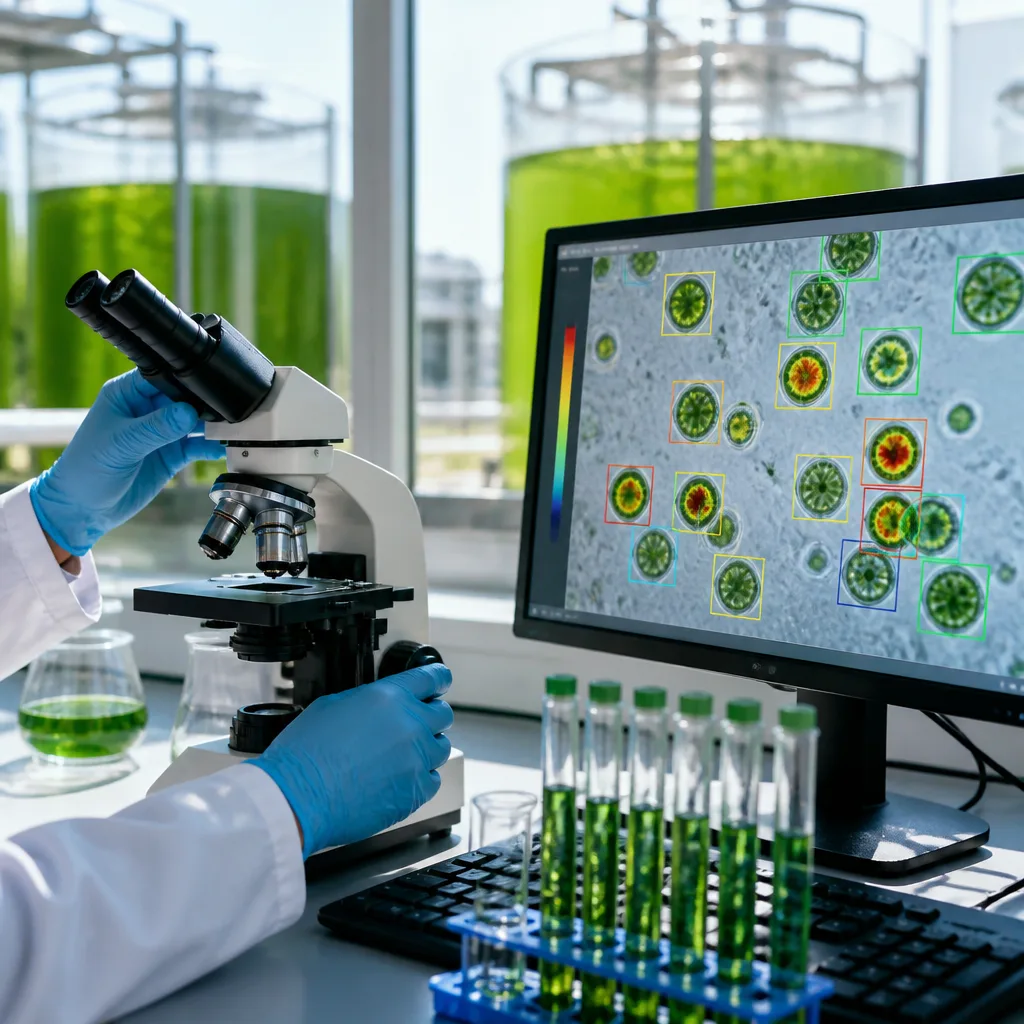
Scientists have applied artificial intelligence to tease apart performance differences between individual algal cells, identifying which cells produce the most oil that can be converted into biofuel. The work promises a more efficient route from laboratory experiments to large tank production, where even minor variations between single cells can translate into large swings in output.
From single-cell quirks to industrial yield
Algae naturally manufacture lipids — fats and oils — as energy stores during photosynthesis. Under nutrient stress, such as nitrogen deprivation, many species boost lipid production, and researchers have long sought to harness this for sustainable fuel. But scaling up from flasks to tanks is not straightforward: even genetically identical cells growing together will adopt different metabolic behaviours, with some becoming high lipid producers and others lagging behind.
Miguel Fuentes-Cabrera, a professor at Northeastern University’s Khoury College of Computer Sciences, explains that the assumption of uniform behaviour is misleading. He said researchers routinely find cells diverging in performance despite identical environments.
"You assume that all of them behave in the same manner, but they actually don't,"
This heterogeneity complicates efforts to maximise lipid output at industrial scale because growers must cultivate vast numbers of cells to reach economically significant quantities.
AI as a microscope and a scale-up tool
By applying AI to data from algae cultures, the research team could flag which cells are the most productive. The technology acts both as a high-resolution diagnostic and as a practicable guide for improving biomanufacturing. Rather than treating the culture as a uniform slurry, the approach highlights the distribution of cell behaviours and points to strategies to favour high-performing subpopulations.
Practical improvements fall into two broad categories:
- Biological selection — identifying or breeding strains where a greater fraction of cells are high lipid producers.
- Process control — altering temperature, light, nutrient regimes and other conditions to shift the population toward productive phenotypes.
Why single-cell variation matters at scale
The researchers note that a modest tank can contain prodigious numbers of cells. For context, a 260-gallon container — roughly equivalent to a large household tub — holds about as much culture as five domestic bathtubs when expressed in volume.
| Container | Volume |
|---|---|
| Research tank (example) | 260 gallons (~980 litres) |
| Domestic comparison | ~5 bathtubs |
Multiply that by the hundreds or thousands of such tanks envisaged for commercial production and small shifts in the proportion of high-yielding cells become economically significant.
Limits, next steps and industrial context
Turning algal lipids into fuel requires both high per-cell lipid content and the ability to cultivate enormous cell numbers reliably. Current optimisation strategies include genetic modification of high-performing strains and fine-tuning of culture conditions — temperature, light intensity, nutrient composition, pH and dissolved oxygen. The AI-driven approach complements these by providing a quantitative map of how individual cells respond, enabling targeted interventions.
The study does not claim immediate commercial deployment but offers a means to reduce unpredictability during scale-up. By integrating single-cell insights with cultivation engineering, producers could raise average lipid yields and reduce the wasteful need to grow many more cells than necessary.
Implications for sustainable fuels
Biofuels made from algal lipids are attractive because algae use sunlight and carbon dioxide, rather than arable land, to produce oils. If the challenge of variability can be managed, algal biofuels could become a more viable component of low-carbon transport and chemicals. The use of AI to identify and favour the best-performing cells is a pragmatic step along that path, turning a problem of microscopic variability into an actionable route to higher macro-scale productivity.
As the technology matures, the combination of computational diagnostics and process engineering may make large-scale algal biomanufacturing less of a hopeful experiment and more of a predictable industrial enterprise.