
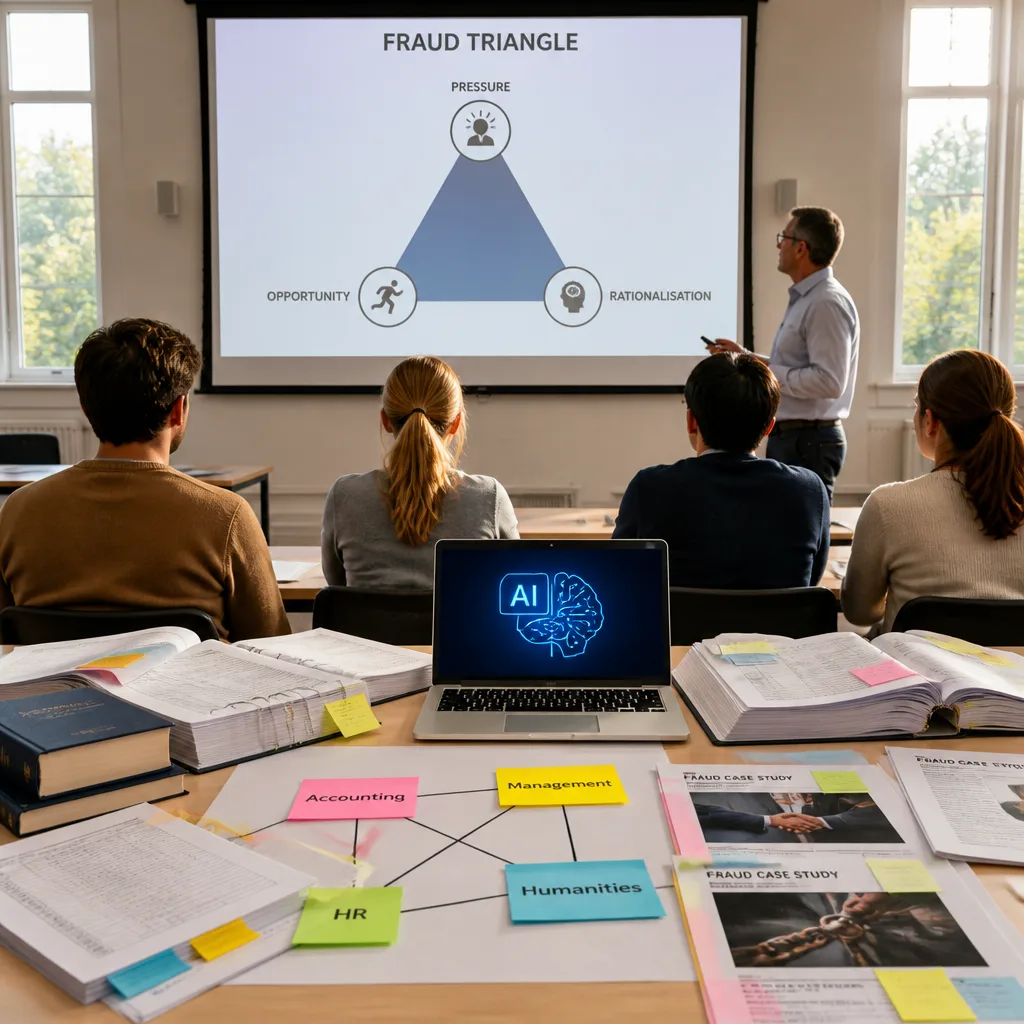
Two faculty members at SUNY Polytechnic Institute are calling for ethics and values to be integrated throughout accounting and business education as a means of equipping future professionals to recognise and prevent workplace fraud.
From standalone modules to programme-wide learning
The paper, An Integrated Approach to Developing Students' Ethical Values for Accounting Fraud Prevention: Aligning Course Learning Objectives with the Elements of Fraud, published in the Business Education Innovation Journal, is co-authored by Dr Katie Matt, an assistant professor of accounting, and Dr Lisa Berardino, an associate professor of management. Using the well-established Fraud Triangle — pressure, opportunity and rationalisation — as a pedagogic framework, the authors recommend that ethics instruction be embedded across a student’s entire course of study rather than isolated in a single unit.
Their proposal rests on two central premises. First, that individual ethics, values and integrity are important in reducing the incidence of fraudulent behaviour; and second, that curricular design can shape students’ ability to detect and respond to fraud risks encountered in real workplaces.
What the authors propose
Matt and Berardino advocate for curriculum mapping and an interdisciplinary approach that places ethical decision-making alongside technical accounting skills. They argue that courses in accounting should be coordinated with modules in strategic management, organisational behaviour, human resource management and the humanities so students can consider how personal values, workplace culture and external pressures interact.
- Use the Fraud Triangle (pressure, opportunity, rationalisation) as an organising framework for learning objectives.
- Embed ethics-based learning outcomes across multiple courses rather than confining them to a single ethics unit.
- Include interdisciplinary content so students examine cultural and organisational influences on behaviour.
The authors set out a range of proposed learning objectives that would allow students to:
- Evaluate real-world fraud cases and identify contributory factors.
- Recognise common fraud risk indicators in organisational contexts.
- Understand how workplace culture and pressures influence decision-making.
- Identify how emerging technologies, including artificial intelligence, may create new fraud risks.
Why this matters for universities and employers
The paper responds to a wider concern about the rising complexity of fraud risks in organisations and the limits of technical instruction alone. By aligning learning objectives with practical risk indicators and situational pressures, educators can give students repeated opportunities to practise ethical reasoning in contexts that mirror professional life.
Embedding ethics across the curriculum also has implications for curriculum planners, accreditation bodies and employers. If professional integrity is to be a demonstrable outcome of a degree, course learning outcomes, assessment strategies and placement experiences will need to reflect that aim.
| Fraud Triangle Element | Curriculum focus |
|---|---|
| Pressure | Case studies on financial and non-financial pressures; resilience and ethical decision-making |
| Opportunity | Controls, audit awareness and risk identification in accounting practice |
| Rationalisation | Ethical reflection, organisational culture and professional identity |
The authors also highlight the need to address how new technologies could alter opportunities for fraud and the ways in which rationalisations are formed. This signals a requirement for up-to-date syllabuses that account for technological change as well as classic controls and norms.
For students, the practical promise of the approach is clear: repeated exposure to ethical dilemmas across different course settings should build the confidence to spot and escalate concerns. For employers, graduates who have practised ethical decision-making in curricula that mirror workplace complexity may present lower fraud risk.
While the paper sets out a curricular model rather than an evaluation of implemented programmes, it adds to a growing conversation about how higher education can balance vocational competence with professional ethics — an issue likely to interest regulators, professional bodies and institutions reviewing degree standards.
At a time when organisations face evolving fraud risks and regulators place emphasis on ethical culture, the proposal to weave ethics through accounting education offers a structured route for universities to demonstrate how their programmes prepare students to act with integrity in the field.