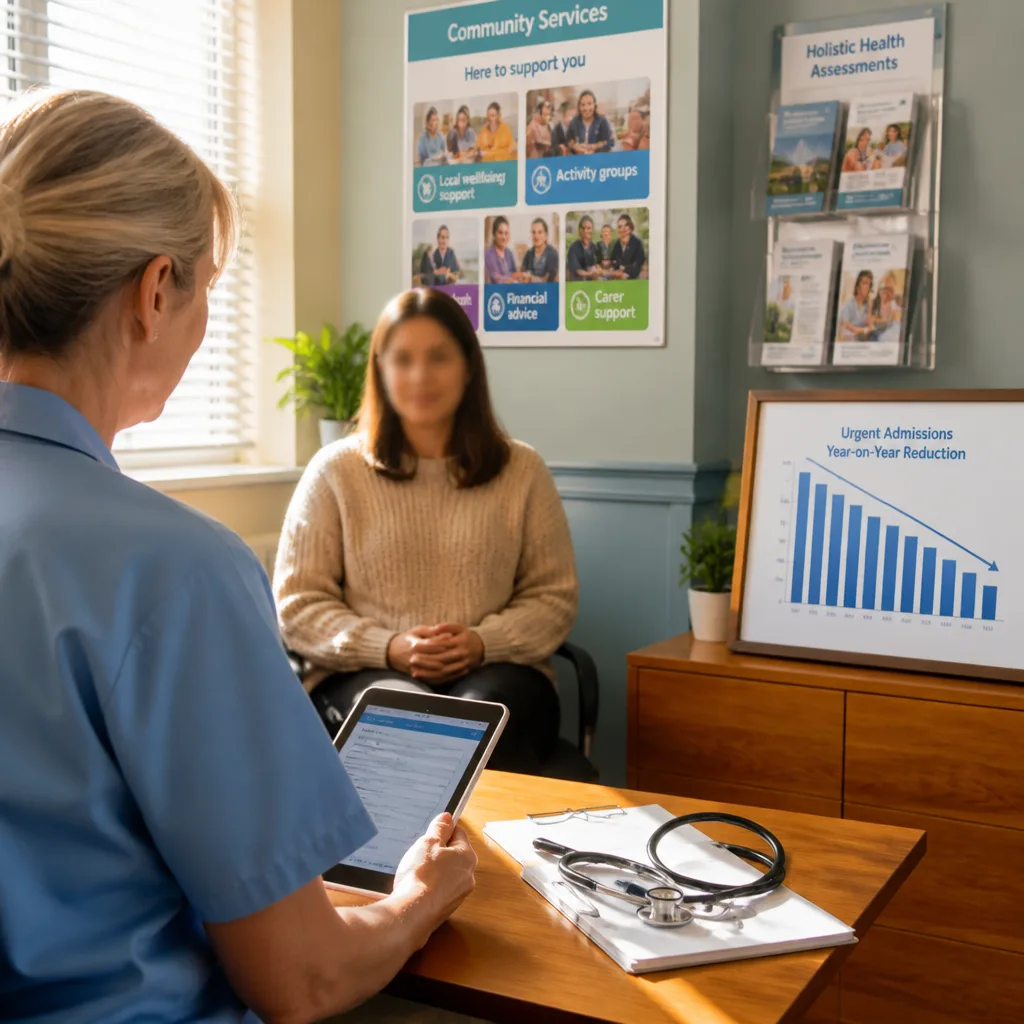
The Holistic Health Assessment (HHA) programme rolled out across Lancashire and south Cumbria has been linked by the regional integrated care board (ICB) to an 11.7% reduction in urgent or unplanned hospital admissions among people with long-term conditions, and an estimated 1,500 avoided admissions over 2025/26, the ICB’s latest data shows.
Primary care checks aim to identify unmet needs earlier
The HHAs — offered through general practices — are designed to take a broader view of people with chronic conditions, systematically identifying those with complex clinical, social or inclusion health needs who are at higher risk of emergency care. The assessments cover clinical and non-clinical areas, including social care and access to primary care services such as dental, pharmacy and optometry, plus community health support.
When an unmet need is found, patients are referred or signposted to appropriate services, or booked for follow-up. Those assessed as highest risk are discussed in structured local multidisciplinary meetings where clinicians and community partners agree next steps.
"The success we’ve seen demonstrates the value of looking beyond a patient’s immediate clinical condition and taking a truly whole-person approach to care," said Dr John Miles, clinical and care professional lead at the ICB.
Dr Miles added that by addressing unmet social and health needs earlier, teams had been able to help people manage conditions more effectively and reduce the likelihood of emergency hospital attendance.
Data and limitations
The ICB reports that more than 95,000 HHAs were delivered by general practices in Lancashire and south Cumbria during 2025/26. The headline figure of 11.7% fewer urgent or unplanned admissions relates to patients who received an HHA compared with their previous patterns of care, and the ICB has estimated this corresponds to roughly 1,500 prevented admissions.
Officials acknowledge the analysis is ongoing and have not published a peer‑reviewed evaluation. The association reported by the ICB should therefore be interpreted cautiously: observational programme data can show correlation but does not by itself prove causation. External factors — such as changes in hospital capacity, broader community services, or case-mix shifts — can also influence admission rates.
Nonetheless, the approach aligns with evidence that integrated, person-centred primary care interventions and social prescribing can reduce emergency use for some populations, provided services are well co-ordinated. Robust controlled studies remain the gold standard to establish effect size and cost‑effectiveness, and the ICB’s continuing analysis will be important for assessing longer-term impact.
Practical effects and next steps
The ICB says around 5% of people assessed were referred to social prescribing services in the first year, indicating a route by which non-clinical needs were being addressed. The programme also relies on multidisciplinary meetings to plan care for those at greatest risk.
- Scale: >95,000 HHAs delivered in 2025/26.
- Reported outcome: 11.7% reduction in urgent/unplanned admissions among assessed patients.
- Estimated impact: c. 1,500 hospital admissions avoided.
The ICB’s initial findings may inform commissioning decisions across other integrated care systems considering similar targeted assessment programmes. Key considerations for wider adoption will include workforce capacity in general practice, availability of community and social resources to meet identified needs, and mechanisms for monitoring equity and outcomes.
| Metric | Value (2025/26) |
|---|---|
| Holistic Health Assessments delivered | 95,000+ |
| Reduction in urgent/unplanned admissions | 11.7% |
| Estimated admissions avoided | c. 1,500 |
For policy-makers, the headline figures are promising but not definitive. A careful, independent evaluation — including cost-benefit analysis and consideration of whether the benefits are sustained across different patient groups — will be necessary before this model is scaled nationally. Meanwhile, practices and local partners in Lancashire and south Cumbria are continuing to refine delivery as further data is analysed.
Reporting on service innovations such as HHAs should distinguish early programme associations from proven effects. The ICB’s ongoing work will be important to determine whether the reductions in urgent admissions persist and whether similar programmes can be implemented without widening inequalities or placing unsustainable burdens on primary care.