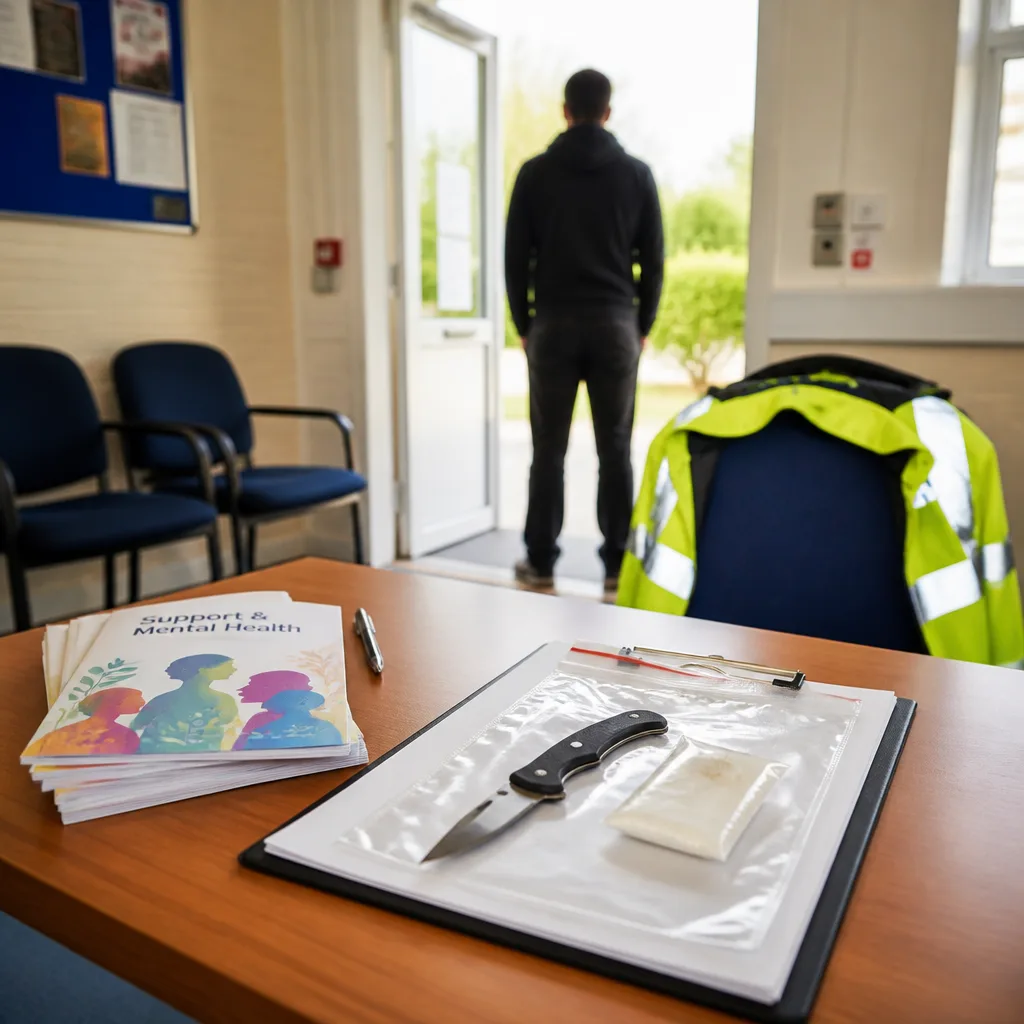
Cleveland Police’s Divert Programme allows some people arrested for possession of knives or drugs to avoid prosecution and prison if they agree to take part in mental health or other support interventions, the force has said.
How the scheme works and where concern has centred
The initiative, which the force describes as designed to “steer first‑time and low‑level offenders away from the criminal justice system”, has operated since 2018. According to reporting, the scheme had 1,853 participants from its launch through to 2025.
Under the programme, people who admit possession of blades or drugs can be offered help that aims to address what are described as the “root causes of their offending behaviour” instead of being sent to court. The policy has prompted debate about where to draw the line between diversion and punishment, particularly after a series of serious incidents in Middlesbrough that have focused public attention on crime and policing in the area.
“Young men were being pulled into criminality 'without any regard for the consequences',” Labour MP Andy McDonald told LBC, as the town faced multiple recent tragedies.
Those incidents include a crash on the A66 that resulted in multiple deaths and a separate house fire in which a seven‑year‑old girl and her aunt died. Cleveland Police said detectives were not linking the house fire to the crash, and the force deployed an additional 200 officers to help investigate after nine deaths over six days in the area.
Political reaction and public concern
Conservative shadow home secretary Chris Philp criticised the policy, calling it “soft justice at its worst” and describing the approach as “cosy” in media comments. The debate has therefore become tangled with wider concerns about public safety following the recent fatalities in Middlesbrough.
Supporters of diversionary schemes argue such programmes can reduce reoffending by tackling underlying problems such as substance misuse, mental ill health or social and economic factors. Opponents say that for offences involving weapons or where there is significant public harm, custodial sentences or formal prosecution are necessary to uphold justice and deter future offending.
- Programme start: 2018
- Participants to 2025: 1,853
- Recent context: Multiple deaths in Middlesbrough, additional policing resources deployed
| Metric | Detail |
|---|---|
| Programme name | Divert Programme (Cleveland Police) |
| Operational since | 2018 |
| Participants (2018–2025) | 1,853 |
Evidence and limits
Public health and criminal justice experts typically emphasise the importance of evaluating diversion schemes with robust data on outcomes such as reoffending rates, mental health measures and victims’ experiences. The publicly reported figures for this specific scheme are limited to the cumulative number of participants to 2025; the material available does not provide detailed outcomes or comparative reoffending statistics.
Without published evaluations made available in the reporting, it is not possible to draw firm conclusions about the effectiveness of the programme in reducing crime or improving mental health. Observers should therefore take care to distinguish between measurable impact and policy intent: offering support for underlying issues is conceptually different from demonstrated reductions in future offending.
Implications for policy and policing
The controversy highlights wider tensions facing policing and justice policymakers: how to balance diversion and rehabilitation with public demands for accountability and safety, particularly after high‑profile incidents. The deployment of extra officers to Middlesbrough reflects immediate operational priorities in the wake of recent deaths, while the debate over the Divert Programme underscores longer‑term questions about how best to prevent knife crime and drug‑related offending.
Any considered response should weigh available evidence, seek transparent outcome data from diversionary schemes, and ensure victims’ voices and community safety are central to policy discussions. At present, reporting indicates the scheme remains a live and contested element of Cleveland Police’s approach to first‑time and low‑level offending.