
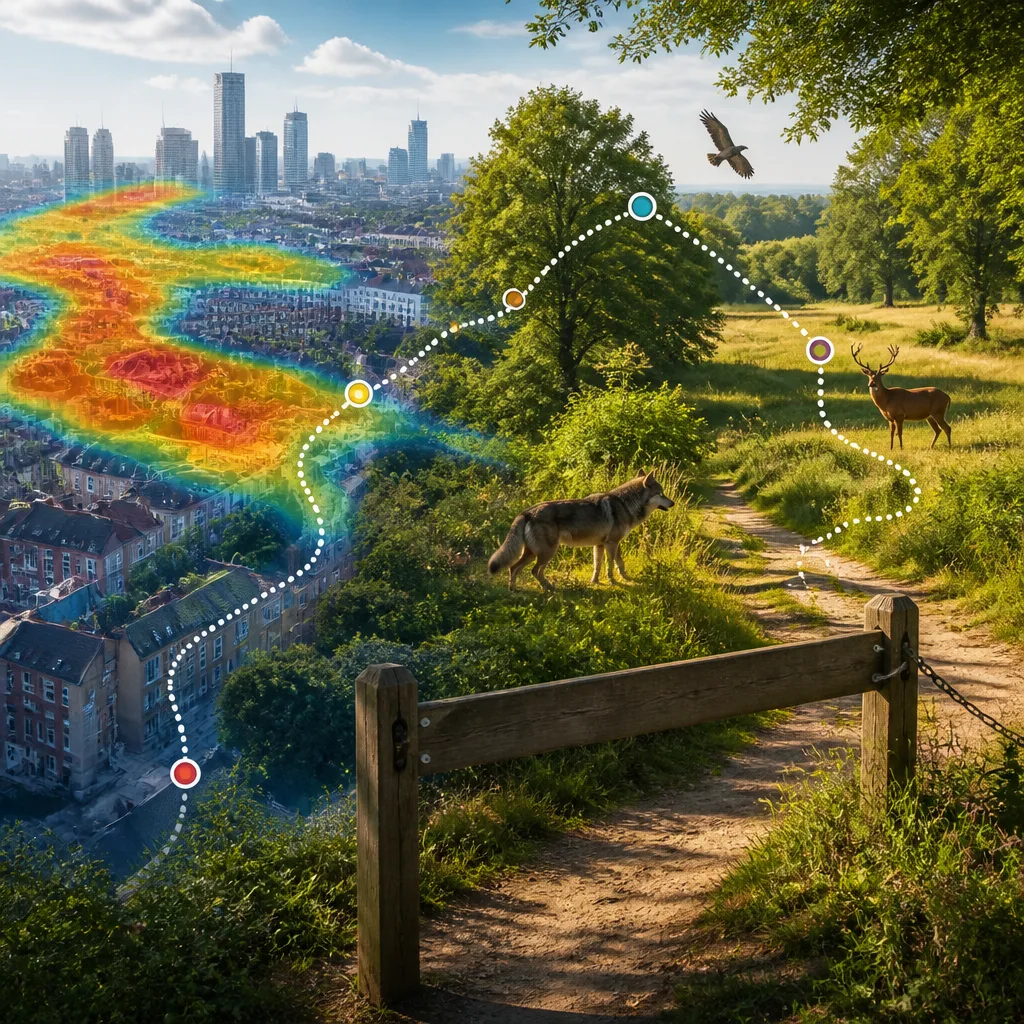
A team of researchers from UC Santa Barbara, the Smithsonian’s National Zoo and Conservation Biology Institute and Yale University has shown that the mere presence of people — tracked using anonymised smartphone location data — changes how wild animals use space, independently of landscape modification.
Method and scope: neighbourhood-level human movement linked to animal GPS
The scientists combined anonymised cellphone location records across the United States with GPS tracking data for 4,581 individual mammals and birds representing 37 species across 2019 and 2020. The period spanned the dramatic reduction and subsequent redistribution of human movement associated with COVID-19 restrictions, offering a natural experiment to separate the effects of static habitat alteration (for example urbanisation or agriculture) from the dynamic effect of people moving through an area.
Using weekly movement summaries, the researchers compared the animals’ home-range sizes and niche use with variations in human presence at neighbourhood resolution. The approach is notable for being the first to use human geolocation data at that fine scale to test wildlife responses.
Key findings: most species respond to people as well as to habitat
The results show that human impacts cannot be reduced to landscape change alone. Across the species examined:
- 57% were affected by both human presence and landscape modification.
- 67% of mammals altered home-range or niche size in relation to nearby people.
- 68% of birds showed similar changes.
Crucially, the researchers found that animals were often more sensitive to the physical presence of people in less-modified landscapes — for example, in national parks compared with cities. In other words, even where habitats remain relatively intact, human activity can substantially reduce the space animals use.
“Humans have complicated effects on wildlife, from our physical presence to how we reshape habitats, but we can’t understand our full impact without information on both,” said co-lead author Ruth Oliver of UC Santa Barbara.
Varied species responses and a noteworthy example
Responses were not uniform. The behaviour of different species varied: some contracted their ranges when people were nearby, while others expanded them. The report highlights wolves as an example that expanded their habitats in the presence of people, a finding the authors suggest could reflect the complex and long-standing relationship between wolves and humans.
The divergence of responses underscores that conservation and public-access policies cannot assume a single reaction across taxa. Management strategies that work for one species — or in urban settings — may be inappropriate in wilderness or protected areas.
| Metric | Value |
|---|---|
| Individual animals tracked | 4,581 |
| Species represented | 37 |
| Species affected by both presence and landscape | 57% |
| Mammals changing range with people nearby | 67% |
| Birds changing range with people nearby | 68% |
Implications for conservation and public access
The study has practical implications. Conservation planners typically account for habitat loss, fragmentation and land-use change when designing protected areas and corridors. These findings imply that the pattern and intensity of human movement through a landscape — hikers, park visitors, commuters passing through green corridors — can independently shape wildlife space use and therefore should be considered explicitly.
Because sensitivity to human presence was higher in less-modified landscapes, managers of national parks and reserves may need to reconsider visitor routing, timing and density to avoid unintended compression of animal ranges. Conversely, urban wildlife may have adapted to high human density in ways that make them relatively less sensitive to additional visitors, complicating one-size-fits-all approaches.
By quantifying uncertainty through comparisons before and during the COVID-19 mobility shifts, the researchers provide a clearer separation of the mechanisms by which humans influence wildlife — a valuable refinement for modelling species’ responses to our growing footprint.
The study, published in Science, demonstrates that understanding our impact on biodiversity requires data not only on how we change the shape of the land, but on how we move through it.









