
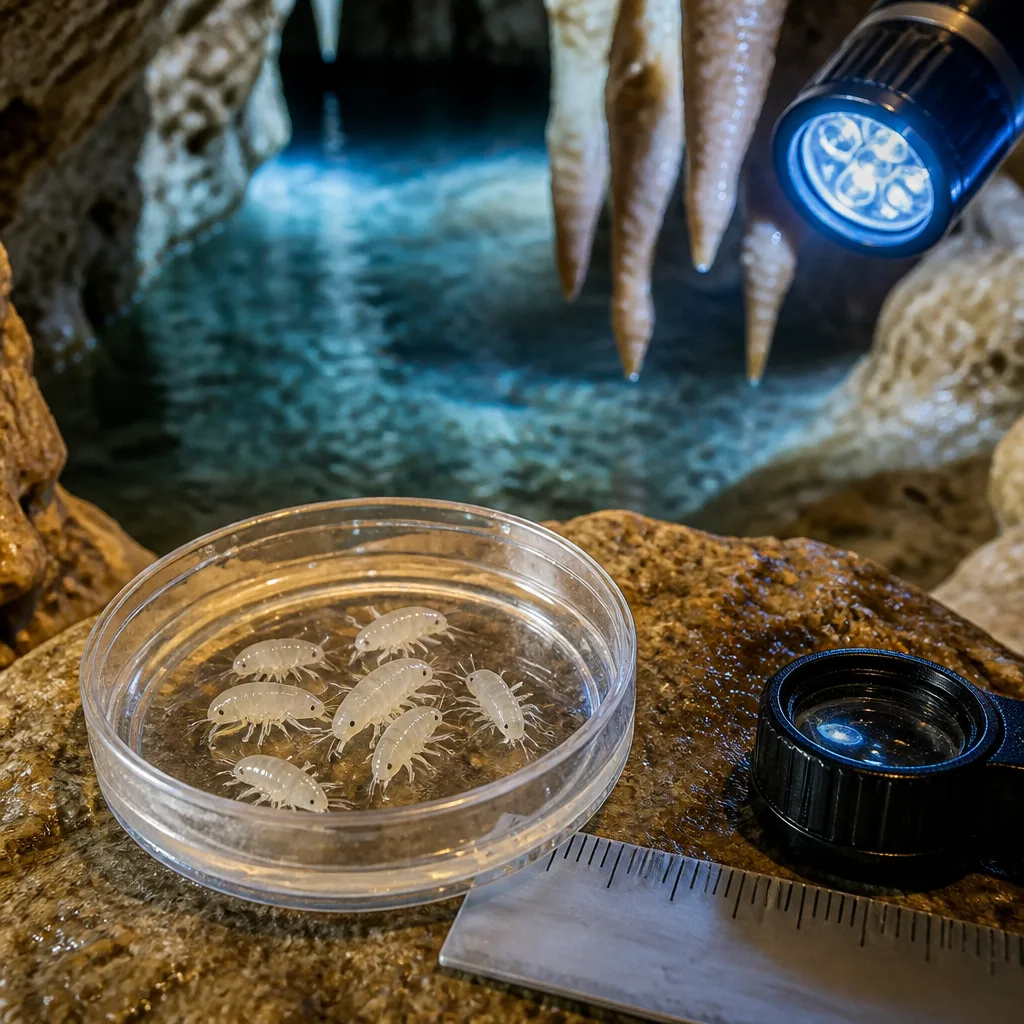
Scientists have formally described two new species of tiny, eyeless amphipods found in the subterranean waters of Japan’s Ryukyu Islands, the team reported in Zootaxa in June 2026. The crustaceans, members of the genus Bogidiella in the family Bogidiellidae, were collected from two separate cave systems and show classic adaptations to life in darkness.
Where they were found and how small they are
The two species have been named Bogidiella isajii and Bogidiella painushima. B. isajii was taken from an anchialine undersea cave on Minamidaito Island, while B. painushima was retrieved from freshwater flowing through a cave on Ishigaki Island, part of the subtropical Ryukyu chain that stretches towards Taiwan.
Specimens are minute: individuals measure roughly 1.4–3.2 mm in length, with the largest approaching the size of a sesame seed. Visually, the animals are unpigmented and lack functional eyes — traits commonly linked to long-term subterranean habitation — and their limbs show elongation while swimming appendages (pleopods) are reduced.
Adaptations and habitats
The newly described amphipods illustrate how isolated groundwater and cave channels can produce highly specialised fauna. Members of Bogidiellidae are known to occupy a wide range of subterranean aquatic niches, from purely freshwater systems to brackish and seawater-influenced environments such as anchialine pools connected to the ocean by underground passages.
“Groundwater has long been used in human life as a source of drinking water and for agricultural purposes, but in recent years, the conservation of the groundwater enviro
The published account, led by researchers at Hiroshima University’s Graduate School of Humanities and Social Sciences under Professor Ko Tomikawa, notes that cave and groundwater environments are often overlooked despite supporting specialised, and sometimes endemic, species.
- Species: Bogidiella isajii (anchialine, Minamidaito Island) and Bogidiella painushima (freshwater cave, Ishigaki Island)
- Key traits: eyeless, unpigmented, elongated appendages, reduced pleopods
- Size range: 1.4–3.2 mm (largest near sesame-seed size)
| Species | Island | Habitat | Notable traits |
|---|---|---|---|
| Bogidiella isajii | Minamidaito | Anchialine undersea cave | Eyeless, unpigmented |
| Bogidiella painushima | Ishigaki | Freshwater cave | Small (1.4–3.2 mm), elongated appendages |
Scientific and conservation significance
Describing new species is the first step in understanding biodiversity and its vulnerabilities. Small cave and groundwater organisms often have restricted ranges and specialised life histories, making them susceptible to groundwater extraction, pollution and habitat alteration. While the published paper confines itself to taxonomy and description, the discovery emphasises how much remains undocumented in subterranean ecosystems.
Taxonomic work like this also sharpens the lens through which ecologists view subterranean networks: narrow conduits and anchialine connections can harbour distinct lineages, and the morphological changes observed in these amphipods — loss of pigment and eyes, elongation of sensory appendages — are evolutionary hallmarks of adaptation to permanent darkness.
It is notable that the Ryukyu archipelago, a chain of subtropical islands with complex coastlines and karst geology, continues to yield new species when subjected to careful sampling. Each formally described organism improves the foundation for conservation assessments and for understanding the biogeography of subterranean fauna across island systems.
The work appeared in Zootaxa in June 2026 and was led by researchers affiliated with Hiroshima University’s Graduate School of Humanities and Social Sciences.









