
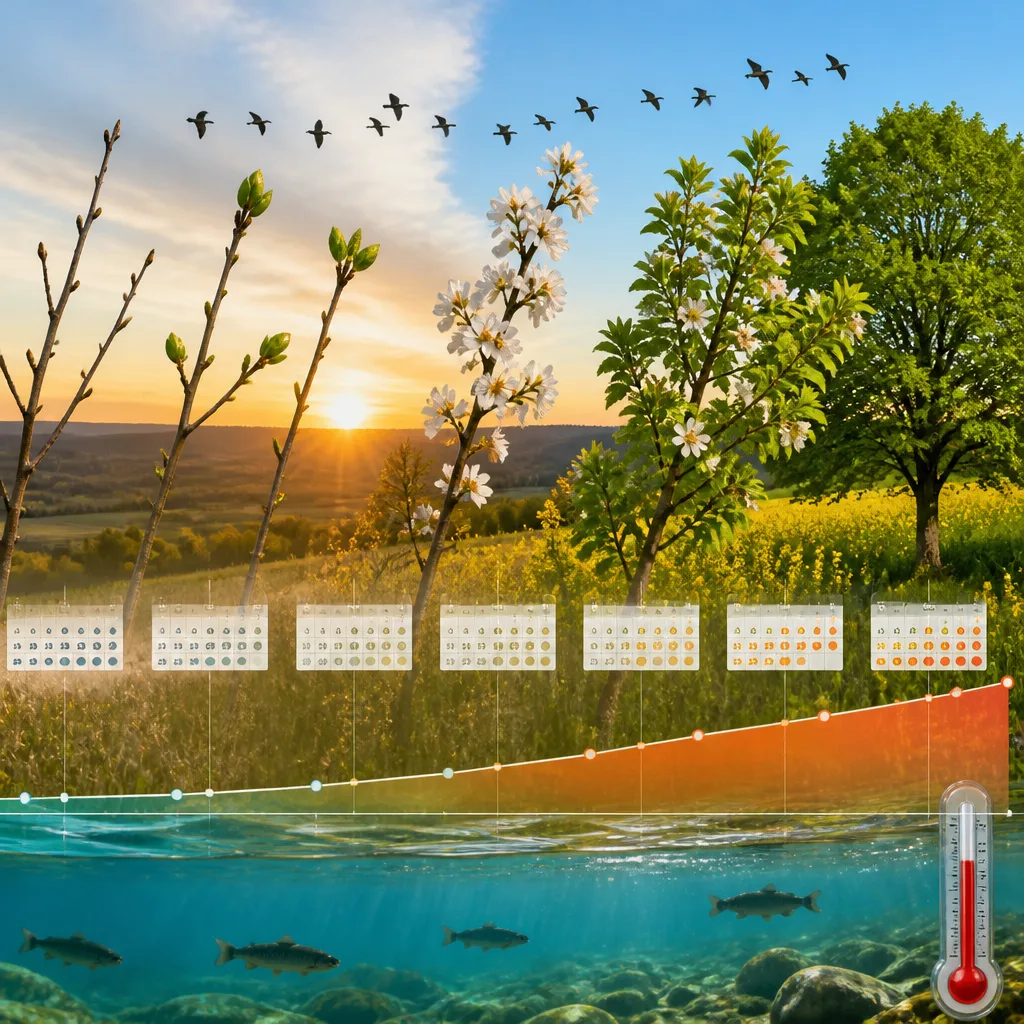
Phenology — the discipline that maps the timing of life-cycle events against environmental signals — is emerging as an essential tool for understanding how ecosystems and human systems will respond to a warming planet.
What phenology studies and why it matters
At its simplest, phenology asks why and when organisms change through the year. The field records events such as leaf-out, flowering, insect emergence, breeding and migration, then links those biological milestones to non-living cues: day length, temperature, ocean currents and other seasonal variables. The approach turns natural calendars into measurable data, revealing cause-and-effect relationships between environment and life.
For example, coastal fish species do not consult a timetable to decide when to spawn. Instead, they respond to cues such as water temperature and currents. In some regions, one species will reproduce later in the year than another — a pattern that phenologists map and explain. These patterns are not trivia: they help determine recruitment success, predator–prey interactions and the availability of food for humans and wildlife alike.
Climate change is shifting the timings
One of phenology’s most important contributions is demonstrating how warming alters seasonal rhythms. As mean temperatures rise, many plants and animals are completing life-cycle events earlier in the year. Budburst and flowering frequently occur sooner; migratory birds and insects may arrive earlier or alter routes; fishes can shift spawning windows. These changes can be subtle in any single year but, aggregated across populations and decades, they amount to substantial ecological realignment.
Such shifts can lead to mismatches. If pollinators emerge before or after peak flowering, plant reproduction and food webs can suffer. If migratory birds arrive when insect prey are scarce, their breeding success falls. Phenology therefore provides an early-warning system: measuring timing shifts highlights where climate-driven mismatches may harm species or disrupt services such as crop pollination.
Applications across policy and society
Phenological data feed into several practical areas:
- Agriculture — timing of planting, pest emergence and the likelihood of late frosts.
- Conservation — predicting breeding windows, migration corridors and habitat management.
- Public health — forecasting pollen seasons and vector-borne disease risk.
- Fisheries — aligning harvests and protections with spawning periods.
By converting life-cycle observations into predictive models, phenology helps decision-makers adapt: adjusting planting calendars, targeting conservation action when and where it is most needed, and preparing health services for altered allergy seasons.
Examples that illuminate the method
Concrete cases show how the method links observation to consequence. In temperate trees, the appearance of buds in spring can be driven by increasing day length, rising temperature, or both — phenology studies disentangle these drivers by combining long-term observations with experimental warming and modelling. In coastal fisheries, species have distinct spawning intervals tied to seasonal conditions; documenting those intervals allows managers to set protective measures for vulnerable life stages.
| Species group | Typical seasonal event | Example timing |
|---|---|---|
| Temperate trees | Budburst/flowering | Early spring (varies with temperature and day length) |
| Coastal fish | Spawning | Species-specific windows tied to water temperature |
These data-driven statements allow managers to quantify uncertainty and to forecast likely outcomes under different warming scenarios. The result is evidence that can guide adaptation rather than rely on intuition.
Where phenology needs to go next
Long-term, standardised observations remain the backbone of phenology. Citizen science programmes, museum records and remote sensing are complementary sources that expand coverage in time and space. Integrating these datasets with mechanistic models will improve predictive power and help identify thresholds beyond which ecosystems may reorganise in ways that are difficult to reverse.
Ultimately, phenology transforms the abstract notion of climate change into concrete shifts in timing that affect food production, biodiversity and human wellbeing. By mapping when nature’s clocks tick, the field provides practical insight into how to adapt to a world in which the seasons themselves are changing.









