A trio of teenagers in Kinsale, County Cork, have demonstrated that soil bacteria associated with pea plants can substantially accelerate the germination of cereal seeds, a finding that challenges received assumptions about the limits of plant–microbe partnerships and could have practical implications for crop establishment.
From a warted pea to lab-bench persistence
The work began when one of the girls removed a pea plant whose roots were studded with pale, wart-like nodules. Those nodules, the girls discovered, contained rhizobium — a group of nitrogen-fixing bacteria that legumes host in exchange for sugars. While rhizobia are a textbook example of a mutualism that supplies nitrogen to legumes, conventional wisdom holds that staple cereals such as wheat, barley and rice do not form the same partnership and therefore cannot access that benefit.
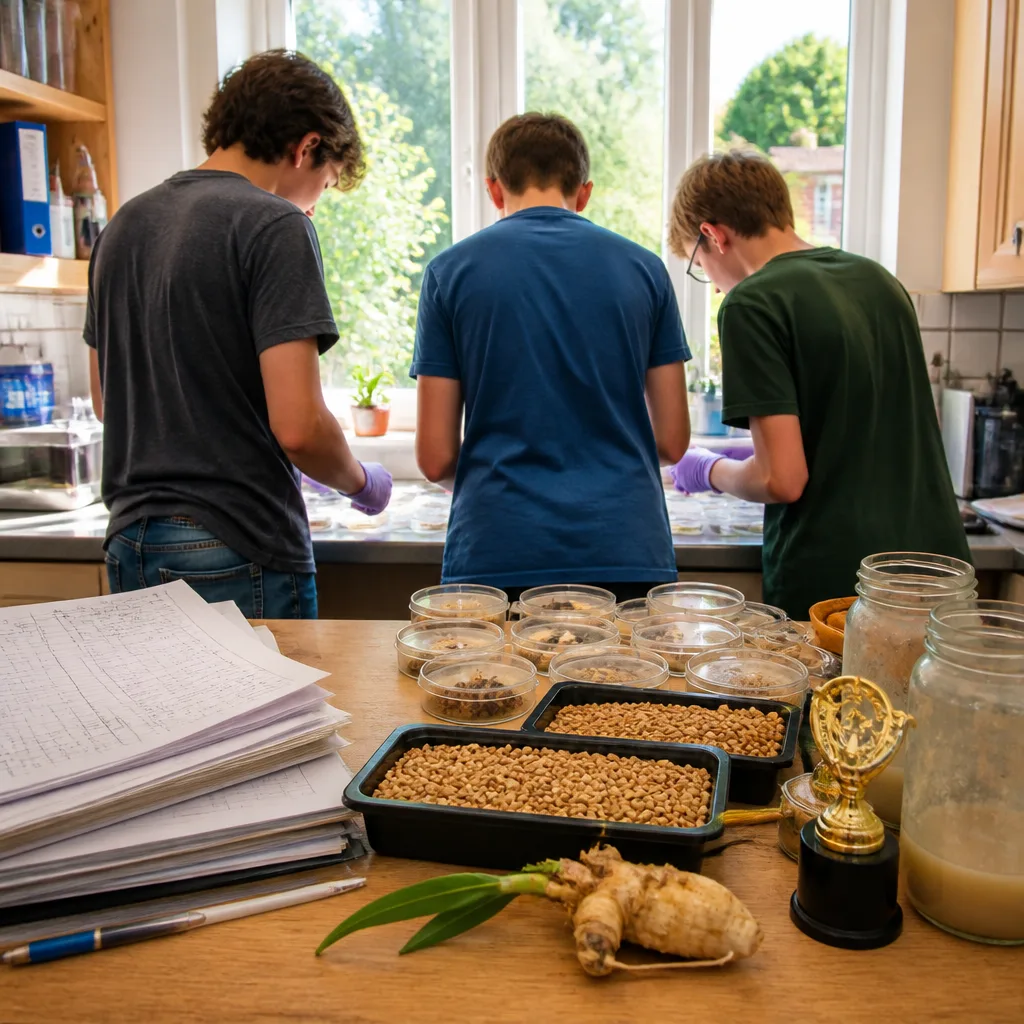
Undeterred by scepticism from parts of the scientific community, the students converted a spare bedroom into a makeshift laboratory. Over three years they ran controlled experiments soaking cereal seeds in cultures of the bacteria and recorded germination and seedling performance by hand.
Scale, method and results
The scale of the project was unusually large for a school-based endeavour: the team eventually tested about 13,000 seeds, performed thousands of additional outdoor trials, and logged on the order of 120,000 individual measurements. Their primary finding was that barley seeds treated with the rhizobium cultures germinated roughly 50% faster than untreated controls.
| Metric | Reported figure |
|---|---|
| Duration of study | 3 years |
| Seeds tested | ~13,000 (plus additional field trials) |
| Individual measurements logged | ~120,000 |
They measured time to germination, germination rate, seedling growth and dry mass under controlled conditions, then corroborated results in outdoor plots. The students persisted despite being told by adults that the bacteria would have no effect on cereals.
"Many people told them the bacteria would have no impact on cereal crops,"
Context and consequences
The apparent acceleration of germination does not, by itself, mean cereals gain full access to atmospheric nitrogen in the way legumes do. The study addresses an earlier, narrower question — can rhizobium influence early seed and seedling performance in non-legumes — and provides an affirmative answer at least for barley in these experiments.
If reproducible and scalable, an increase in germination speed could have practical value. Faster emergence can reduce vulnerability to weather or pests, improve uniformity of stands and potentially lower production risk in marginal environments. The work also prompts further scientific questions about mechanisms: whether the bacteria promote germination through biochemical signals, nutrient delivery during the vulnerable germination window, or by altering the seed microbiome in ways that favour establishment.
- Robustness: the conclusion is supported by extensive replication — thousands of seeds and many measurements across seasons.
- Limits: the experiments demonstrate an effect on germination speed and early growth; they do not show that cereals form nitrogen-fixing nodules comparable to legumes.
- Next steps: independent replication, mechanistic studies and field-scale trials will be necessary to assess agronomic value.
The significance of the result was recognised by a major award: the project won Google's grand prize, underscoring both the scientific interest and public appeal of the work. The accolade will help the students attract attention to follow-up studies and potential collaborations.
What scientists will want to see next
For the agricultural and scientific communities to move from curiosity to application, three lines of work are essential: rigorous replication by independent teams; elucidation of the biochemical or microbiological mechanism behind the germination boost; and demonstrations of benefit at field scale under diverse climates and soils. Without these steps, the result remains an intriguing and potentially transformative observation rather than an immediate agricultural solution.
In a field historically dominated by institutional laboratories, the Kinsale experiment is a reminder that careful observation, patient replication and methodical record-keeping can produce findings of real interest. Whether rhizobia will become part of the cereal farmer's toolbox will depend on the outcome of the next wave of inquiry, but for now the message is clear: an everyday gardening curiosity, pursued with scientific rigour, can shift long-held assumptions.