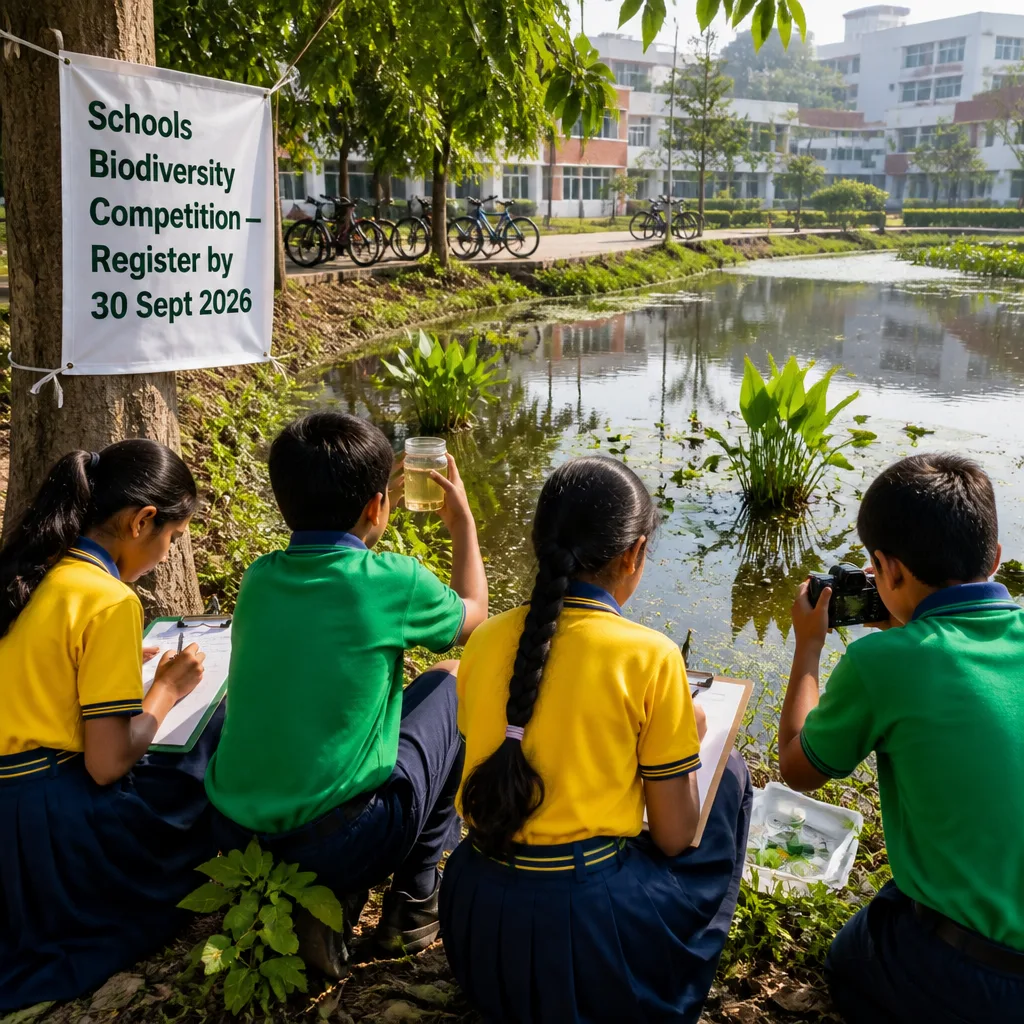
The Wipro earthian Schools Biodiversity Competition has opened for entries, inviting Indian schools to register teams of students in grades 6 to 12 to carry out local ecological investigations and submit an analytical essay. The programme, organisers say, is intended to strengthen research skills, promote sustainability education and connect school-level observations with broader environmental concerns. The last date for submission is 30 September 2026.
Two-part competition combines fieldwork and analysis
The contest is structured in two linked components. First, student teams undertake practical, on-the-ground surveys of biodiversity in their immediate surroundings. This field element asks participants to record and analyse aspects such as local plant life, animals and insects, habitat types, species diversity and human impacts on ecosystems. The second component requires teams to produce an analytical essay that links their field findings to wider environmental or social issues.
- Hands-on investigation: observation and documentation of local species, habitats and human pressures.
- Analytical essay: interpretation of findings with connections to larger ecological and societal contexts.
- Capacity building: aims to strengthen school-level sustainability education and long-term student engagement.
Objectives and expected outcomes
According to the competition brief, the initiative seeks to foster practical environmental research skills among young learners, enhance critical and analytical thinking, encourage teamwork and improve understanding of biodiversity conservation. The organisers also aim to help schools build sustained programmes of sustainability education rather than relying solely on classroom theory.
The format explicitly encourages students to place their local observations in a broader frame, exploring links between biodiversity and issues such as land use, livelihoods, seasonal variation and other social or environmental pressures. The combination of fieldwork and written analysis is designed to give pupils both empirical skills and the ability to communicate findings coherently.
Who can participate and how it works
Teams may be formed from students in the target grades within participating schools. The hands-on phase is open to a wide range of practical activities, from simple species inventories to more structured habitat assessments, depending on local context and resources available to the school. After completing the field component, teams prepare an essay drawing on their data and reflections.
| Component | Focus |
|---|---|
| Hands-on investigation | Local plants, animals, habitats, species diversity and human impacts |
| Analytical essay | Interpretation of observations; links to local or global environmental issues |
Organisers highlight that the exercise is intended to integrate classroom learning with practical experience: teams are encouraged to use local contexts to ask questions, collect data and derive conclusions that have pedagogic and real-world relevance.
Educational significance and accountability
School-based biodiversity projects can provide early exposure to field methods used in ecology and conservation, while developing students’ capacities to analyse and communicate environmental information. By emphasising both observation and interpretation, the competition aims to nurture a generation of learners who can contribute to informed discussions on conservation and sustainable use of natural resources.
Principal organisers advise participating schools to ensure ethical field practices, respect for wildlife and habitats, and accurate record-keeping. The competition framework also emphasises collaborative learning, encouraging students to work in teams and involve teachers and local resource persons where appropriate.
Entry details, submission guidelines and any regional coordination arrangements are available from the Wipro earthian programme materials; interested schools should note the 30 September 2026 deadline for submissions.