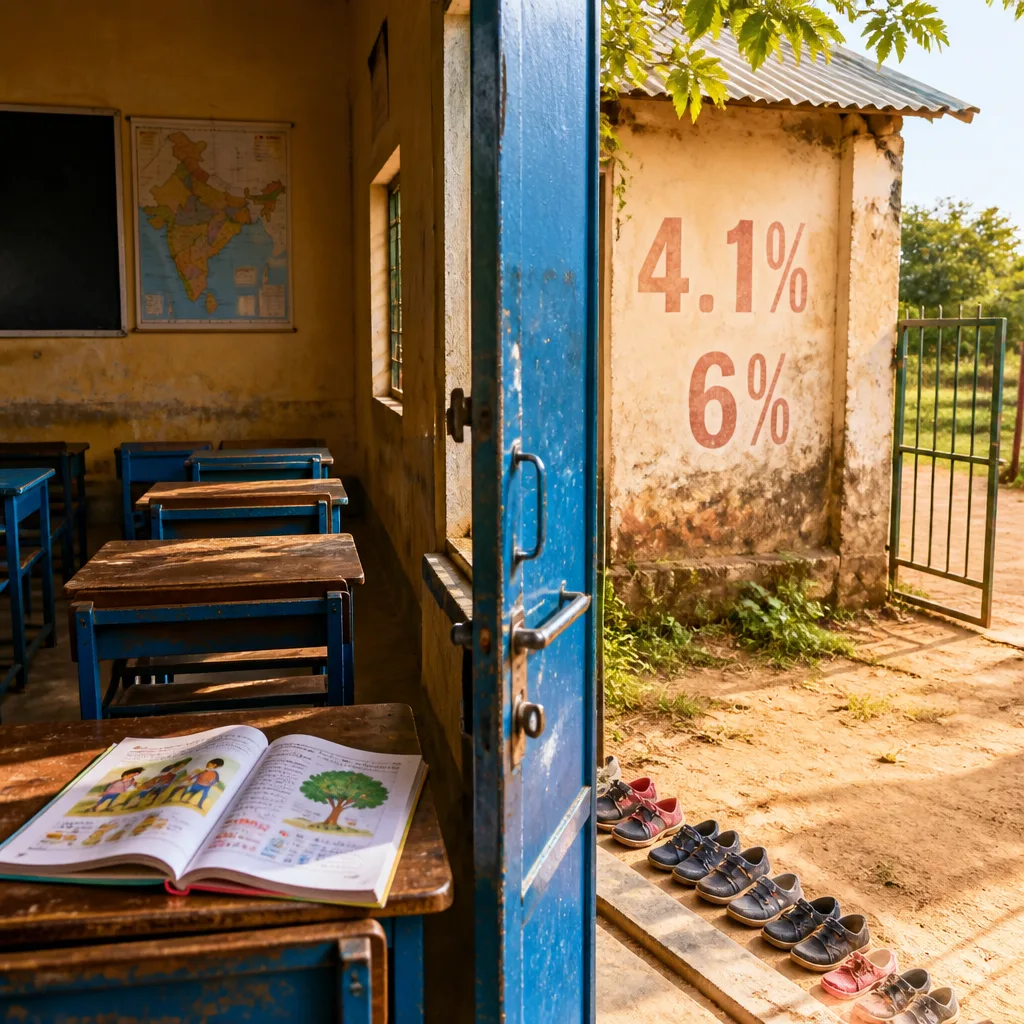
New Delhi, 11 August 2026: India faces large and persistent shortfalls in education access and financing, with roughly 46 million children aged 6–17 out of school and public education expenditure estimated at around 4.1 per cent of GDP — well below the 6 per cent target set six decades ago, according to UNESCO’s latest SDG 4 Scorecard and the Ministry of Education’s UDISE+ 2024-25 data.
Key figures from international and national datasets
The UNESCO SDG 4 Scorecard, published this year, assesses progress on global education goals and highlights that many countries — including India — are behind on key priorities such as early childhood education, teacher training for pre-primary levels and foundational reading by the end of primary school. At the same time, the Ministry of Education’s UDISE+ 2024-25 report offers the country-specific picture: India operates one of the world’s largest school systems but continues to register large gaps in enrolment, retention and learning outcomes.
| Indicator | Figure (Source) |
|---|---|
| Children aged 6–17 out of school | 46 million (UNESCO) |
| Total schools | 1.47 million (UDISE+ 2024-25) |
| Students enrolled | ~247 million (UDISE+ 2024-25) |
| Teachers | Over 10 million (UDISE+ 2024-25) |
| Public education spending | About 2.7–4.1% of GDP (UNESCO; government range) |
What the data shows and why it matters
The juxtaposition of scale and shortfall is stark. India’s school system, with nearly 247 million enrolled learners and more than 10 million teachers recorded in UDISE+ 2024-25, remains unable to prevent a very large cohort of children from being out of school. UNESCO’s global review shows that public education spending worldwide has moved further away from recommended thresholds in 2024 than a decade earlier — a trend that is reflected in India’s persistent gap with the long-standing 6 per cent of GDP benchmark.
Lower public spending constrains investments that are essential to address inequities in access and learning, such as early childhood education, recruitment and training of pre-primary teachers, remedial support to bring children up to expected learning levels and targeted efforts in states or districts with the largest out-of-school populations.
State-level variation and policy implications
UDISE+ 2024-25 and independent surveys, noted alongside the UNESCO scorecard, indicate that gaps in enrolment, retention and learning vary widely between states. This implies that central and state policies must be calibrated — not only to increase aggregate spending but to improve its allocation. Higher allocations without targeted reforms in teacher training, school infrastructure and foundational learning programmes may not translate into better outcomes for the most marginalised children.
- Expansion of early childhood care and education and training of pre-primary teachers are flagged as urgent by UNESCO.
- Strengthening measures to ensure children complete primary and upper-primary cycles is critical to reduce the 46 million out-of-school figure.
- Improving quality — particularly early-grade reading and numeracy — must accompany efforts to boost enrolment and retention.
India does not appear as a named entry on the public dashboard of the UNESCO Scorecard; it is part of regional and global aggregates in that dataset. Nevertheless, the country-specific UDISE+ figures provide the granular view needed for policy response.
Next steps for policymakers and families
For policy-makers, the combined message from UNESCO and UDISE+ is clear: meeting the nation’s education ambitions will require both greater resources and smarter deployment of funds. Families and civil society groups seeking clearer timelines and accountability may watch upcoming budget announcements and state education plans closely to see whether allocations and targeted programmes shift in response to these findings.
The UNESCO SDG 4 Scorecard and UDISE+ 2024-25 reports together underline that India’s size confers responsibility; translating scale into universal access and meaningful learning will require renewed focus on financing, early childhood expansion, teacher development and remedial learning initiatives where gaps are deepest.
For official documents: consult the UNESCO SDG 4 Scorecard and the Ministry of Education’s UDISE+ 2024-25 report for full datasets and state-wise breakdowns.