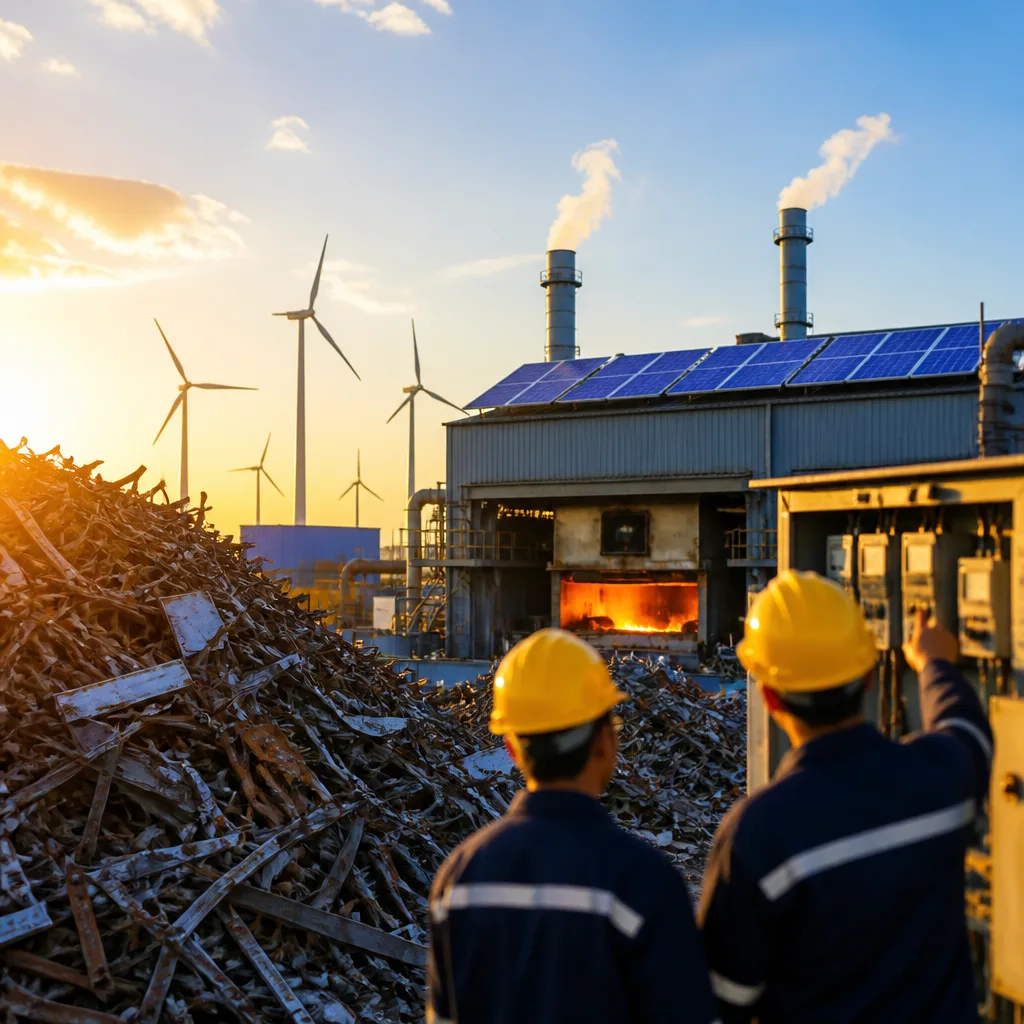
BENGALURU — Smaller steel manufacturers that account for nearly 40% of India’s crude steel production could cut their electricity bills by roughly a third and significantly reduce carbon emissions by shifting to renewable power, a new report said on Wednesday.
Report findings and context
The study, titled Powering India’s Secondary Steel Transition, was produced by a consortium including the Confederation of Indian Industry, WWF-India, the non-profit Climate Catalyst and think tank JMK Research. It concluded that renewable electricity could lower annual power costs by about ₹22 million to ₹24 million per unit — a reduction of up to 34%.
Electricity is a major cost for smaller steelmakers, accounting for as much as 40% of operating costs for many firms in the sector. The report notes that profit margins at such companies have been strained by rising fuel costs linked to the Iran war.
Why it matters for emissions and trade
India is among the world’s largest emitters of carbon dioxide and other greenhouse gases. The steel sector alone contributes up to 12% of the country’s annual emissions, making decarbonisation of steel manufacturing crucial to meeting India’s stated ambition of reaching net-zero emissions by 2070.
Beyond domestic climate goals, the shift to clean power could shield Indian steel producers from external policy pressures. The report points out that European carbon border adjustment measures, which came into force at the start of this year, increase the cost exposure of high-emitting exporters.
Practical implications for secondary steel sector
- Electricity accounts for up to 40% of operating costs for many small steel producers.
- Renewable power could reduce annual power costs by ₹22 million–₹24 million per unit, or up to 34%.
- Smaller producers are vulnerable to fuel-price shocks, including those arising from international conflicts such as the Iran war.
The consortium emphasised that cost-effective decarbonisation pathways are vital because the secondary steel sector comprises numerous smaller units with thin margins. Transitioning to renewables can therefore deliver both climate and commercial benefits.
"With rising pressure on all industries to reduce their carbon emissions, a high-emitting sector like steel has to look at ways to reduce emissions at the least cost possible," said Prabhakar of JMK Research, one of the report's authors.
Numbers at a glance
| Metric | Value |
|---|---|
| Share of crude steel production (smaller companies) | Nearly 40% |
| Potential reduction in annual power costs | ₹22 million–₹24 million per unit (up to 34%) |
| Steel sector share of national emissions | Up to 12% |
The report’s findings point to an actionable near-term measure for the secondary steel sector: procurement of renewable electricity, either through direct purchase agreements, captive renewable capacity or bundled green tariffs. Such approaches can lower exposure to volatile fossil-fuel prices and reduce the carbon intensity of steelmaking.
Policy and financial support will be critical to accelerate adoption. Smaller units often lack capital and expertise to negotiate power purchase agreements or finance onsite renewables. Industry associations, multilateral finance and government schemes could therefore play a role in bridging the gap.
This assessment underlines that decarbonisation in India’s industrial landscape need not be at odds with competitiveness. For smaller steelmakers, the switch to renewable power offers an avenue to cut costs, lower emissions and better position themselves amid tightening global carbon rules.