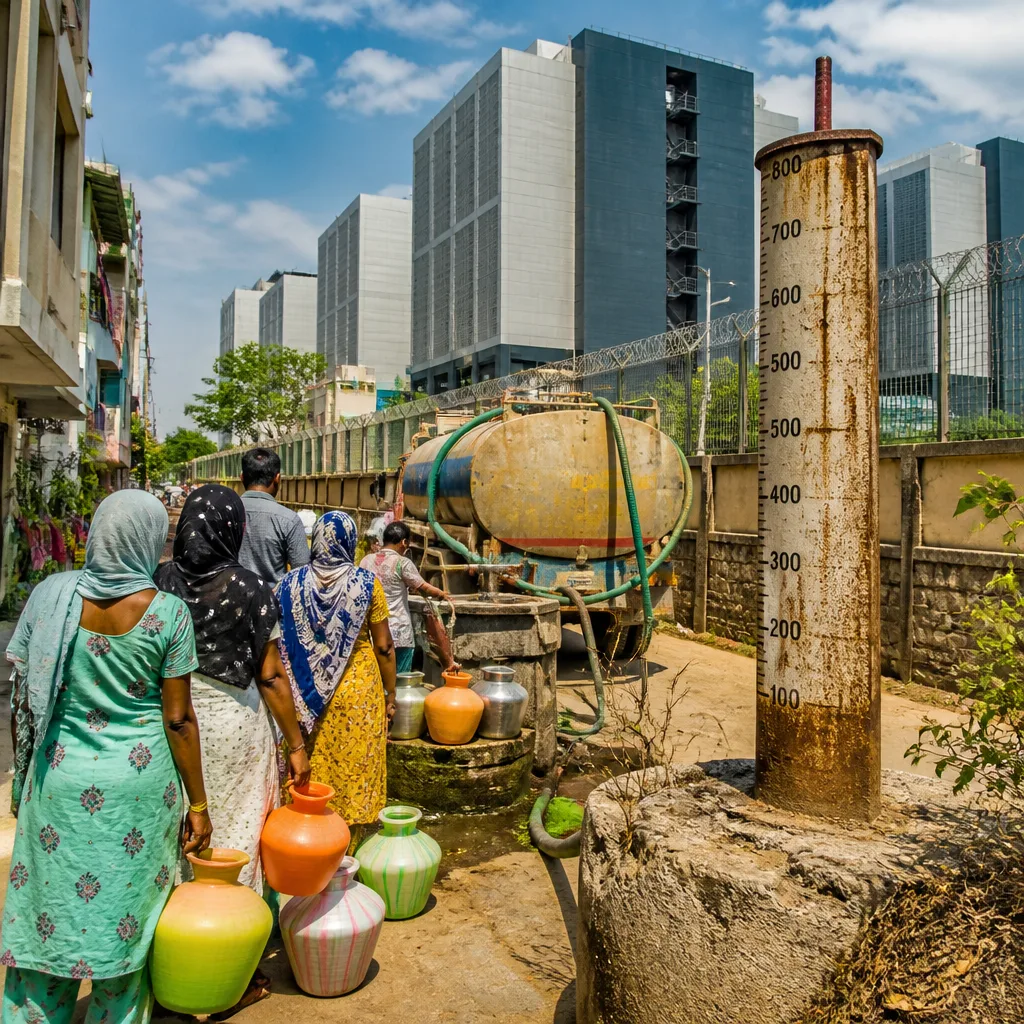
Ghaziabad residents in the Khora neighbourhood are facing acute water shortages even as new data‑centre facilities expand around them, heightening competition for already depleted groundwater reserves. Community leaders and residents describe reliance on deep borewells and shared connections, with costs and uncertainty rising as aquifers fall.
Local dependence on deep groundwater
Khora, a densely populated locality on the periphery of New Delhi, relies heavily on groundwater. Community representatives say wells in the area now require drilling of around 1,000–1,200 feet (305–366 metres) to reach extractable water. Families without individual connections typically pay between ₹1,000 and ₹1,200 per month for access to a shared borewell.
“We are dependent on groundwater. In some parts, one has to dig 1,000–1,200 feet to extract water,” said Deepak Joshi, president of the Khora Residents' Association.
Residents reported that many cannot afford the capital cost of private wells; local estimates put the price of a borewell at about ₹5 lakh. The community also warns that even newly sunk wells are not a permanent fix: water levels can decline unpredictably.
Data centres and water demand
India is positioning itself as a major hub for data‑centre infrastructure, partly driven by demand for artificial‑intelligence computing capacity. Server farms require substantial volumes of water for cooling. According to recent reporting cited in the area, more than half of the country’s data centres are located in regions already classified as water‑stressed by analysts at the World Resources Institute (WRI) India.
In Ghaziabad and neighbouring Noida, groundwater has been subject to sustained overexploitation. The Central Ground Water Board (CGWB) data referenced for the region show an annual extractable groundwater resource of 2,714 hectare‑metres (ham), while withdrawals in 2024–25 reached around 272% of the recommended share.
| Metric | Value |
|---|---|
| Annual extractable groundwater (Ghaziabad) | 2,714 ham |
| Groundwater extraction (2024–25) | ~272% of recommended level |
| Estimated cost of one borewell | ~₹5 lakh |
Social and governance consequences
Residents say the water crisis has already produced migration from the neighbourhood and has forced households into communal arrangements to meet basic needs. One long‑term resident explained that despite 35 years in Khora he still lacks an individual water connection and depends on shared supplies.
“I cannot afford it alone,” said Carpenter Naeemuddin Saifi, describing the monthly burden of paying for a shared borewell connection.
The situation spotlights tensions between industrial siting decisions and local resource availability. While national policy has prioritised data‑centre growth to capture investment and digital services, the concentration of such facilities in water‑scarce districts raises questions about long‑term sustainability and equitable resource allocation.
- Economic burden: Households pay recurring charges for shared water access and may face displacement if aquifers decline further.
- Resource planning: Data‑centre siting in water‑stressed areas magnifies competition between commercial and domestic water uses.
- Governance challenge: Overextraction well beyond recommended levels points to gaps in monitoring, enforcement and integrated urban water planning.
As India continues to build digital infrastructure, the Ghaziabad case underscores the need for stronger coordination between planning authorities, industry and water managers to avoid worsening scarcity for vulnerable communities. Sustainable cooling technologies, wastewater recycling within data centres and restrictions on siting in critically stressed aquifers are among technical and policy measures often discussed by water planners, though those solutions were not detailed in the local reporting.
For residents of Khora, the immediate concern remains access to reliable, affordable water. The mismatch between deepening demand from energy‑intensive digital infrastructure and declining local groundwater reserves poses a pressing test for urban resource governance in the National Capital Region.