India’s surge in data‑centre construction to support cloud services and artificial intelligence is creating fresh environmental questions about energy demand, water security and land use, with high‑profile projects facing legal and public opposition.
Capacity growth and flagship projects
Official figures and sector studies indicate rapid expansion. The Ministry of Electronics and Information Technology recorded a rise in data‑centre capacity from 375 MW in 2020 to 1,500 MW in 2025. The Council on Energy, Environment and Water (CEEW) estimates capacity could reach between 4.5 and 6.5 GW by 2030. As of January 2026, India had about 271 data centres.
| Year | Reported capacity |
|---|---|
| 2020 | 375 MW |
| 2025 | 1,500 MW |
| 2030 (estimate) | 4.5–6.5 GW |
A notable and contested proposal is Google’s planned $15‑billion AI hub in Visakhapatnam, which includes a data‑centre campus with a planned capacity of one gigawatt. The project has provoked protests and legal action over concerns including water availability and proximity to protected areas.
Local opposition, legal challenges and ecosystem concerns
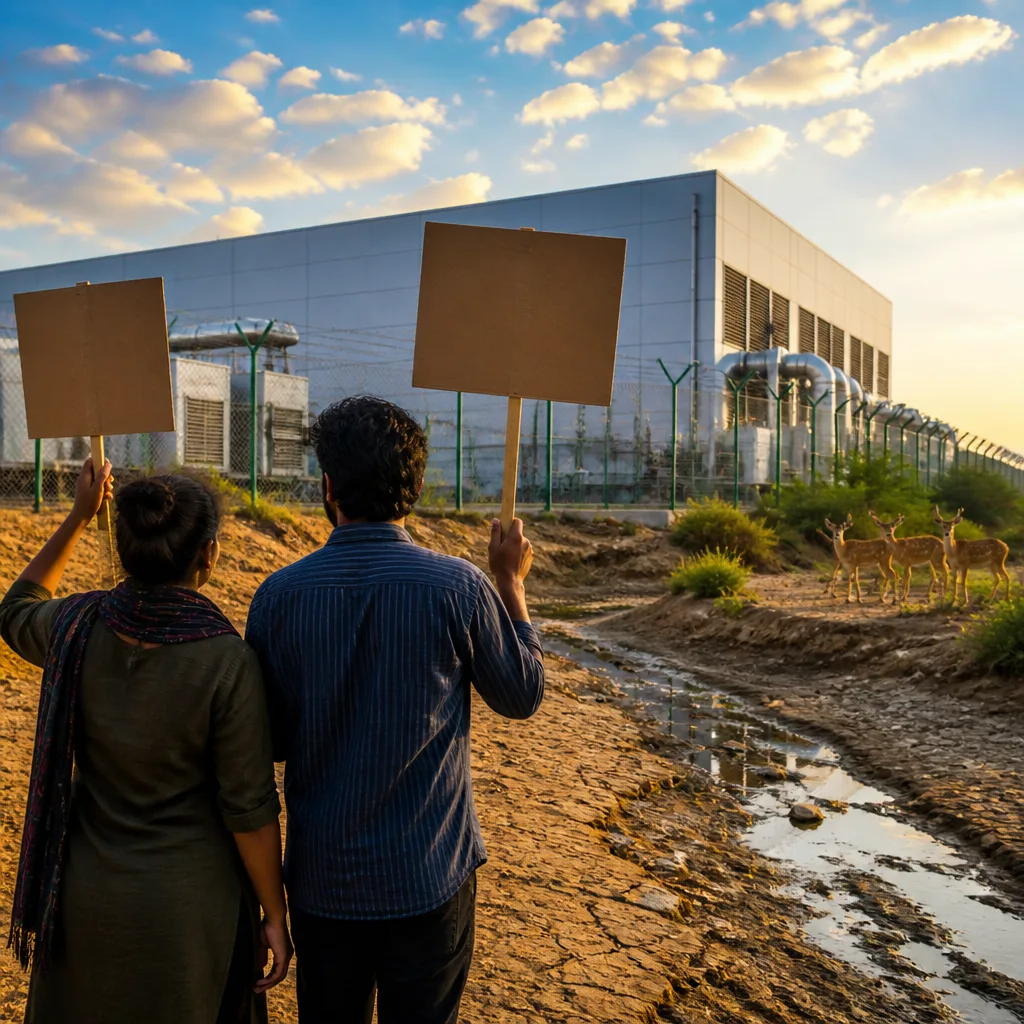
Activists and residents have objected to the Visakhapatnam proposal, mounting demonstrations and filing litigation. The dispute has produced a public interest litigation before the Andhra Pradesh High Court and three matters pending at the National Green Tribunal. Protesters have carried banners with the slogan
“We cannot drink DATA”
Concerns centre on the project’s potential to draw on scarce drinking‑water resources in a city already described as having water shortages, and on its siting roughly 860 metres from a wildlife sanctuary that supports species such as leopards and pangolins.
Company statements, as reported, say measures including advanced air‑cooling and sound‑dampening technologies will be used to reduce impacts. The Andhra Pradesh government has rejected claims that drinking‑water supplies will be diverted to the project.
Environmental trade‑offs: energy, water and land
Data centres are energy‑intensive facilities that run large server banks and cooling systems around the clock. As capacity scales towards the multi‑gigawatt level, the sector’s electricity footprint will rise, with implications for grid demand and generation mix. Water usage is another pressure point: many cooling technologies require substantial water withdrawals unless alternate cooling or closed‑loop systems are used.
- Energy: Growing capacity from 375 MW to 1,500 MW in five years signals rising electricity demand with implications for generation and emissions.
- Water: Cooling requirements could strain local water supplies, especially in water‑stressed regions such as parts of Andhra Pradesh.
- Land and biodiversity: Siting near protected areas raises risks to wildlife and ecosystems, and can produce community opposition.
Policy choices on where to locate facilities, how they are powered and which cooling systems are adopted will shape the overall ecological footprint. The balance between centralised, large campuses and distributed smaller facilities also matters for resource impacts and local acceptance.
Accountability and mitigation options
Industry and regulators can reduce environmental pressure through several approaches: purchasing renewable energy, improving energy efficiency of servers and cooling, deploying low‑water or air‑based cooling systems, recycling waste heat, and selecting less ecologically sensitive sites. Transparent environmental impact assessments and consultations with local communities and conservation authorities are key to addressing legal and social objections.
The Visakhapatnam case has crystallised public concerns about resource allocation and conservation in the face of large technology investments. Pending court proceedings and protests underline the need for clear environmental safeguards and demonstrable water‑and‑energy neutrality where projects proceed.
As India expands its digital infrastructure to support AI and cloud services, the trade‑offs between economic and technological ambitions and environmental stewardship will be central to sustainable planning.