The Northwest Territories is moving to expand the role of local renewable generation, but power companies and experts are urging a cautious path because of costs, ageing equipment and technical limits on small, isolated grids.
Government seeks higher cap on local renewable input
Last year the territorial government directed the Public Utilities Board to support growth in renewable energy across communities. One specific instruction was to raise the limit on how much power independent producers — community energy projects, co-ops or homeowners — can feed into local distribution systems. The current threshold is set at 20 per cent of a community’s annual average load; the government wants that limit increased to 30 per cent.
Government officials say several N.W.T. communities have now reached the existing cap and that lifting it would allow additional projects to move forward. The territory’s two utilities, Naka Power and the N.W.T. Power Corporation (NTPC), submitted responses to the utilities board last month indicating they will work toward enabling the higher limit, but with conditions.
Utilities flag technical and cost constraints
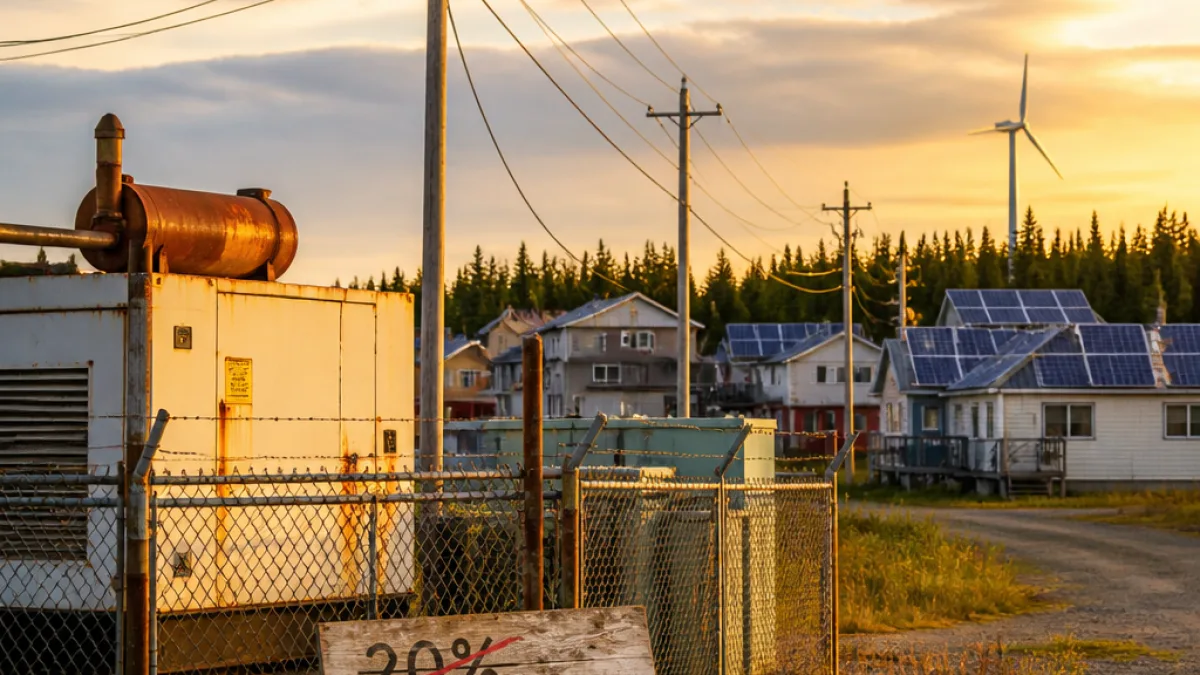
In their submissions, Naka Power and NTPC emphasised the reasons limits exist. On small, isolated diesel-based systems, adding intermittent sources such as solar can cause diesel generators to operate less efficiently and reduce reliability if not managed correctly. Utilities warned that any penetration beyond the proposed 30 per cent mark would require deliberate mitigation measures.
Those mitigation measures, the utilities note, often mean investment in:
- modern control systems and grid management technology;
- energy storage or other dispatchable resources to smooth variability;
- upgrades to ageing generation and distribution infrastructure.
All of those carry costs that are significant in smaller communities and must be weighed against capital budgets and rate impacts.
What the cap means for communities
The current 20 per cent cap limits the size of community solar, wind or other independent projects relative to annual demand. Some communities have already reached that ceiling and therefore cannot add additional independent renewable capacity without regulatory change.
Raising the limit to 30 per cent would open the door for more projects, including grassroots and community-led developments that can reduce diesel consumption and local emissions. But where grids are old and generation assets are near end-of-life, utilities argue the necessary upgrades to accommodate high penetrations may not be immediately feasible without phased investments.
Balancing ambition with reliability
The exchange before the Public Utilities Board highlights a familiar tension in remote and northern jurisdictions: strong policy support for renewables and emissions reduction on the one hand, and the operational realities of small, diesel-reliant grids on the other. The utilities have signalled willingness to collaborate on definitions and limits that would enable the government’s target while preserving system reliability.
They caution that uncontrolled or poorly integrated renewable additions can force diesel units to cycle more frequently, which increases wear and maintenance costs and can present reliability challenges during extreme cold or peak demand periods.
Path forward and questions for decision-makers
The utilities board will have to weigh the government’s directive against technical evidence and cost estimates provided by the power companies and by independent proponents. Key questions for regulators and communities include:
- Which mitigation measures are required to safely allow higher penetration, and who pays for them?
- Can upgrades be phased so communities can benefit from expanded renewables sooner without jeopardizing reliability?
- What definition of ‘‘independent producer’’ will be used, and how will annual average load be calculated for small, variable communities?
A simple comparison of the thresholds under consideration is shown below.
| Current cap | Proposed cap |
|---|---|
| 20% of annual average load | 30% of annual average load |
For communities, the stakes are practical. More renewables can lower diesel burn and reduce fuel deliveries, which are logistically complex and costly in the North. But premature integration without the right controls could undermine the very benefits communities hope to achieve.
The utilities board’s review will be watched closely by community leaders, renewable developers and territorial policymakers. Its decision will shape how quickly independent projects can scale up in the N.W.T., and what investments will be needed to keep lights on reliably while cutting emissions.
Further filings and technical evidence are expected as the board considers how to balance climate goals, community aspirations and the technical limits of northern grids.