YELLOWKNIFE — Homeowners who tied rooftop solar systems to the local grid say proposed changes to territorial electricity regulation could undercut the economics of their installations and raise household energy costs.
Local solar investors face uncertainty
About a year ago, Norah McNaughton took out a roughly $36,000 loan through the former federal Canada Greener Homes Loan program to install solar panels on her Yellowknife home. The federal program — now closed — previously offered interest-free loans for energy upgrades.
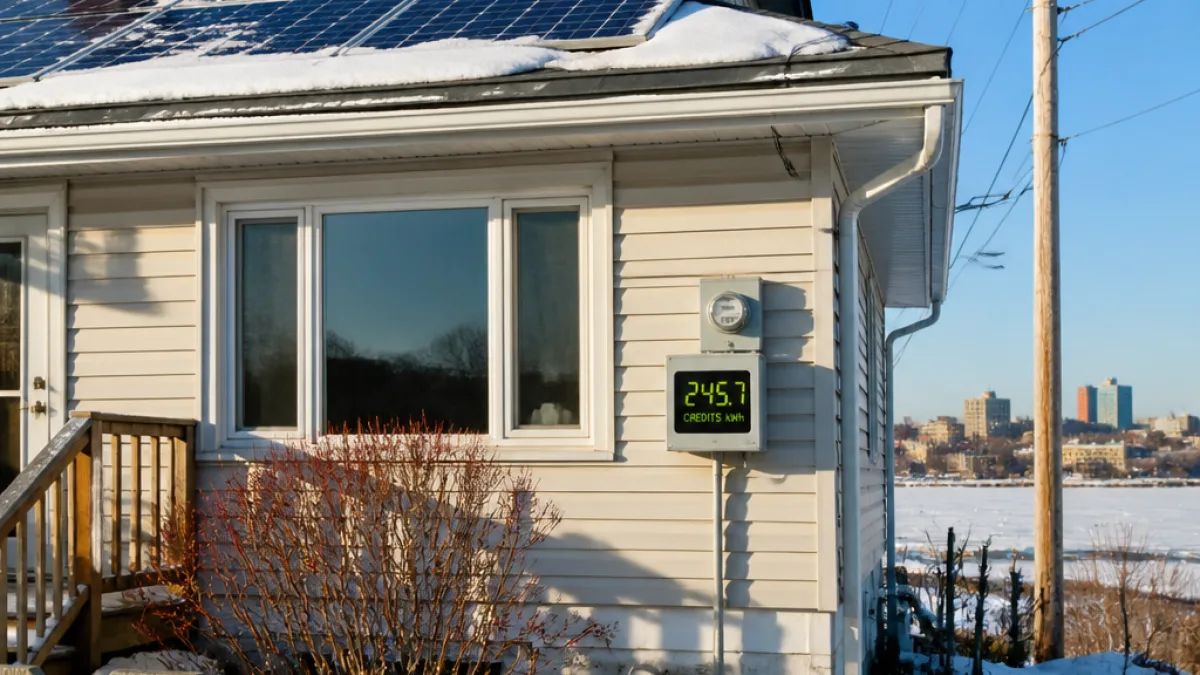
Under her current arrangement with Naka Power, McNaughton’s system is connected to the grid and generates credits when it produces more electricity than the household uses. That arrangement, commonly known as net metering, allowed her to design a system that generates excess electricity in summer months to offset use during the darker winter months.
“It was actually cheaper to take out that loan and install solar and pay that over the next 10 years than it was to be paying my monthly power bills,” McNaughton said.
But proposed revisions to how small-scale energy producers are compensated — measures being considered as part of the Northwest Territories’ Integrated Power System Plan (IPSP) — could change that balance. McNaughton said the changes could leave her paying a regular monthly electricity bill in addition to loan repayments for her solar system.
What the GNWT says it wants to achieve
In 2025 the Government of the Northwest Territories directed the territory’s energy regulator, the Public Utilities Board, to pursue reforms the GNWT describes as necessary to modernize the power system and accelerate renewable energy adoption.
Proposals linked to the IPSP include:
- Permitting more renewables in diesel-dependent communities,
- Adding regulatory support for electric heating adoption, and
- Creating a “low water rate rider” intended to smooth electricity costs during drought-related low hydro production.
Energy minister Caroline Wawzonek has described the IPSP as urgent. The GNWT says the reforms will better integrate renewable sources and protect customers from extreme price swings.
Community concerns over compensation and fairness
While the GNWT frames the plan as modernizing, some homeowners and small producers are worried the changes could reduce the value of exported solar power or alter credit mechanisms that currently allow households to offset seasonal consumption.
Residents who financed installations under past federal programs are particularly vulnerable to policy shifts because they carry loan payments tied to a set economic expectation. McNaughton told WE NEWS the potential loss of netting benefits could push already-tight household budgets — and she said the rising cost of living is prompting people to consider relocating south.
Those concerns point to a broader policy tension: the GNWT seeks to expand renewables across the territory while ensuring utilities remain financially stable and ratepayers are protected. Changing compensation formulas for distributed generation affects both goals.
What this means for homeowners and small producers
The debate centres on how to value electricity contributed to the grid at different times of year, and how to allocate fixed system costs among customers. If compensation for exported solar power is reduced or restructured, some owners could see longer payback periods for their investments.
Practical steps households can consider while the IPSP process unfolds include:
- Contacting your local utility to confirm current compensation and how proposed changes might apply;
- Reviewing loan terms from past federal programs to understand repayment obligations; and
- Following Public Utilities Board consultations to provide input and monitor timelines.
Next steps and public process
The Public Utilities Board will play a central role in implementing changes. How quickly proposals move from direction to regulation will determine whether existing solar owners face abrupt economic impacts or benefit from transition measures.
For communities outside Yellowknife that rely heavily on diesel generation, the IPSP’s provisions to allow more renewables could reduce fuel use and emissions over time. But the distributional effects — who pays, and who benefits — are under active discussion.
The coming months will be crucial for small producers seeking clarity. Regulatory filings, consultation sessions and decisions from the Public Utilities Board will shape the practical outcomes of the IPSP and determine whether rooftop solar remains a financially viable option for Northwest Territories households.
Warren Lafferty, WE NEWS — Northwest Territories Correspondent.