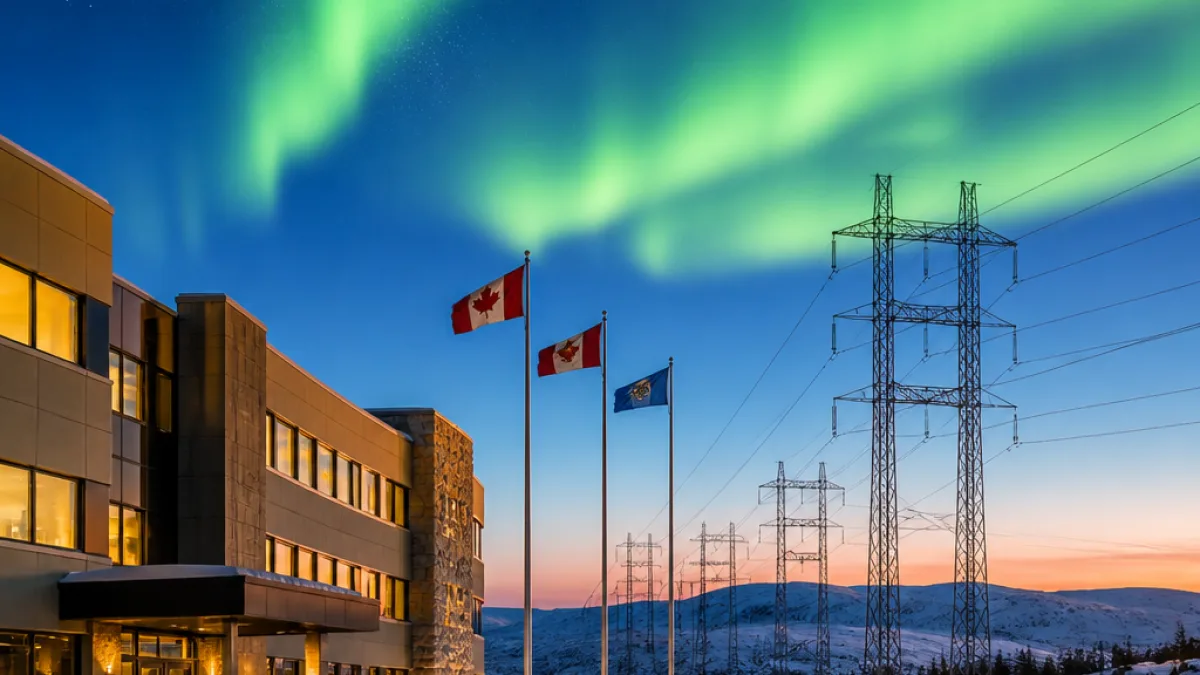
The Government of the Northwest Territories has formalised a regional energy partnership with Alberta and Saskatchewan aimed at strengthening electrical grid reliability and exploring nuclear-generation options.
Framework for collaboration, not project approval
The memorandum of understanding, announced Sept. 14, establishes a mechanism for the three governments to share information and assess technologies ranging from large-scale reactors to small modular reactors (SMRs) and microreactors, and to examine potential enhancements to transmission infrastructure linking Alberta, Saskatchewan and the Northwest Territories.
Officials say the agreement is intended to respond to rising electricity demand across Western Canada and the North and to help the jurisdictions evaluate pathways to reliable, affordable and lower-carbon electricity systems.
"Reliable and affordable electricity is essential to economic growth and energy security," Premier Scott Moe said in the Saskatchewan release. "By partnering with Alberta and the Northwest Territories, we can explore opportunities to advance nuclear energy, strengthen regional transmission connections and support the long-term resiliency of our electricity systems."
The MOU sets out three shared priorities that will guide cooperation:
- Security, reliability and long-term affordability of electricity systems;
- Evaluation of nuclear technologies as an economical pathway to carbon-neutral electricity generation;
- Exploration of transmission enhancements between the three jurisdictions.
The release emphasises the MOU as a framework for ongoing collaboration rather than an agreement that commits any government to build specific facilities or to select particular technology vendors.
Why this matters in the N.W.T.
For residents and industries in the Northwest Territories, the MOU could shape future options for improving grid reliability and lowering the cost and carbon intensity of electricity. Northern communities face high energy costs and, in some areas, constrained generation capacity; closer connections to southern grids and alternative generation technologies are frequently discussed as ways to address those challenges.
However, the agreement does not itself authorise construction or procurement. It instead creates a collaborative space where policymakers can assess technical, economic and regulatory issues — including how any future projects would reflect the N.W.T.'s unique energy needs, geography and community priorities.
Questions for next steps
Key issues for further work under the MOU will include:
- Technical studies on transmission routes and intertie capacity;
- Assessment of cost, timeline and siting implications for different nuclear technologies;
- Engagement with Indigenous governments, local communities and industry stakeholders to determine social licence and local benefits;
- Regulatory and environmental reviews required for any future projects.
| MOU priority | Focus |
|---|---|
| Security, reliability, affordability | Regional planning to reduce outages and stabilise costs |
| Nuclear technology evaluation | Study of large reactors, SMRs and microreactors as decarbonisation tools |
| Transmission enhancements | Exploration of interties between Alberta, Saskatchewan and N.W.T. |
Alberta Premier Danielle Smith was quoted in the Saskatchewan release as saying nuclear energy has “enormous potential” to provide dependable power for homes and businesses and to support economic growth. The statement underscores Alberta’s interest in diversifying its generation mix while pursuing grid connections that could benefit the broader region.
Practical implications for residents
At this stage, residents in the N.W.T. should expect the MOU to trigger studies, stakeholder consultations and technical work rather than immediate construction activity. Outcomes that could affect Northerners include potential reductions in wholesale electricity costs if larger and cheaper generation enters the regional system, and possible improvements to reliability if new transmission lines are pursued and built.
Any proposals that move beyond the planning phase would require separate approvals, environmental assessments and consultations with Indigenous governments and local communities — processes that will shape the pace and location of any projects.
The memorandum sets the direction for interjurisdictional cooperation on energy, but it leaves open many of the practical details and timelines that will determine whether nuclear technologies or strengthened interties become realities for the Northwest Territories.
Reporting will continue as the three governments publish workplans, study results and engagement schedules tied to the agreement.