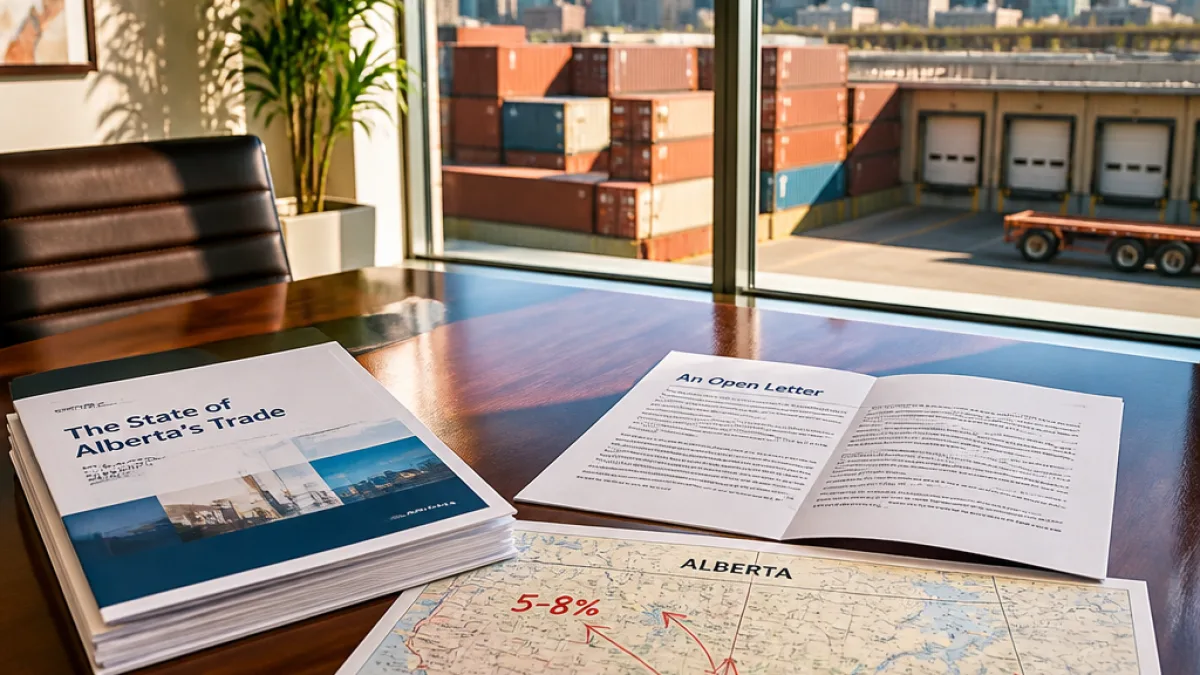
A report commissioned by the Calgary Chamber of Commerce and released Tuesday warns of severe economic consequences for Alberta if the province pursues separation from Canada. The analysis, prepared by University of Calgary economist Trevor Tombe, estimates higher trade costs and significant job losses should Alberta leave the federation.
Business leaders, economic bodies sign open letter
The chamber accompanied the report with an open letter signed by senior executives from major Calgary-headquartered and regional firms and organisations. Among those listed as signatories are heads of AltaGas, ATCO, AltaLink, Capital Power, Keyera, BHE Transmission and Chirp Foods Inc., as well as Tourism Calgary, Calgary Economic Development and a former CEO of Trans Mountain Corp. The chamber said more signatories are expected.
"We must remain at the table and prioritize relationships, opportunities and stability that have helped make this province and this country prosperous," the letter reads. "Alberta can be proud of Its identity while remaining confident in its future within Canada."
In three weeks, Albertans will vote on a set of 10 referendum questions that include whether the province should remain in Canada or begin the process of holding another referendum on separation. The chamber said the report and letter aim to inform that public debate by focusing on trade, labour and fiscal impacts.
Estimated impacts: higher trade costs, fewer jobs
Tombe's analysis projects trade costs would rise by 5 to 8 per cent, a range the report notes is similar to the increase the United Kingdom experienced after leaving the European Union. The report describes Alberta as the most trade-exposed jurisdiction in Canada, with nearly one in three workers employed in sectors particularly vulnerable to disruptions in trade.
The higher trade costs, according to the study, would translate into job reductions of up to 175,000 in Alberta — a substantial hit to the province's labour market. The chamber emphasised those figures as central risks in the event of separation.
| Estimated change | Reported range |
|---|---|
| Increase in trade costs | 5–8% |
| Potential job reductions in Alberta | Up to 175,000 |
Local context and potential consequences
Calgary's economy is tightly linked to trade and energy markets, and the chamber's intervention underscores concern among local employers that separation would raise costs and create uncertainty for investment, labour mobility and supply chains. The signatories represent utilities, energy services and tourism bodies — sectors that depend on cross-border trade and integrated national markets.
- The chamber commissioned the study to inform public debate ahead of a referendum in three weeks.
- Signatories include major Calgary and Alberta business leaders and organisations.
- The report highlights Alberta's high exposure to trade disruptions relative to other provinces.
The chamber's appeal is aimed at preserving the existing economic framework that, it argues, has supported growth and stability in Calgary and Alberta. For residents and businesses weighing the referendum, the chamber has offered the Tombe analysis as a data-driven assessment of risks tied to separation.
As the referendum date approaches, the study and the open letter add a prominent business voice to a debate that will shape political and economic decisions across the province. The chamber said its goal is to keep the focus on relationships, opportunities and stability that it says underpin prosperity in both Calgary and Canada.