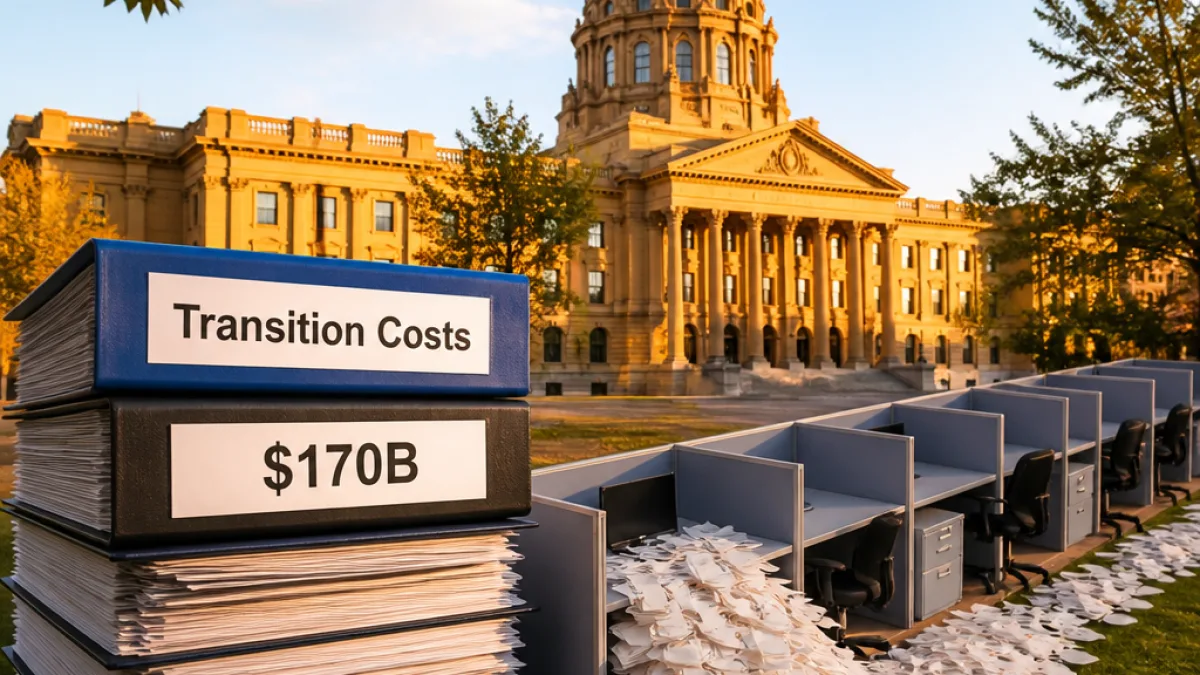
EDMONTON — A government-commissioned study released Wednesday sketches a costly and complex pathway to Alberta sovereignty, estimating the province would need between $50 billion and $170 billion over the first five years to replicate federal functions, acquire infrastructure and assume a share of federal debt.
Report spells out steep upfront and ongoing costs
The analysis, prepared by the University of Calgary's School of Public Policy at the request of the provincial government, says the minimum first-five-year bill for establishing an independent Alberta would be about $50 billion, with an upper-bound scenario pushing to $170 billion.
The report breaks out a number of significant components driving that estimate. It says roughly $69 billion would be required to replicate programs currently administered by Ottawa, while annual operating costs for a stand-alone Alberta government could reach $67 billion. The authors also warn of the risk of sustained deficits — potentially at least $25 billion annually — depending on tax choices and economic performance.
"Alberta separating from Canada and becoming an independent country involves far more than just drawing new borders and building a new state," the report says. "It completely changes how public services, trade, taxes and laws work."
Public service expansion, debt and logistics
The study says the province would need to hire a substantial public service to manage federal functions transferred to provincial control. Officials estimate the transition would require the creation of at least 70,000 civil service positions.
Those hires, along with one-time asset purchases and assumed portions of federal debt, together explain much of the projected price tag. The report's authors caution that the many moving parts make it difficult to provide a single definitive figure.
- Estimated first five years: $50B–$170B
- Program replication: $69B
- Potential annual operating costs: $67B
- Minimum projected annual deficits in some scenarios: $25B
- New civil servants required: ~70,000
Choices on revenues, services and risk
Authors say new tax tools could be developed to cover the increased costs, but they flag the potential for "staggering" deficits depending on how revenues and spending are structured. The report notes there is substantial uncertainty in any forecast because of unpredictable economic, legal and political consequences of separation.
Provincial officials commissioned the work in June to inform Albertans ahead of a referendum scheduled for Oct. 19 that will ask whether the province should remain in Canada or pursue a binding vote on leaving Confederation.
What the numbers mean for ordinary Albertans
The fiscal scenarios imply significant trade-offs for households and businesses. If the province opts to raise revenue to match the higher operating costs, that could mean new or higher taxes, altered transfer arrangements for health and social programs, or a reduction in services. If Alberta chooses to limit revenue increases, the report suggests the province could face large deficits and pressure on credit ratings.
| Item | Estimate |
|---|---|
| First five-year cost (range) | $50B — $170B |
| Program replication | $69B |
| Annual operating cost (potential) | $67B |
| Estimated new civil servants | ~70,000 |
| Potential minimum annual deficit | $25B |
The authors say the numbers illustrate the magnitude of the administrative, legal and fiscal tasks involved in creating a new country and note that many costs would be front-loaded during a transition period.
Context and next steps
The report comes after comments from Premier Danielle Smith and others who have discussed the prospect of a referendum on Alberta's place in Confederation. The provincial government has presented the document as information for voters.
Analysts and critics will now pore over the assumptions behind the figures — including how federal assets would be divided, which programs ought to be replicated, the pace of hiring and the province's ability to generate new revenue streams. Those details will matter for voters weighing the trade-offs on Oct. 19.
For now, the report provides a practical, if stark, fiscal framework: independence is not a simple political recalibration but an expensive structural change with large, measurable implications for public services, taxation and provincial finances.