Training in-town again: realistic fire scenarios without leaving Airdrie
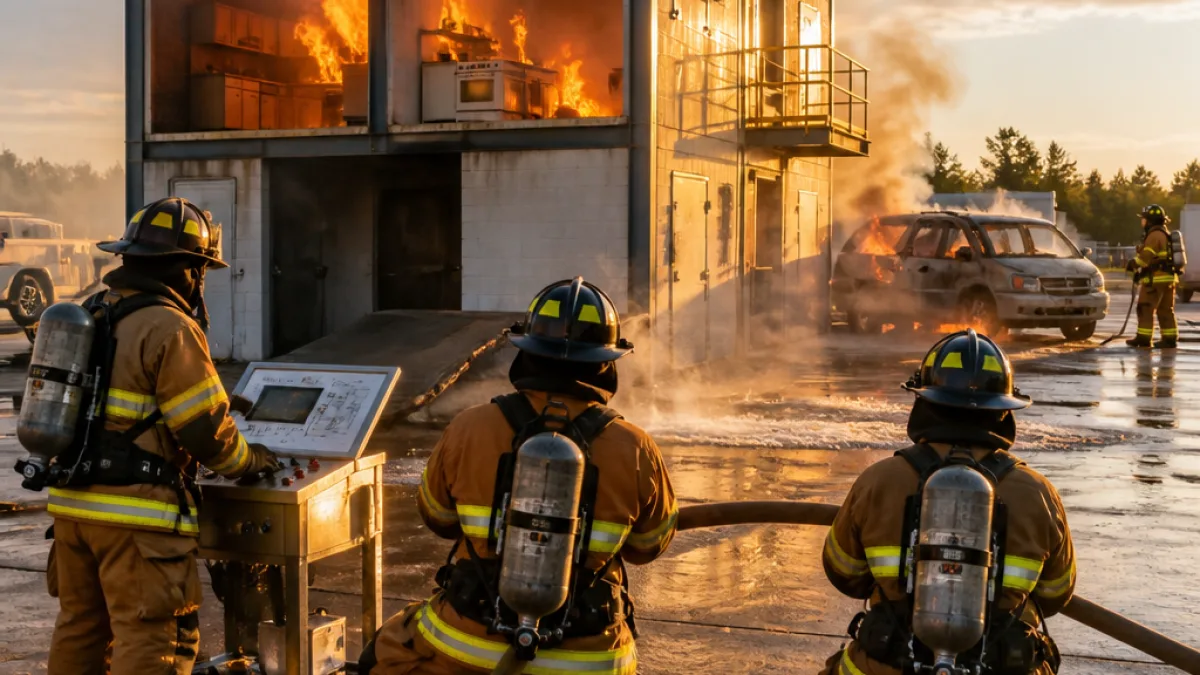
The Highland Park Fire Station and Training Centre in Airdrie will house a new live-fire training structure designed to give local crews realistic, controlled experience with overhead fire, kitchen blazes, garage and vehicle fires, and full-room scenarios. The system, installed and managed by Fire Training Solutions, uses gas-fuelled training props and a range of specialised systems to reproduce changing fire conditions while allowing instructors to retain control of each exercise.
Municipal officials say the facility will provide Airdrie firefighters with access to live-fire training inside the city after years without that capability locally. That matters in a fast-growing city on Alberta’s prairies, where response demands and the complexity of incidents have been increasing.
Tools to teach crews to read and react to changing fires
Mike Bailey, owner and managing director of Fire Training Solutions, described the structure’s design in written responses. He said instructors will be able to build multi-stage scenarios that force crews to advance through the building, encounter shifting fire conditions and practise coordinated responses.
"Firefighters aren't limited to repeatedly attacking one type of fire," Bailey wrote. "Instructors will be able to build scenarios that require crews to advance through the structure, encounter changing fire conditions, locate and attack the main fire, conduct searches, communicate with other crews and operate as they would at an actual incident."
Among the installations are hallway/ceiling rollover props that create controlled overhead fire as crews advance toward a main burn area. Instructors can vary the flames to simulate a rollover event and then shut down the exercise if conditions become unsafe. Other props recreate kitchen-fire dynamics, garage and vehicle fires, and full-room incidents that require entry, hose advancement, search operations, fire attack and on-scene communications.
- Overhead/rollover props: simulate fire overhead as crews advance.
- Kitchen and garage/vehicle props: reproduce common residential and vehicle fire conditions.
- Full-room scenarios: practise entry, hose advancement, search, communication and crew co-ordination.
Controlled fuels, controlled risk
The live-fire system relies on gas-fuelled props instead of conventional combustible materials. That approach allows instructors to modulate heat and flame behaviour, create varied scenarios and terminate an exercise instantly if needed. The technology is intended to strike a balance between realistic training and participant safety.
| Prop type | Primary purpose |
|---|---|
| Hallway/ceiling rollover | Teach crews to recognise and react to overhead fire before reaching main fire area |
| Kitchen | Simulate common residential cooking fires and appropriate suppression tactics |
| Garage/vehicle | Reproduce vehicle and garage fires with differing fuel loads and access challenges |
| Full-room scenarios | Practice entry, search, hose advancement, communication and coordination under heat and smoke |
For Airdrie residents, the practical outcome is straightforward: firefighters will be able to train on complex, evolving incidents without travelling to out-of-town facilities. That reduces time lost to travel and allows repeated, supervised practice in conditions that closely mirror real calls.
As Airdrie grows, so do the demands placed on emergency services. Local access to live-fire training is a key piece of modern preparedness — it sharpens crews’ ability to identify rapidly changing hazards, practise cooling and attack techniques, and coordinate searches and rescues. The training centre is a municipal investment in capability that aims to keep frontline crews ready for the range of fires they are likely to encounter in homes, garages and vehicles across the city and surrounding areas.
Officials have said the training structure will be part of the Highland Park complex and is expected to fill a long-standing gap in local training infrastructure. Fire Training Solutions will continue to manage the system and its specialised components as the centre moves into regular use.