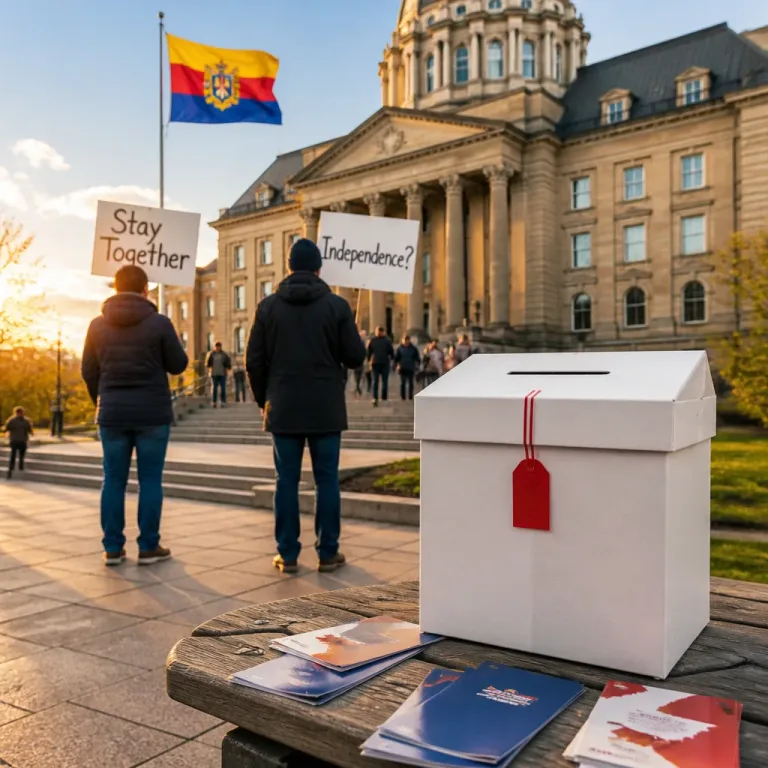
EDMONTON — Voters across Alberta will be asked on Oct. 19 whether the province should hold a future, binding referendum on withdrawing from Canada — a question that crystallizes decades of western alienation and recent political manoeuvring.
What’s on the ballot
The provincial government has placed before voters a single, forward-looking question: should Albertans be asked at a later date in a binding referendum whether the province should separate from the rest of Canada. If a majority votes yes, a separate legally binding plebiscite on separation would be scheduled.
Roots in a long history
Grievances that feed the separation debate are not new. Protest and protest rhetoric in Alberta trace back decades and have periodically surged in response to federal policies perceived to penalize the province’s economy, particularly energy.
Key moments in that history include policy clashes from the 1980s through the present and electoral episodes where separatist and regionalist sentiment found expression at the ballot box. The story of how this question reached the provincial ballot is the result of both long-standing resentment and recent political choices made in Edmonton.
Recent political steps
Premier Danielle Smith took steps this year to channel the debate through formal democratic mechanisms. Her government set up a panel to examine Alberta’s place in Confederation and pledged to respect a citizen petition that met thresholds for forcing a referendum question.
Her position, publicly expressed, has been to frame the option of separation as a grievance-driven possibility rather than a first preference. The government has also pursued rules to lower requirements for citizen-initiated petitions — a change that helped clear the procedural path for the Oct. 19 question to appear.
"A lot of Albertans are angry and some are more than angry. They're hurt," the premier told an assembly discussing Alberta's future in Canada.
Timeline — key dates and events
| Year | Event |
|---|---|
| 1980 | Federal National Energy Program sparks deep resentment in Alberta over energy pricing and revenue sharing. |
| 1982 | Separatist candidate Gordon Kesler wins a provincial byelection; later loses seat in general election. |
| 2019 | United Conservative Party under Jason Kenney wins provincially amid anti-federal sentiment. |
| 2023 | Danielle Smith becomes premier, emphasizing provincial autonomy while rejecting portrayal of separatists as fringe. |
| April 28, 2025 | Justin Trudeau-era federal politics shift after an election that installed a Liberal minority; political dynamics in Ottawa change. |
| May 5, 2025 | Provincial panel announced on Alberta’s future; government signals it will honour a valid citizen petition for a referendum. |
Political and practical stakes
The ballot question is procedural rather than an immediate declaration of separation. Yet a successful vote would set in motion a legally binding plebiscite on leaving Confederation — with enormous constitutional, economic and legal implications.
Constitutional experts, federal officials and provincial leaders will be watching the results closely. A binding referendum on separation would raise complex questions about negotiation mandates, the division of assets and liabilities, and the legal processes for attempting to withdraw a province — matters that cannot be resolved by a simple majority vote alone.
Local impact and the campaign ahead
Campaigns on both sides are likely to intensify in the weeks before the vote. Proponents frame the question as giving Albertans a chance to force a serious national conversation about what they see as unfair federal policies. Opponents argue the ballot item legitimizes a fringe movement and risks economic uncertainty.
For ordinary Albertans, the immediate decisions are practical: whether to vote and how to interpret a procedural question that could lead to a consequential future referendum. Town halls, community forums and media coverage will play a major role in shaping public understanding ahead of Oct. 19.
- What to watch: turnout rates and regional splits across the province.
- Legal next steps: the mechanics of scheduling a binding referendum, should the question pass.
- Economic concerns: how markets, investors and interprovincial trade partners respond to the result.
The Oct. 19 vote does not itself sever Alberta from Canada. It does, however, mark a pivotal public test of how deep and widespread separatist sentiment has become — and whether the province wants to force a national reckoning with those grievances through a future, binding referendum.