
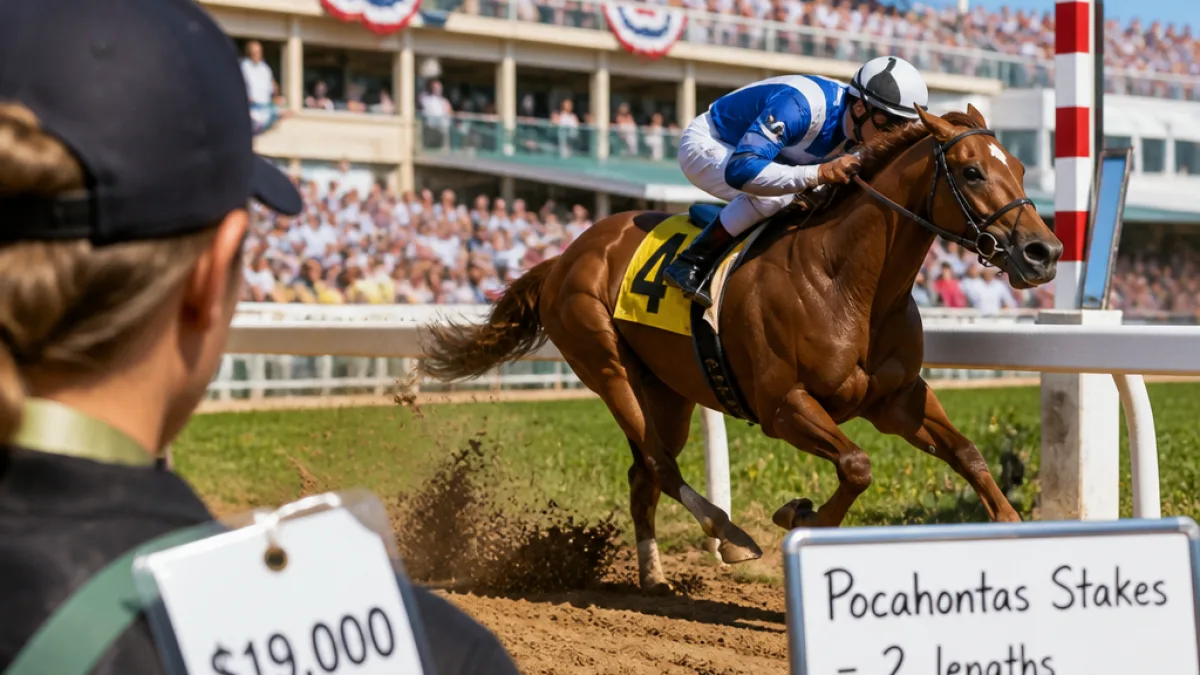
Thoroughbred racing’s forward-looking calendar produced a reminder this week that early-season form and sale price do not always line up. For fans in Airdrie keeping an eye on the classic trail, Manuka Honey — a filly who was a $19,000 RNA at the Fasig-Tipton Kentucky October Yearlings Sale — posted a convincing victory in the Pocahontas Stakes (G3) to register the first Kentucky Oaks (G1) points-paying result of the current season.
From modest price to points-paying performer
Manuka Honey’s victory came by two lengths and extended her unbeaten record to three starts. The filly’s progression was emphatic: a 7 1/4-length debut win at Churchill Downs over five furlongs on June 20; a seven-length score in the Ellis Park Debutante Stakes; followed by the Pocahontas triumph. That sequence of results emphasises precocity and tactical speed, traits that have value in early-season stakes racing.
- Sale price: $19,000 RNA (Fasig-Tipton Kentucky October Yearlings Sale)
- Record: Three wins from three starts
- Latest result: Pocahontas Stakes (G3) winner by two lengths
The filly is by Upstart, a sire noted for early speed who himself displayed both precocity and the capacity to carry form beyond sprint distances. Upstart, a New York-bred, opened his career with a 5 1/2-furlong maiden at Saratoga by 5 1/4 lengths and later won the restricted Funny Cide Stakes over 6 1/2 furlongs. He tested open company late in his juvenile campaign with a second in the Champagne Stakes (G1) behind Daredevil and a hard-fought third in the Breeders’ Cup Juvenile (G1).
Connections and implications
The contrast between Manuka Honey’s modest sale price and the larger sums routinely seen in the marketplace underlines a persistent dynamic in Thoroughbred investing: early returns and race-track success can come from relatively small outlays. For those in Airdrie who follow the sport as owners, trainers or punters, the filly’s rapid rise is a practical reminder that value can still be found at lower levels of the yearling market.
“Manuka Honey’s quick progression and triple-win streak show the upside of buying into precocity rather than pedigree alone,”
That assessment reflects the broader lesson of the early prep season. While yearling price tags are often correlated with perceived long-term potential, the immediate payoffs in juvenile and early 3-year-old stakes — and the points structure leading to the Kentucky Oaks and Kentucky Derby — reward horses that are ready to perform sooner rather than later.
Upstart’s own career offers a template: a spectacular start as a 3-year-old, winning the Holy Bull Stakes (G2) by 5 1/2 lengths, followed by high-profile placings in the Fountain of Youth Stakes (G2) and Florida Derby (G1). For Manuka Honey, the question facing her connections and public backers now is whether her sprint-based dominance will translate to the middle distances required for the Kentucky Oaks at 1 1/8 miles next spring.
| Horse | Sale/Value Detail | Notable recent form |
|---|---|---|
| Manuka Honey | $19,000 RNA (Fasig-Tipton October) | Three wins in three starts; Pocahontas (G3) winner |
| Upstart (sire) | New York-bred, noted for precocity | Won Holy Bull (G2); placed in Fountain of Youth (G2) and Florida Derby (G1) |
For local racing supporters in Alberta, the emergence of horses like Manuka Honey is worth watching both for its sporting intrigue and its economic signal. The sport’s structure — where early points-paying races shape campaigning decisions months before the Classics — creates windows of opportunity for lower-cost purchases to generate outsized returns. That reality influences bloodstock strategy from the sales rings to the training sheds.
As the Breeders’ Cup and the next tranche of Derby/Oaks preps approach, the racing community will be parsing performances and pedigrees. Manuka Honey’s run at the Pocahontas has already put her name on that early list, reminding owners and observers across Alberta that market price is only one piece of a much larger equation.