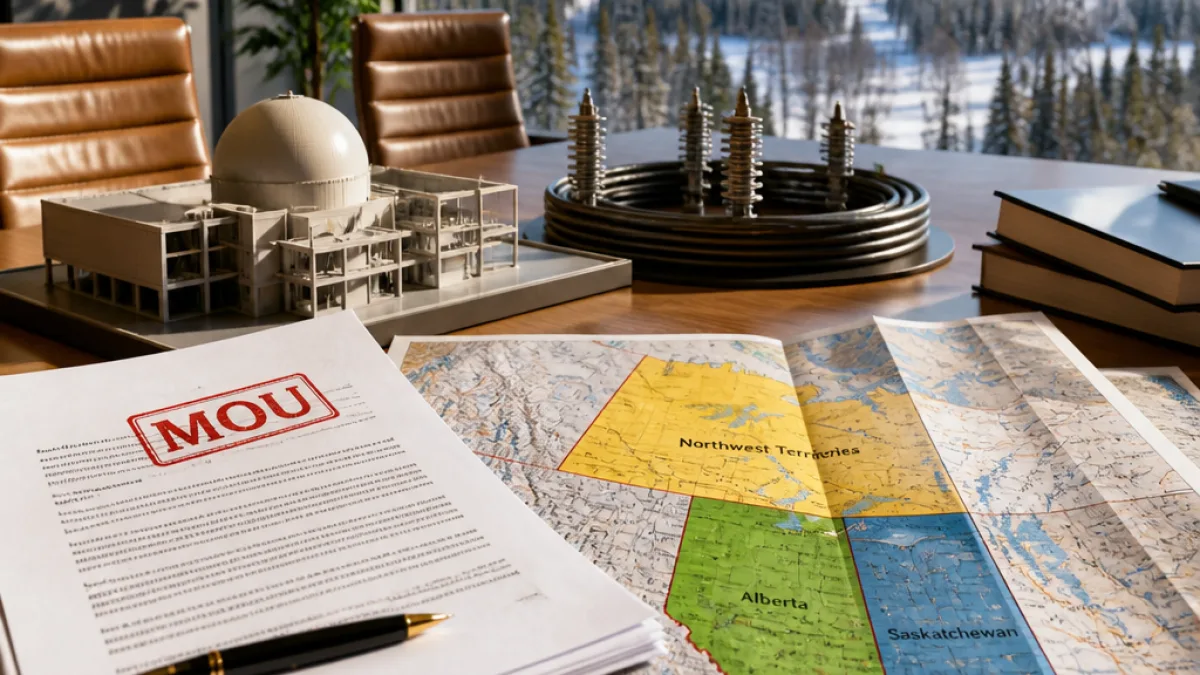
The Government of the Northwest Territories has formally joined Alberta and Saskatchewan in a memorandum of understanding to create a framework for collaboration on nuclear generation technologies and regional transmission infrastructure, officials announced in a joint release.
What the agreement covers
The MOU commits the three jurisdictions to work together on the evaluation and potential development of a range of nuclear technologies, from large reactors to small modular reactors (SMRs) and microreactors. It also sets out cooperation on transmission planning to strengthen regional interconnections that would support a mix of generation sources.
“The MOU is guided by three shared priorities: strengthening the security, reliability, and long-term affordability of electricity systems; supporting the evaluation of nuclear technologies as an economical pathway to carbon-neutral electricity generation; and exploring opportunities to enhance electricity transmission infrastructure across the region,”
The document, issued as a joint release, states the agreement respects the unique energy needs of each jurisdiction while providing a platform for ongoing collaboration.
Areas of joint work
Under the MOU the governments will co-operate on a range of technical, regulatory and policy matters, including:
- technology selection and development for nuclear reactors of differing scales;
- financing approaches for potential projects and shared infrastructure;
- environmental assessment processes and regulatory and federal approval pathways;
- uranium fuel supply and transportation logistics;
- nuclear waste management; and
- planning for transmission and interconnections to integrate nuclear, natural gas, wind, solar, hydro, and battery storage.
Those elements indicate the MOU is intended as an early-stage, co-ordination agreement rather than a commitment to build specific projects. The release frames the MOU as a mechanism for information-sharing and joint study to inform future decisions.
Why this matters to the Northwest Territories
For the N.W.T., which faces a unique mix of remote communities, diesel-dependent grids and ambitious climate goals, the MOU opens a potential pathway to reconsider the role of non-emitting and low-emitting baseload options in northern energy systems. Improved transmission links to southern grids could also change options for integrating renewable resources and decreasing reliance on on-site diesel generation in some communities.
At the same time, the agreement raises practical questions that will be pivotal for residents and local governments: how siting and environmental assessments will be carried out in sensitive northern landscapes; what financing models might mean for territorial budgets and ratepayers; and how fuel transport and waste management would be handled across vast distances and challenging terrain.
Shared priorities in one table
| Shared priority | Focus areas |
|---|---|
| Security, reliability, affordability | Transmission planning; diversified generation mix; grid resilience |
| Carbon-neutral electricity | Evaluation of nuclear and integration with renewables |
| Transmission opportunities | Regional interconnections and shared infrastructure planning |
Next steps and practical implications
The MOU signals the start of collaborative work on technical evaluations, regulatory pathways and potential financing strategies, but it does not commit any party to construction or procurement. For residents and Indigenous governments in the N.W.T., those subsequent assessments — and the consultation and environmental review processes they trigger — will be the crucial moments when specific impacts and benefits are laid out.
Officials say part of the collaboration will include exploring uranium fuel supply and transport arrangements as well as nuclear waste management — matters that carry logistical, environmental and jurisdictional complexity in the North.
How long it will take to move from planning to any concrete proposals is unspecified in the release. Observers should expect a series of studies, stakeholder engagement processes and regulatory reviews before any project approval decisions are made.
Regional context
The MOU places the N.W.T. alongside two larger prairie provinces that have been actively exploring SMRs and other nuclear options as tools to meet emissions and grid reliability targets. For the territory, partnership with provincial governments could provide technical expertise and potential access to broader transmission solutions — but it will also require careful negotiation to ensure northern priorities and rights are reflected in any future project plans.
As work under the MOU proceeds, communities, Indigenous governments and territorial authorities will be watching for timelines, funding commitments and how environmental and rights-based consultations are embedded in the planning process.
This agreement is a strategic step: it aligns three governments around common study objectives and starts a formal channel for shared planning on technologies that could change the electricity landscape across an immense, climatically sensitive part of the country.