The Orlando Science Centre opened a travelling exhibition on Sept. 26 that places the public inside the science of high-adrenaline sports, with hands-on challenges and virtual simulations designed to explain the physical demands and mental skills that athletes use to push limits.
Canadian collaboration brings exhibit to Florida
Developed by Science North in Sudbury, Ontario, in partnership with the Ontario Science Centre, the production combines interactive installations with multimedia storytelling. The exhibit is presented in Orlando by Nemours Children’s Health and is free to centre members; it is also included in general admission.
Immersive zones focus on skill, strength and technology
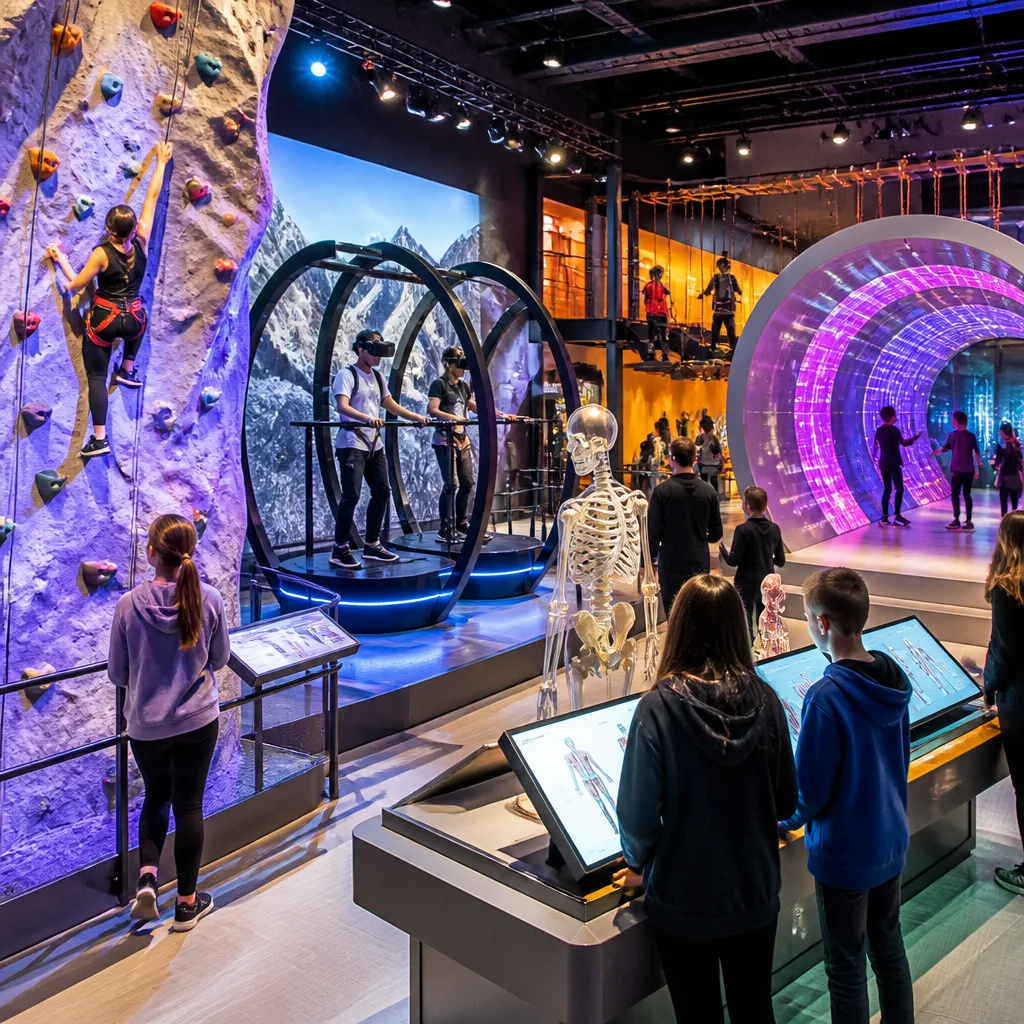
Visitors encounter five themed zones that mimic the environments extreme athletes face. The centre’s promotional materials and advance previews describe physical challenges such as climbing and balance tasks alongside virtual experiences that simulate wingsuit flight and high-speed races.
- Physical skill stations: a real rock-climbing wall, a parkour course and a high-line balance challenge to test coordination and core strength.
- Simulated experiences: virtual wingsuit piloting and simulated racing that allow participants to experience sensations that would otherwise be unsafe for the general public.
- Bike and off-road elements: an off-road biking path where visitors can learn about biomechanics and equipment design.
- Storytelling: athlete profiles from around the world that examine training, focus and risk management.
Exhibit aims and public-access details
The exhibit’s educational aim is to demystify extreme sports by breaking down the components that contribute to performance — from muscle power and balance to perception and decision-making. Organisers emphasise both the capabilities of elite athletes and strategies for risk reduction and training.
Members of the science centre were given an early preview the morning of opening day, and the exhibit opened to the general public at noon. To minimise wait times, visitors are able to purchase timed tickets through the centre’s website.
| Item | Detail |
|---|---|
| Opening date | Sept. 26, 2026 |
| Closing date at Orlando | Jan. 3, 2027 |
| Producers | Science North (Sudbury) & Ontario Science Centre |
| Sponsor (local) | Nemours Children’s Health |
Context and consequences
Travelling exhibitions built by public science organisations play a distinct role in informal science education: they present complex ideas in accessible formats and reach audiences who may not otherwise encounter structured programmes on physiology, biomechanics or cognitive science. This particular production also highlights cross-border collaboration between Canadian and American institutions, illustrating how national science centres export programming and expertise internationally.
For the public, the exhibit balances spectacle and explanation. Simulators and physical challenges attract interest and provide memorable experiences; the educational value depends on how well interactive components are tied to clear explanations of underlying science. When done well, such exhibits can influence attitudes toward safety, training and the science behind sport performance, and may inspire young people to pursue studies in related fields such as kinesiology, biomedical engineering or sports psychology.
Orlando Science Centre curators also gain an opportunity to broaden their remit across age groups by pairing high-energy attractions with explanatory displays and live demonstrations on the centre’s four floors. The exhibit’s multi-sensory approach is consistent with contemporary museum practice: engage first, then offer layered interpretation for deeper learning.
As the exhibit travels, feedback from visitors and educators will shape future presentations. For now, Orlando visitors have until early January to test balance, climb, race and simulate flight while learning the science that underpins pursuits often framed simply as spectacle.