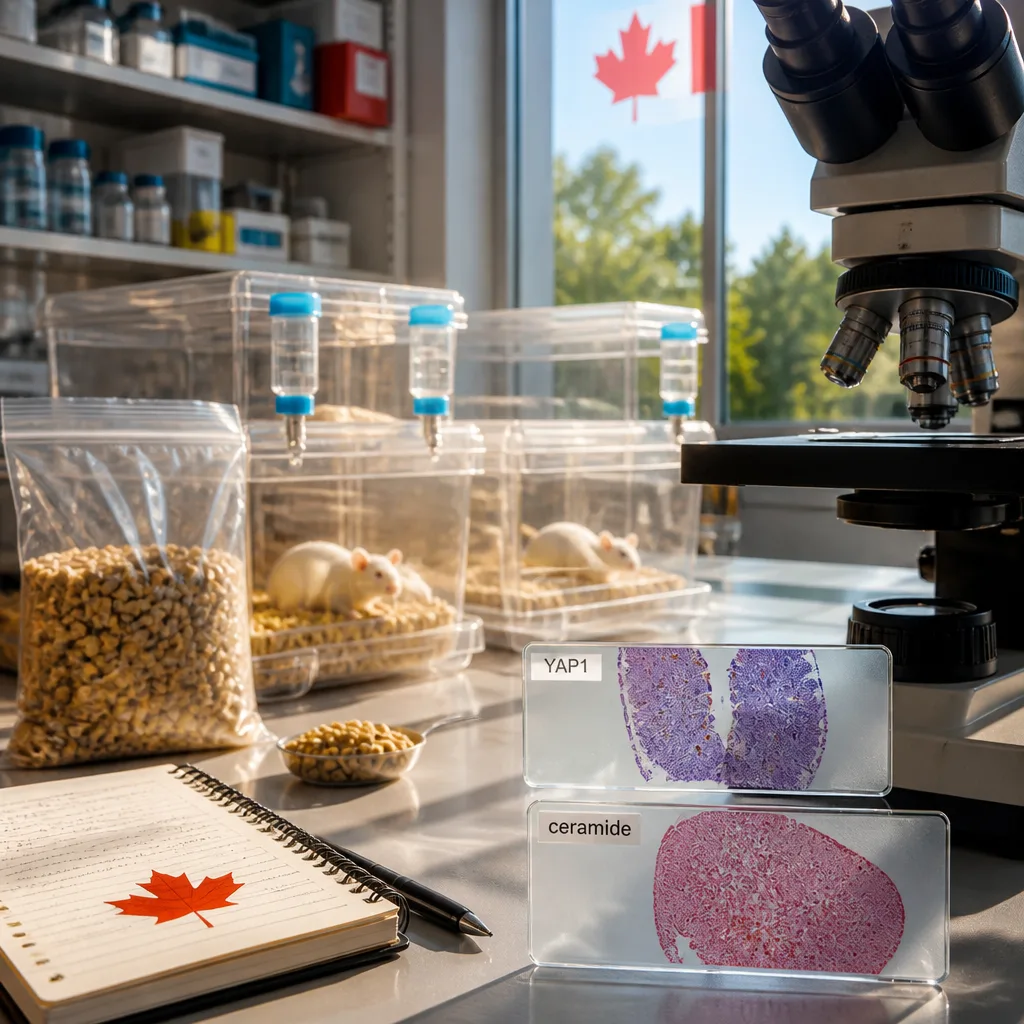
A new study published in Science reports that colorectal cancer cells co‑opt a YAP1‑driven regenerative programme to metastasize to the liver, and that a high‑fat diet promotes the process through increased ceramide synthesis. In laboratory mice, disrupting either YAP1 activity or ceramide production markedly reduced liver metastases, and the authors report a clinical association between greater YAP1 activity and worse survival among patients with higher body mass index (BMI).
What the research found
The paper, led by the Ömer H. Yilmaz laboratory and authored by a large collaborative team, identifies a molecular cascade that links diet, lipid metabolism and a regenerative transcriptional programme driven by the transcriptional co‑activator YAP1. The investigators show that ceramide synthesis mediates colorectal cancer cell behaviour that enables liver colonization.
“A new Science Magazine study from the Omer Yilmaz lab shows how colorectal cancer cells hijack a YAP1-driven regenerative program to metastasize to the liver. A high-fat diet fuels this process through ceramide production, and in mice, disrupting YAP1 or ceramide synthesis markedly reduced liver metastases. Patients with higher BMI also showed greater YAP1 activity and worse survival.”
The quote above was shared on X by Ilyas Sahin, assistant professor of medicine at Harvard Medical School and a medical oncologist at Massachusetts General Hospital, congratulating the Yilmaz team on their findings.
Evidence across models and patients
According to the paper’s description, the team combined genetic and pharmacologic approaches in mouse models to interfere with both YAP1 function and enzymes involved in ceramide synthesis. In both lines of experiment, the interventions were reported to substantially reduce the incidence of liver metastases from colorectal primary tumours.
Complementing the preclinical work, the authors examined human tumour data and found that patients with higher BMI exhibited greater YAP1 pathway activity and experienced poorer survival. The study therefore connects a mechanistic pathway established in controlled models with an observational signal in human disease.
- Mechanism: YAP1‑driven regenerative programme enables metastatic behaviour.
- Diet link: High‑fat diet increases ceramide production, which fuels the pathway.
- Intervention effect: Disruption of YAP1 or ceramide synthesis reduces liver metastases in mice.
- Clinical correlation: Higher BMI in patients associated with increased YAP1 activity and worse survival.
| Finding | Model |
|---|---|
| YAP1 drives regenerative programme that supports metastasis | Mouse and molecular analyses |
| High‑fat diet increases ceramide production | Mouse diet studies |
| Blocking YAP1 or ceramide reduces liver metastases | Genetic/pharmacologic mouse experiments |
| Higher BMI linked to greater YAP1 activity and poorer survival | Human tumour data |
Why this matters
Colorectal cancer is a leading cause of cancer mortality worldwide in part because of its propensity to metastasize to the liver. By delineating a biochemical and transcriptional circuit that is responsive to dietary fat and lipid metabolism, the study points to potential avenues for prevention or therapy.
Targeting YAP1 directly has been challenging in clinical oncology, but the identification of ceramide synthesis as a necessary metabolic node offers an alternative strategy. If ceramide production can be pharmacologically modulated in patients, it could blunt the metastatic advantage conferred by the YAP1‑driven programme — a possibility that the mouse experiments in this study support, though clinical testing would be required.
The paper unites epidemiologic observations about obesity and cancer outcomes with mechanistic laboratory work, reinforcing the complex interplay between lifestyle factors and tumour biology. The authors’ multi‑author team reflects contributions from molecular biologists, clinicians and metabolic scientists who together chart a pathway from dietary intake to molecular changes that alter cancer behaviour.
Future work will need to clarify the safety and feasibility of targeting ceramide synthesis in people, identify any patient subgroups most likely to benefit, and determine whether diet modification could play a role alongside pharmacologic approaches. For now, the study provides a coherent mechanism that links diet, lipid metabolism and metastatic progression in colorectal cancer.