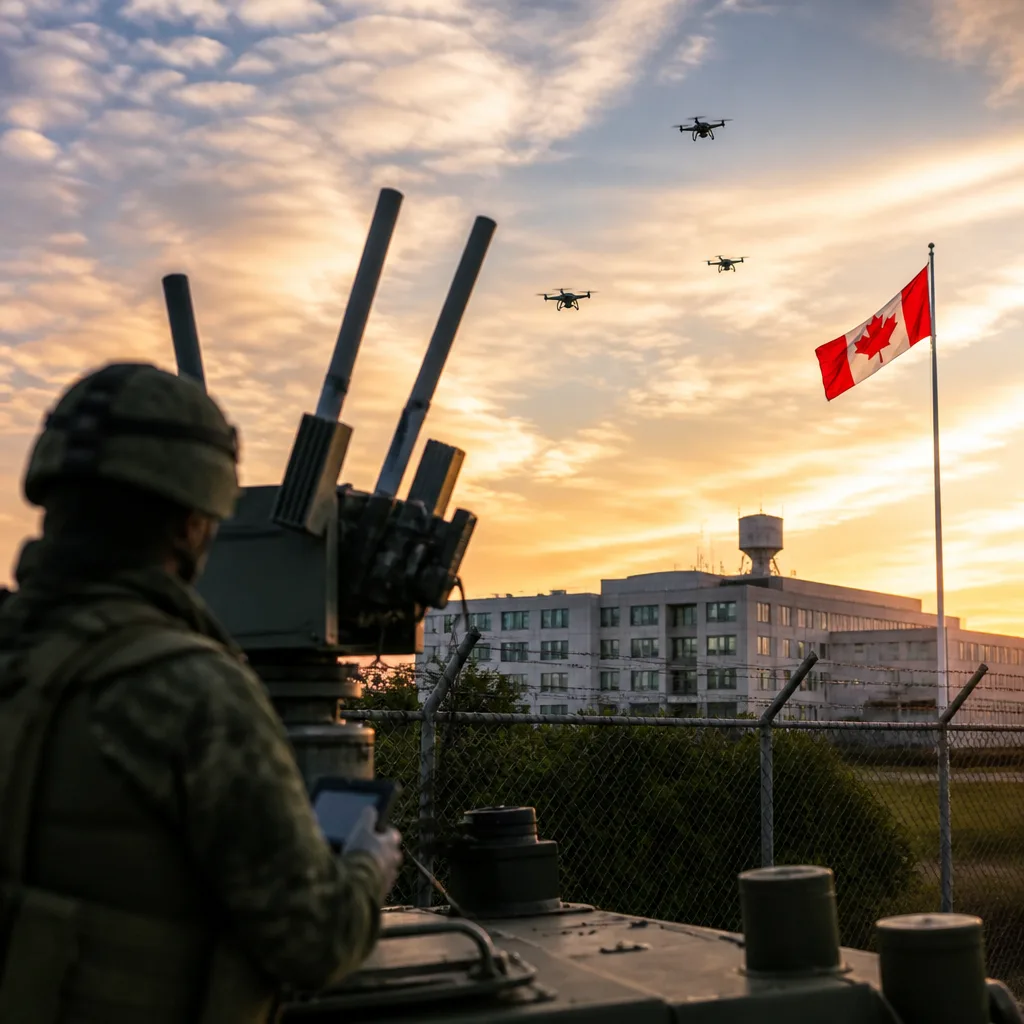
The Department of National Defence (DND) has moved to procure anti‑drone defences for military locations across Canada, according to a short notice posted online by federal procurement officials.
Domestic protection for personnel and infrastructure
The notice says the department needs a capability that can shield personnel, equipment and facilities from drone attacks at sites across the country. Specific technical details and the nature of threats the system is intended to counter were not disclosed publicly; the information is being shared only with suppliers who meet the government's qualifications.
Officials at DND did not respond to requests for comment on the notice over the two days following its posting.
Lessons from overseas and evolving threat environment
The request comes as the Canadian Armed Forces (CAF) have been developing counter‑drone measures in recent years, particularly for personnel deployed on NATO missions. Military work to protect troops overseas has included investments during Operation Reassurance in Latvia, where Canadian forces have gained direct exposure to changing drone tactics since Russia's full‑scale invasion of Ukraine began in 2022.
News reports noted the CAF has spent hundreds of millions of dollars on strengthening drone defences for deployed personnel — a process that offered a "front‑row seat" to how drone threats evolve on the battlefield.
Domestic risk assessment and security concerns
While Canadian military bases are not on a conventional frontline, defence analysts say the homeland is not immune to drone‑related risks.
Stephanie Carvin, a professor at the Norman Paterson School of International Relations and a former intelligence analyst, warned that hostile actors may choose to co‑opt domestic operatives rather than move personnel across borders. She pointed to a trend of individuals allegedly hired inside Canada to carry out attacks on behalf of outside interests—an approach that can be difficult to detect and counters traditional border security assumptions.
“It’s very, very hard to sneak operatives across borders. So the model really is just to find people on social media and convince them to engage in this,”
Carvin added that both the CAF and the Royal Canadian Mounted Police have increased focus on counter‑drone capabilities, with the RCMP operating a unit dedicated to such threats.
- Purpose: Protect people, equipment and infrastructure at Canadian military sites.
- Details: Technical specifications withheld; available only to qualified suppliers.
- Context: Builds on CAF experience in Latvia and broader concern about domestically carried out attacks linked to foreign actors.
Implications for procurement and interagency response
The procurement notice signals a shift in emphasis toward bolstering domestic resilience against unmanned aerial threats. That approach raises immediate practical questions: what technologies will meet the military's requirements, how solutions will be integrated into existing security architecture, and how coordination will occur among federal agencies responsible for public safety and counter‑intelligence.
Procurement for counter‑drone systems often spans detection, electronic disruption and kinetic options; however, the DND's brief notice did not list preferred approaches. With details limited to qualified vendors, the competitive process and timeline for acquiring systems remain unclear.
| Aspect | Known information |
|---|---|
| Buyer | Department of National Defence |
| Purpose | Defend personnel, equipment and facilities from drone attacks |
| Public details | Limited; available to qualified suppliers only |
| Context | CAF experience in Latvia; concern about domestic actors hired by foreign powers |
How Ottawa balances rapid acquisition with legal, civil‑liberties and safety considerations will be watched closely by industry and security stakeholders. The move also underscores how lessons from overseas deployments are shaping domestic defence priorities as governments contend with emerging technologies that can be repurposed for malign activity at home.
As the procurement process unfolds, further information will be needed to understand capability timelines, costs and where systems will be deployed across Canada's military footprint.