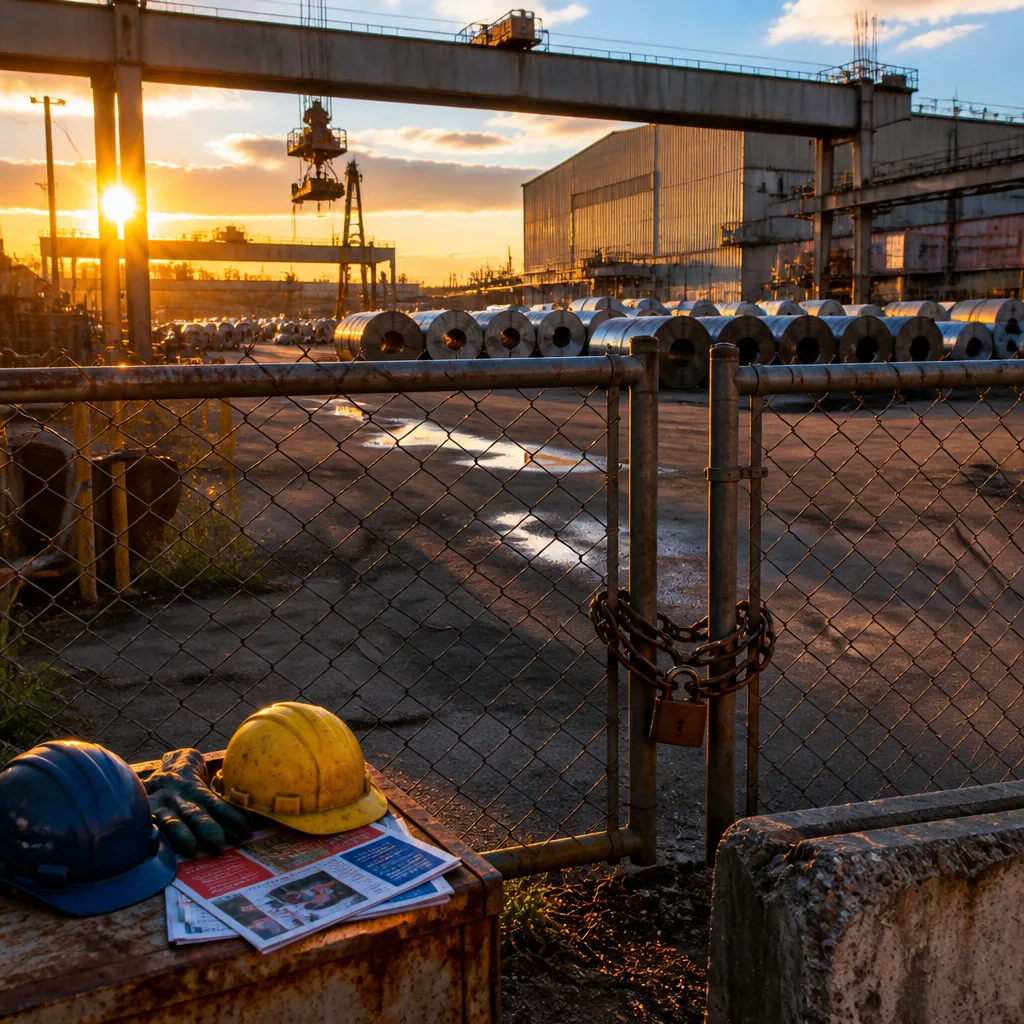
Stelco Holdings Inc. announced Monday that it will indefinitely idle its cold‑rolled and coated production lines at its Hamilton Works site, citing a collapse in market conditions for those products after recent U.S. trade measures.
The company said operations will begin winding down on Oct. 9. In a memo obtained by CBC News, Stelco framed the action as necessary to "ensure the survival" of the business in what it described as an "unsustainable market" for cold‑rolled and coated steel.
Impact on workers and local community
Stelco indicated the decision will affect as many as 500 employees. United Steelworkers Local 1005 president Ron Wells provided a narrower estimate, telling reporters that about 350 steelworkers would be laid off, based on a meeting with the company.
"Christmas ain't that far away, and we have no idea the duration of these layoffs ... People are concerned. I don't blame them."
Wells said the union has sought assurances that any layoffs will follow seniority provisions. The company said the idling will not affect its ability to supply hot‑rolled steel products from the Hamilton site.
Trade measures cited as the cause
Stelco explicitly linked its decision to recent U.S. trade actions. In June, U.S. President Donald Trump signed an executive order imposing tariff measures that can reach up to 50 per cent on certain steel and aluminium imports from Canada. Stelco said its market for cold‑rolled and galvanized products "has contracted significantly," while import penetration for those products remains elevated.
"This is an unfortunate but necessary action to help ensure the survival of Stelco in what has become a challenging and unsustainable market for cold‑rolled and coated products caused by the ongoing and sustained trade disruptions impacting the Canadian steel industry,"
the company said in the memo, quoting Frederic Fafard, vice‑president of sales.
Wider implications for the Canadian steel sector
The shutdown in Hamilton signals broader pressure on Canadian steelmakers that supply higher‑value cold‑rolled and coated products used in automotive, appliance and construction sectors. While Stelco will continue hot‑rolled production, the idling narrows its product mix and could amplify supply chain challenges for customers that rely on cold‑rolled and coated steel.
Analysts and industry stakeholders have warned that elevated U.S. tariffs and other trade measures distort cross‑border commerce and can result in job losses, plant idlings and shifts in production strategies. For Stelco, management described the step as part of a survival strategy amid "ongoing and sustained trade disruptions."
Timeline and immediate next steps
Company officials told employees and the union the wind‑down would start Oct. 9, but did not specify a restart date. The indefinite nature of the idling leaves uncertainty over the duration of the layoffs and potential impacts on contractors and local supply chains.
| Item | Detail |
|---|---|
| Operations affected | Cold‑rolled and coated production at Hamilton Works |
| Estimated employees affected | Up to 500 (company); union estimates 350 |
| Wind‑down start date | Oct. 9 |
| U.S. tariff level referenced | Up to 50% on certain steel and aluminium imports |
Labour leaders in Hamilton and federal trade officials will be watching for further details. The idling will test support mechanisms for displaced workers, including union‑negotiated severance and government programs, and could prompt political pressure to address cross‑border trade frictions.
- Key risk: prolonged idling could lead to permanent job losses and reduced product diversity at the plant.
- Sector impact: other Canadian steelmakers providing cold‑rolled and coated products may face similar market stress if U.S. tariffs persist.
- Trade angle: the move adds to scrutiny of U.S. tariff policy toward Canada and its downstream effects on employment and manufacturing.
For now, Stelco's action is both a local labour story and a marker of how recent U.S. trade measures are reshaping operations at Canadian industrial plants. The company and the union have begun talks about implementation; workers, suppliers and customers will be closely monitoring whether the idling remains temporary or evolves into a longer‑term reduction in capacity.