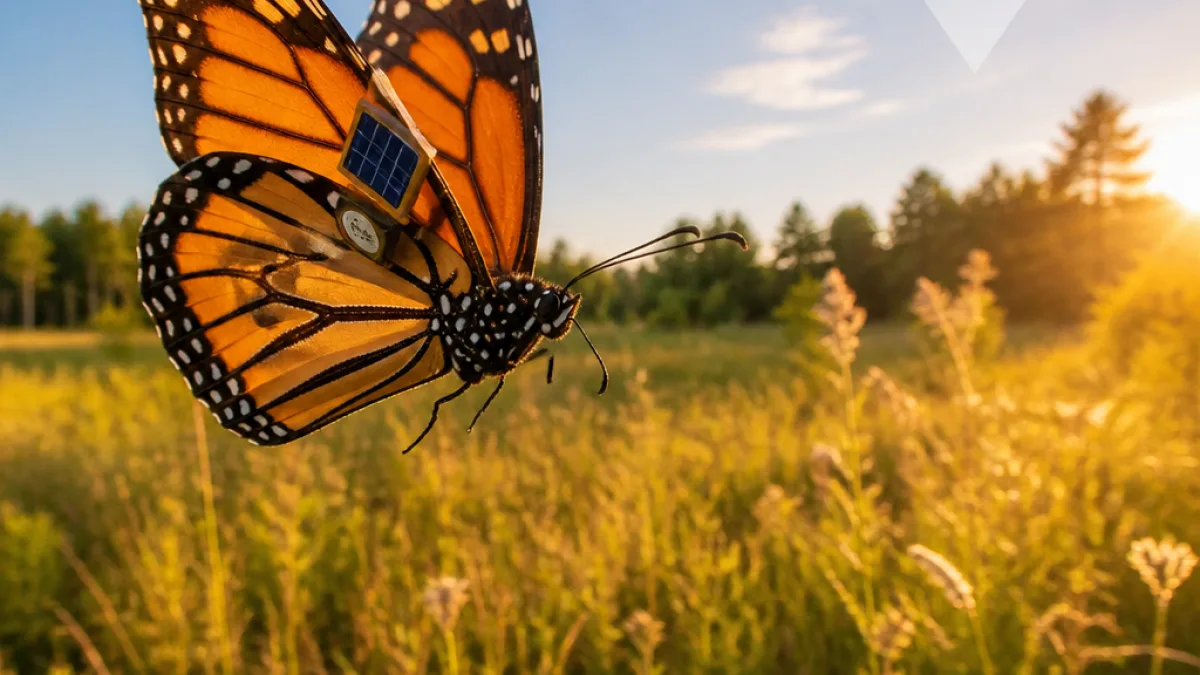
FREDERICTON — Conservation groups in New Brunswick have begun using tiny, solar-powered Bluetooth tags to follow monarch butterflies on their long southbound migration, attaching devices to 22 insects in early September to build a more complete picture of where the butterflies stop and shelter on their journey.
New technology to fill migration gaps
The tags emit a signal that can be picked up by any Bluetooth-enabled cellphone within about 100 metres. When a tagged monarch passes within range of a compatible phone, the location is automatically posted to the Project Monarch map, allowing researchers to trace the annual migration of roughly 4,000 to 5,000 kilometres to overwintering grounds in Mexico.
Nature NB, which partnered with the Point Lepreau Bird Observatory on the effort, says the new approach provides far more frequent positional data than traditional visual tagging and recapture methods. That denser stream of observations should help scientists chart where monarchs are stopping along the route and identify places they use to seek refuge during storms.
Why the data matters to New Brunswick
Monarchs were designated as an endangered species in New Brunswick in 2022. Provincial and local conservation groups say understanding the butterflies' stopover and sheltering sites is essential to crafting effective protection plans and bolstering resilience as the climate changes.
“If we can get a better understanding of the areas that monarchs are taking refuge … we can better protect them to be more resilient in the face of climate change,”
Francie Morgan, a program coordinator with Nature NB, said the project is intended to inform both science and policy by revealing habitat connections that were previously only guessed at from sporadic recaptures.
Local experience with tagging supports pilot
Volunteer and long-time tagger Jim Wilson of the Point Lepreau Bird Observatory noted the advantages of near-real-time tracking. “It’s light-years ahead because in real time, we can see where our butterflies are going,” he said. “Everybody who is following this literally is mesmerized by what we’re seeing.”
Wilson has been tagging monarchs at Point Lepreau for two decades, and the new Bluetooth technology represents what supporters describe as a step-change in monitoring capability.
Project logistics and funding
Each tag costs about $300, according to Nature NB. The pilot received support from the New Brunswick Environmental Trust Fund, NB Power and Environment and Climate Change Canada. The project’s reliance on widely distributed consumer devices — smartphones — to record tag signals is key to collecting large numbers of location points without requiring researchers to chase recaptures across thousands of kilometres.
- Number of monarchs tagged: 22
- Tag detection range: ~100 metres
- Estimated migration distance: 4,000–5,000 km
- Approximate cost per tag: $300
| Item | Detail |
|---|---|
| Tags attached | 22 |
| Power source | Solar |
| Signal range | ~100 metres |
| Project map | Project Monarch (online) |
What researchers hope to learn
Beyond identifying specific stopover and refuge sites, researchers say denser tracking data can illuminate timing, route variation and how weather events influence daily movements. That information may help prioritize land protections, restoration efforts and guide municipal or provincial planning where monarch habitat overlaps with development or coastal exposure.
Organizers emphasise that this is an early stage pilot. While the tags can produce many more data points than visual tagging, the success of the approach depends on the density of participating smartphones along migration pathways and on recipients' devices coming within range of tagged butterflies.
The project sits at the intersection of citizen science and conservation technology, using modest public participation — a smartphone passing near a butterfly — to generate scientific returns that would otherwise be prohibitively costly to collect across hundreds of thousands of square kilometres.
Nature NB and Point Lepreau Bird Observatory intend to continue assessing how the Bluetooth-tag data can be integrated into broader conservation strategies for monarchs in New Brunswick and across the Atlantic flyway.