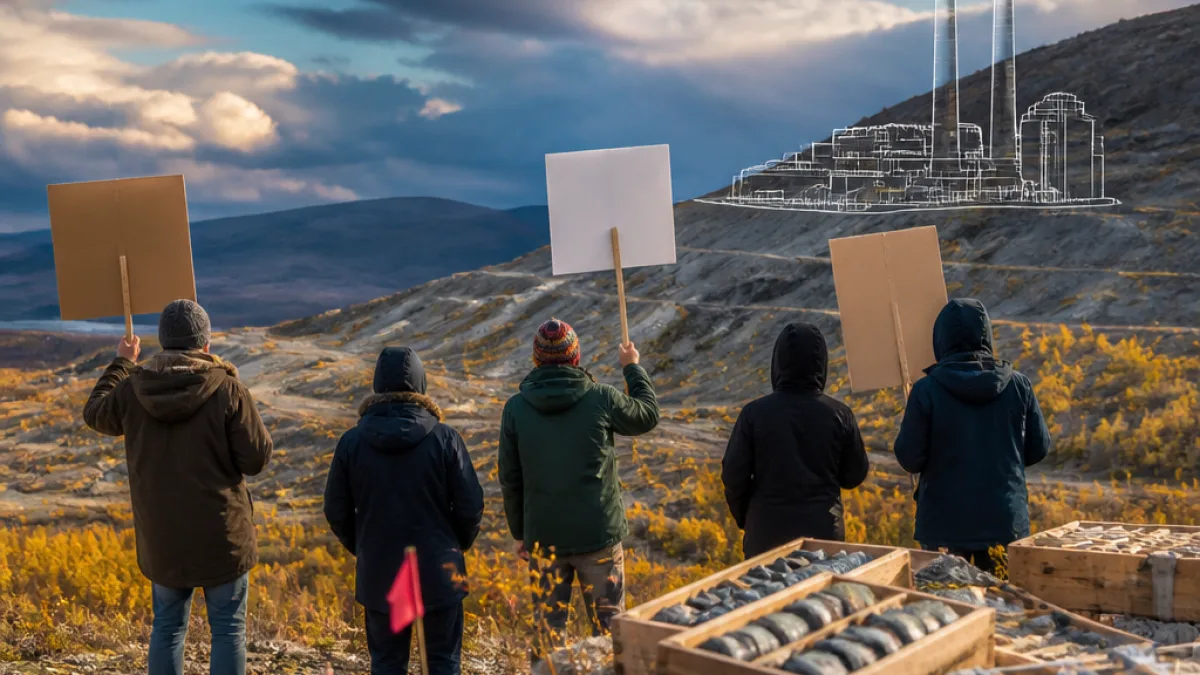
The announcement that Strategic Metals is considering a coal-fired power plant at Division Mountain, near Braeburn, has put Yukon energy policy and emissions targets back in the spotlight. The company says the nearby deposit contains a measured resource of 50 million tonnes — enough, by its estimate, to supply a 100-megawatt generating facility for roughly a century if fully developed.
Local deposit, national context
The company’s chief executive has framed the plan around emissions-control technology that would meet federal regulations by 2030. That approach has attracted scepticism from climate experts and environmental groups. A senior researcher at the Canadian Climate Institute told reporters they doubted the effectiveness of such technology, and the Yukon Conservation Society’s spokesperson labelled the idea “bonkers.”
“It’s environmentally terrible. It’s never going to go ahead.”
The public debate highlights several tensions that confront the territory: the need for reliable, dispatchable electricity for mines and communities; the limited contribution so far from renewables; long lead times on major infrastructure such as a BC–Yukon grid connector; and the interim reliance on imported fossil fuels.
Fossil fuels and the territory’s power mix
Yukon has been expanding capacity using liquefied natural gas (LNG) and diesel to meet demand beyond what existing hydro and other renewables can supply. The story notes Yukon Energy’s plans for two LNG-fuelled stations in Whitehorse as the latest example. LNG produces roughly half the greenhouse gas emissions of coal when combusted, but both fuels are shipped into the territory by road and sea, adding to emissions from transport.
Across Canada, coal’s role in electricity generation has been shrinking, though it remains a significant source elsewhere: the source material cites that coal supplies about 25% of Saskatchewan’s electricity and roughly 50% of Nova Scotia’s. Those comparisons underscore how far Yukon's energy mix would diverge from national trends if a new coal facility were built.
What the Division Mountain deposit would mean
Key facts emerging from the public information:
- Measured coal resource: 50 million tonnes at Division Mountain
- Proposed capacity: 100 megawatts, estimated supply horizon of about a century
- Alternative fuels in use: LNG and diesel, both transported from Outside
| Item | Figure |
|---|---|
| Coal resource at Division Mountain | 50 million tonnes |
| Estimated plant output | 100 MW |
| Coal share (comparative provinces) | Saskatchewan 25%; Nova Scotia 50% |
Concerns voiced by experts and advocates
Environmental advocates are focusing on the climate implications. Even with proposals to capture emissions, some researchers say current carbon-capture approaches remain unproven at scale and carry substantial costs and energy penalties. The Yukon Conservation Society’s strong rebuke reflects an anxiety that a coal project would lock the territory into decades of high emissions just as much of Canada moves away from coal-fired generation.
There are also practical considerations. The proposed mines referenced in the reporting — Coffee-Gold and Kudz Ze Kayah — are remote from the Yukon electrical grid and, according to the source material, were approved without conditions to limit GHG impacts. That precedent feeds into broader worries about how industrial projects are being assessed against climate objectives.
Where the territory stands
For now, the Strategic Metals proposal is a flashpoint for discussion rather than a settled plan. The company’s statements about meeting federal standards by 2030 and using emissions-control technology will be weighed against technical feasibility, regulatory review and community response. Meanwhile, the territory continues to rely on imported LNG and diesel to fill gaps in generation, with the BC–Yukon grid connector and other long-term options remaining distant prospects.
The announcement raises questions Yukoners will need to consider: How should the territory balance near-term energy reliability with long-term climate commitments? What standards and conditions should be imposed on major resource projects to limit greenhouse gas outputs? And how should decision-makers weigh local economic opportunity against potential environmental risk?
As discussions continue, stakeholders from communities, Indigenous governments, environmental organisations and industry are likely to press for clarity on emissions modelling, mitigation measures and the timeline for any proposal advanced beyond the exploratory stage.
Reporting will continue as more details become available and as public and regulatory scrutiny of the Division Mountain deposit and any proposed development unfolds.