
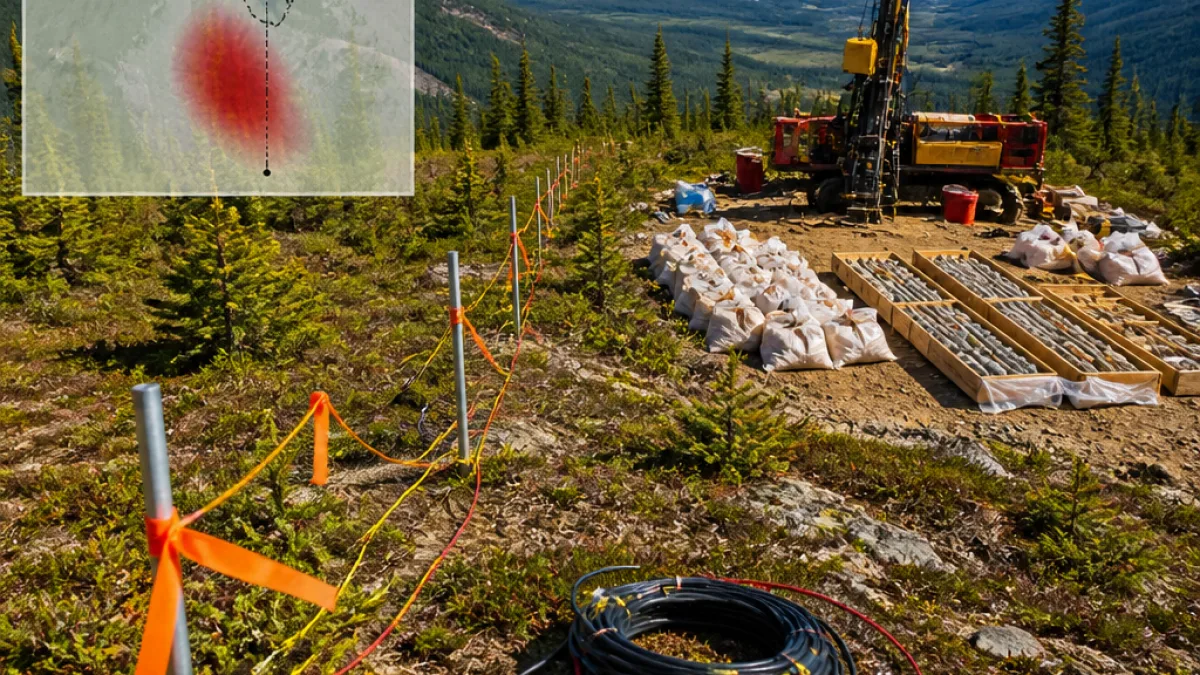
Yukon Metals Corp. says a recent induced-polarization (IP) survey at its 100-per-cent-owned Birch Project has uncovered new subsurface targets roughly 2 kilometres south of previously identified skarn mineralization, expanding the search area for a broader intrusive-related system.
Survey results deepen exploration model
The completed geophysical work picked up multiple chargeability anomalies that coincide with a mapped intrusive body and a magnetic high. Company statements link those anomalies with elevated molybdenum-in-soil geochemistry collected in earlier programs, suggesting the geophysical signature is related to mineralized intrusive rocks rather than isolated skarn lenses.
Yukon Metals carried out 12.7 line-kilometres of two-dimensional IP surveying at Birch, laid out on four principal north–south lines with an east–west tie line. The principal lines were spaced about 300 metres apart. The survey measured induced polarization and electrical resistivity together to identify chargeable zones below identified intrusive targets.
Surface sampling shows strong local grades
Surface grab sampling from the southern target area in 2025 returned locally significant assays, underlining the prospective nature of the newly identified IP anomalies. Select rock samples reported grades as high as 16 grams per tonne (g/t) gold, 1,825 g/t silver and 0.43 per cent copper.
Those high-grade surface values, together with the coincident molybdenum soil anomalies, a mapped intrusive, and a magnetic high, had already drawn attention to the area prior to the 2026 IP survey. The geophysics were intended to add a subsurface dimension to that dataset and to test for chargeability beneath the intrusive target.
Drilling underway; assays pending
One of the new IP targets was tested by diamond drilling as part of Yukon Metals’ 2026 program. The company has reported that assays from that hole are pending. Earlier exploration at Birch emphasised near-surface skarn zones that offered straightforward drill targets; however, ongoing mapping, geochemical sampling and geophysical work have increasingly pointed toward an intrusive-related system extending beyond the recognised skarn horizons.
Skarn deposits typically develop where hydrothermal fluids from intrusions interact with carbonate-rich host rocks such as limestone and marble. At Birch the interplay between intrusive units and favourable host rocks appears to be a central part of the evolving exploration model.
What the data show
A compact table summarises the key data points released by the company:
| Parameter | Reported result |
|---|---|
| IP survey coverage | 12.7 line-km |
| Line spacing | ~300 m |
| Maximum surface gold | 16 g/t Au |
| Maximum surface silver | 1,825 g/t Ag |
| Maximum surface copper | 0.43% Cu |
These datasets — geochemical highs, magnetic features and now chargeability anomalies — are the kind of overlapping evidence exploration teams use to prioritise drill targets. The southern target area now joins the near-surface skarn as a focus for follow-up.
Local context and next steps
For Yukoners watching exploration around the territory, the significance is twofold: the potential to expand a known mineral system beyond accessible skarn and the presence of multi-element mineralization at surface that merits more extensive drilling and mapping.
- Diamond drill assays from the tested IP target are pending and will be key to determining whether the subsurface chargeability corresponds to mineralization.
- Further integration of geology, geochemistry and geophysics will refine target priority and depth potential.
- Remaining work will determine whether the broader intrusive system hosts continuous mineralization or isolated high-grade pods.
Until assay results are available, the new IP anomalies should be viewed as encouraging geophysical indicators rather than proof of an expanded deposit. The company’s approach — combining mapping, soils, rock sampling and geophysics before committing to extensive drilling — follows standard exploration practice and aims to de-risk follow-up programmes.
The Birch Project remains an evolving target. The recent IP survey has broadened the company’s view of the property and provided new drill targets to test the concept of an intrusive-related mineralising system extending beyond the previously drilled skarn.