Ontario-based manufacturer Di-Mond has expanded its truck body and aluminium end-dump operations, repositioning production to meet rising demand at home after tariffs curtailed portions of its U.S. business.
Strategic shift after cross-border tariffs
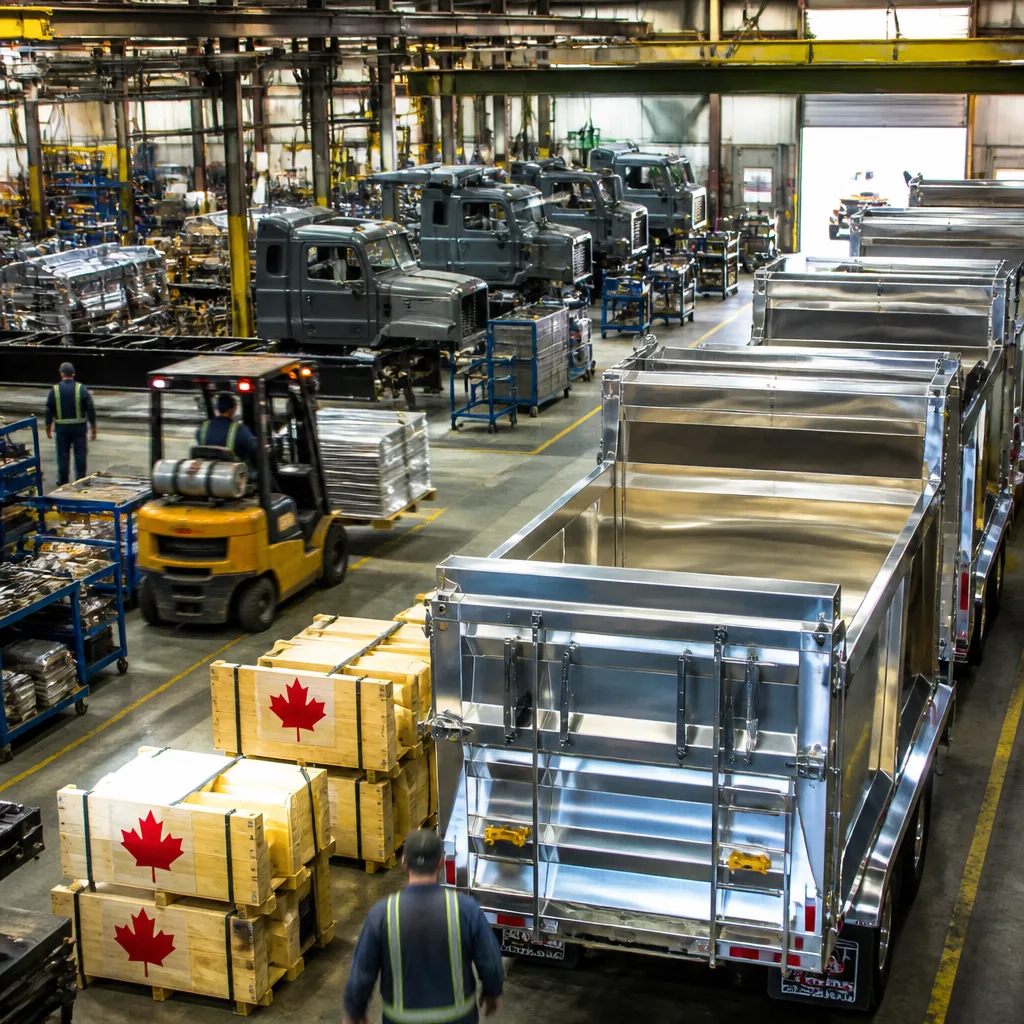
The company has operated a dedicated Di-Mond Truck Body division for roughly 18 months, in a facility separate from its long-established trailer plant. With sustained growth, Di-Mond moved aluminium end-dump manufacturing into that same building to consolidate operations and boost capacity.
“Our truck body location here has been operational for about a year-and-a-half,” said Dave Steane, vice-president of sales. He confirmed the decision to relocate end-dump work was driven by expansion needs rather than short-term logistics.
“We had a lot of business in the U.S., and that has stopped,” Steane said.
The company had targeted northern U.S. states around the Great Lakes as a natural market for truck bodies and trailers. But newly applied tariffs made those products considerably more costly for American buyers, effectively halting previously healthy southbound sales, Steane said.
Refocusing on Canadian customers and binational partners
In response, Di-Mond has shifted emphasis to domestic fleets and to partnerships with American firms that operate Canadian divisions. The approach aims to preserve sales relationships while avoiding tariff exposure on exports to the United States.
- Di-Mond marked about 18 months since the creation of its truck body division.
- Aluminium end-dump production was moved into the truck body facility to accommodate growth.
- Tariffs reduced the company’s ability to sell into northern U.S. states previously targeted.
Steane described the company’s market search as highly targeted: “We’re doing a very, very focused search through Canadian partners.” He emphasised that relationships with U.S. counterparts remain intact and that Di-Mond expects to resume broader cooperation when trade conditions allow.
Impacts on competition in Canada
Tariff changes on trailers entering Canada have also shifted the domestic competitive balance. Higher duties on U.S.-built equipment have helped Canadian manufacturers compete by narrowing the price gap that once favoured imports, according to Di-Mond’s management.
That altered landscape provides an opening for firms such as Di-Mond to capture more of the national market for truck bodies, trailers and end-dumps — equipment used intensively across construction, aggregate, road maintenance and agricultural sectors.
| Item | Detail |
|---|---|
| New division operational | ~18 months |
| Production moved | Aluminium end-dumps into truck body facility |
| Target U.S. region affected | Northern states around the Great Lakes |
For Canadian buyers, the reorientation could mean shorter supply chains and greater access to domestically manufactured bodies and bodies with end-dump capability. For Di-Mond, the move is both defensive — replacing lost U.S. sales — and offensive, capturing business generated by Canadian fleets replacing or expanding equipment.
While the firm has not publicly disclosed specific employment or investment figures tied to the consolidation, the shift aligns with broader patterns in manufacturing where tariff policy prompts firms to reconsider production locations and market focus.
As trade policies evolve, companies operating on both sides of the border are likely to continue adapting — balancing relationships with longstanding American customers and seizing new opportunities within Canada.
The expansion at Di-Mond’s Grimsby, Ont., operations underscores how tariff changes can ripple through supply chains and influence where and how industrial goods are made and sold.