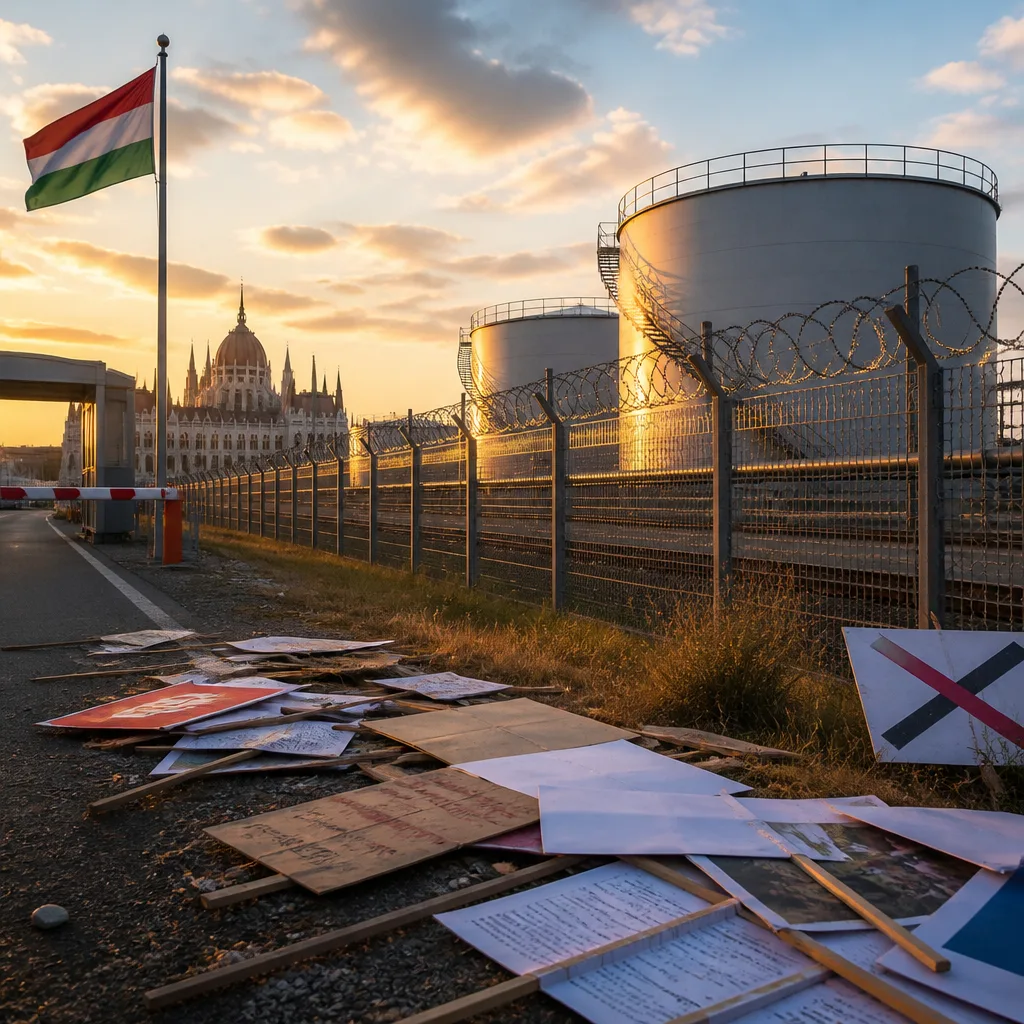
Budapest and Kyiv publicly sparred this week after Hungarian Prime Minister Péter Magyar announced that his government would not permit a proposed MOL–Naftogaz fuel-storage project on Hungarian territory and said Hungary had not agreed to join Ukraine’s new regional cooperation initiative.
What happened
The dispute revolves around a memorandum of understanding signed at the inaugural Carpathian Eight summit, an initiative launched by Ukrainian President Volodymyr Zelenskyy with Austria, Czechia, Poland, Romania, Serbia, Slovakia and Hungary. The memorandum envisages storing petroleum products in Hungary near the Ukrainian border to help Ukraine diversify supplies and protect reserves from strikes.
Magyar told parliament that Hungary had not joined the initiative despite receiving an invitation and that his government would not permit the construction of the planned fuel-storage facilities. Although Hungary was represented at the summit by a senior diplomat, Budapest did not sign the final declaration.
Diplomatic fallout
The row quickly moved to social media. Ukrainian Foreign Minister Andrii Sybiha said he was surprised by what he called an “unnecessarily confrontational” stance from Hungary and accused Budapest of continuing policies of obstruction and isolation. Magyar responded sharply, arguing that Ukraine should not present Hungary as a member of an international grouping without prior consent.
“To claim that a sovereign country is a member of an international cooperation … without prior consultation or consent is completely unacceptable,”
Magyar compared the situation to being unexpectedly told he had joined a neighbouring village’s football team and had to “bring the ball.”
Signatures and non-signatures
The founding declaration was signed by six countries; two invited states declined to endorse it. The practical outcome leaves Kyiv with a regional format that does not include Hungary or Czechia, at least at this stage.
| Category | Countries |
|---|---|
| Signatories | Ukraine, Austria, Poland, Romania, Serbia, Slovakia |
| Declined to endorse | Hungary, Czechia |
Why it matters
The proposed fuel-storage site in Hungary would have offered Ukraine a means to diversify fuel supplies and to safeguard reserves from potential Russian attacks. By rejecting the project, Budapest removes one practical avenue for Ukraine to bolster its energy resilience on EU-NATO territory.
Beyond the immediate energy implications, the disagreement tests diplomatic norms around multilateral initiatives and invitations. Kyiv’s Carpathian Eight was pitched as a cooperation platform on regional security, energy, logistics and cross-border investment. The public exchange raises questions about how such initiatives will proceed without full participation from all invited neighbours.
- Energy security: The proposed storage would have helped Ukraine manage supply shocks and protect reserves.
- Regional diplomacy: Hungary’s refusal to join complicates Kyiv’s efforts to build a nine-country cooperative front in Central and Eastern Europe.
- Domestic politics: The dispute is an early foreign-policy test for the new Hungarian prime minister, coming after leadership change in May.
Hungary’s stance also carries political signals for Brussels and Ottawa observers. The change in Hungarian leadership earlier this year was met with cautious optimism in parts of the European Union. This episode, however, underlines that new governments may still pursue distinct national priorities that diverge from partner expectations on matters such as cross-border infrastructure and strategic cooperation.
For Kyiv, the loss of Hungarian endorsement reduces the immediate geographic and logistical options available for diversifying energy logistics — a key concern amid an ongoing conflict that has targeted critical infrastructure. For Budapest, the position reflects a desire to exercise sovereign control over what projects are sited on its territory and how its membership in multinational initiatives is represented.
The public tone of the exchange — with accusations of obstructionism and insistence on prior consent — signals a diplomatic bruising that both capitals will need to manage if they are to preserve co-operation on other fronts.