Prime Minister Mark Carney used his appearances at the United Nations General Assembly this week to reposition Canada as a leading voice among so‑called middle powers, urging like‑minded states to cooperate to preserve and modernize the postwar international order.
Shifting posture on trade and alliances
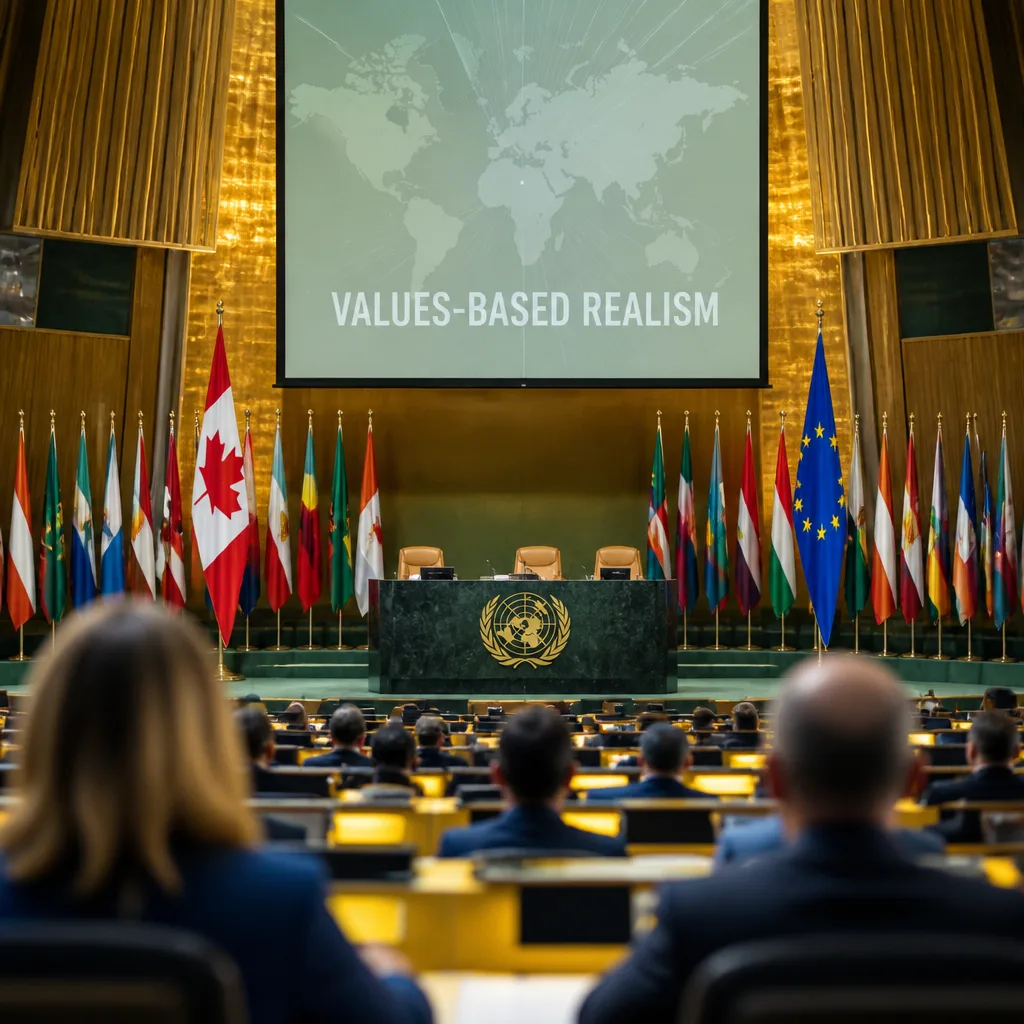
In remarks to Canadian reporters at the UN, Carney framed Canada’s approach as a blend of principle and pragmatism—what he described as “values‑based realism”—and said partners are engaging with Ottawa because the country remains “predictable, reliable and principled in a world that’s anything but.” The prime minister’s comments follow a high‑profile speech to the World Economic Forum earlier this year and a series of diplomatic moves that suggest Ottawa is hedging its longstanding dependence on the United States.
Carney has already taken tangible steps consistent with that posture. He walked away from recent trade talks with Washington after rejecting what he characterised as unacceptable U.S. demands, and has pursued alternative markets and relationships, including discussions that could lead to Canada becoming the European Union’s first associate member—moves that signal an appetite to diversify economic and strategic ties.
Coalitions, calibration and practical values
The prime minister urged other middle powers to band together to defend shared interests and update global rules at a moment when great‑power behaviour has become more unpredictable. He outlined a strategy that mixes commitments to human rights, freedom and sustainability with selective partnership arrangements that do not require full alignment on every issue.
“Partners are working with Canada because Canada’s predictable, reliable and principled in a world that’s anything but,”
The remarks came as the General Assembly convened its annual high‑level meeting, the most visible diplomatic gathering of the year. Carney’s rhetoric is aimed at both domestic and international audiences: domestically to justify a tougher negotiating stance with the United States; internationally to rally countries that may be willing to pursue closer coordination with Ottawa.
Context and consequences for Canadian foreign policy
For years Canada played a supportive, sometimes background, role in multilateral forums. The prime minister’s recent activism changes that dynamic by asking middle powers to act more collectively to protect institutions and rules that underpin global commerce, security and norms.
The short‑term consequence of the new posture is already visible in trade diplomacy: Ottawa’s willingness to suspend talks with Washington after disputes over tariffs and other demands represents a marked departure from the long Canadian strategy of deference to its largest trading partner. Over the medium term, efforts to build formal or informal coalitions with European and other democracies could reshape Canada’s negotiating options on trade, climate and security.
How far such a strategy can go will depend on partner receptivity and on domestic capacity to absorb the political and economic costs of diversification. The prime minister’s push for association with the European Union, if it advances, would be historic and would require substantial negotiation, but it also signals the seriousness with which Ottawa is pursuing alternatives.
What to watch next
- Whether formal follow‑up emerges from the meetings Carney is convening with other middle powers at the UN.
- Any concrete progress toward enhanced economic ties with the European Union, including talks on association.
- How Ottawa manages relations with Washington while pursuing diversified partnerships and whether Canadian businesses see measurable benefits or costs.
| Area | Recent action by Ottawa |
|---|---|
| Trade talks with U.S. | Walked away after rejecting U.S. demands |
| Multilateral posture | Advocating middle‑power cooperation at the UN |
| Relations with EU | Exploring possible associate membership |
Carney’s remarks at the UN mark a deliberate effort to translate a newly asserted international role into practical options for Canada. Whether that will deliver enhanced security or economic resilience for a country of roughly 41 million people remains to be seen, but Ottawa’s diplomats are clearly moving with greater urgency to build alternatives to the long‑standing U.S.‑centric model.