
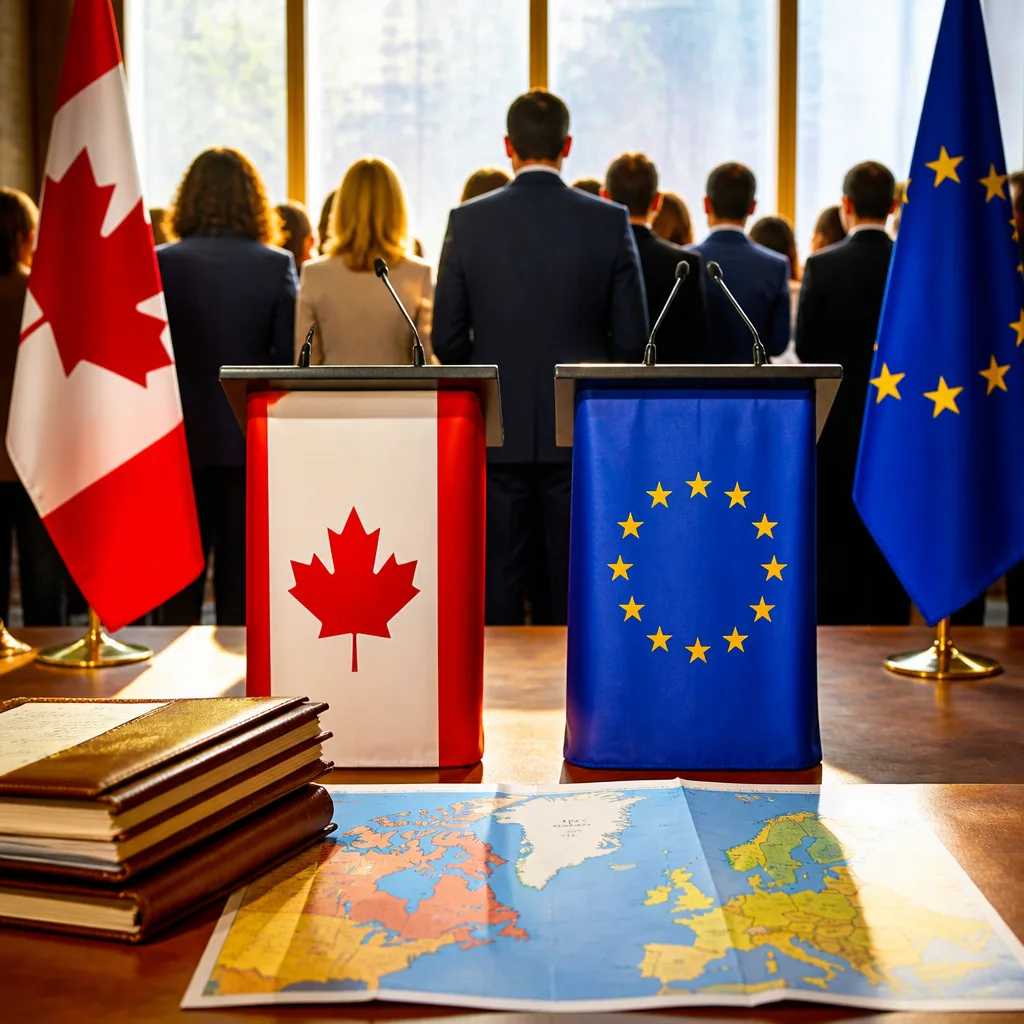
Prime Minister Mark Carney and European Commission President Ursula von der Leyen have publicly promoted a proposal that would create a new, closer relationship between Canada and the European Union — potentially making Canada the bloc’s first associate partner. While both leaders have pitched the idea this week, senior Canadian officials caution that significant legal and policy questions remain before any agreement could be concluded.
What leaders said
Carney used a speech to the European Parliament to welcome von der Leyen’s plan for a novel partnership, framing the concept as an opportunity for deeper cooperation across technology, security, trade and regulatory alignment. The Canadian prime minister has repeatedly stressed that Canada would not seek full EU membership.
“an alliance for the future”
The phrase above, used by the prime minister, has become shorthand in Ottawa and Brussels for what proponents describe as a flexible arrangement that could deepen ties without Canada ceding sovereign decision-making to EU institutions.
How 'associate' would work — and what’s unknown
Officials say the term "associate member" does not yet correspond to a single, legally defined status within EU treaties. A senior Canadian official, speaking on condition of anonymity, told CBC News that Ottawa analysed a range of existing relationships between the EU and non-EU states — including Norway, Switzerland, the United Kingdom and Georgia — and concluded that none matched Canada’s objectives because they would require too much compromise of Canadian autonomy in exchange for access.
Key unresolved matters include:
- the legal form and enforceability of an association;
- the scope of market access for goods and services;
- any requirements to adopt or mirror EU regulations or court decisions;
- the process for dispute resolution and oversight.
Comparing other EU relationships
Ottawa’s analysis drew on models used by several states to interact with the EU, but officials said those arrangements were not viable templates for Canada.
| Country | Relationship model | Assessment by Canadian officials |
|---|---|---|
| Norway | Extensive access via EEA-like arrangements | Found unsuitable |
| Switzerland | Sectoral bilateral agreements | Found unsuitable |
| United Kingdom | Post-Brexit bespoke arrangement | Found unsuitable |
| Georgia | Association agreement model | Found unsuitable |
The official emphasised that Canada wants enhanced cooperation without surrendering too much decision-making power — a balance that, they said, none of the examined models delivered.
Domestic and diplomatic implications
Any new status could have wide-ranging consequences for Canadian regulation, supply chains and international obligations. Closer alignment with the EU might ease trade frictions and reduce barriers to services and investment, but it could also obligate Canada to adopt EU standards or face restrictions on market access if divergence occurs.
In Ottawa, the government will need to judge whether the economic gains justify potential constraints on policy autonomy. That calculus will play out across multiple ministries and with provincial partners who have jurisdiction over many elements of trade and regulation.
For Brussels, the proposal opens a path to deepen ties with a like-minded, democratic partner with shared values on trade, climate and security. For other EU partners, creating a bespoke associate status for Canada would be a precedent-setting move that could spark demands for similar arrangements from other countries.
Carney and von der Leyen’s speeches have crystallized interest and debate on both sides of the Atlantic, but officials stress that a great deal of negotiation and legal work remains before the outline becomes a concrete pact.