
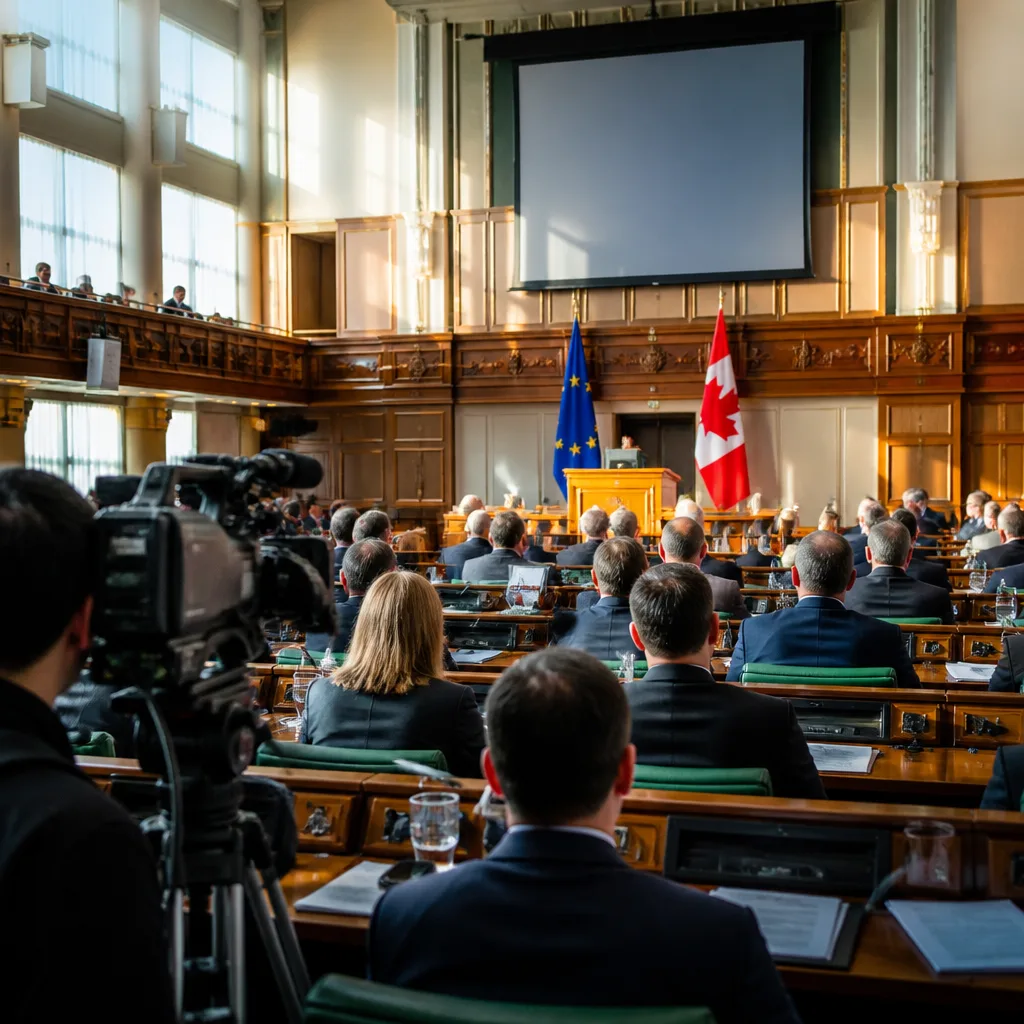
Canada could become the first associate member of the European Union, European Commission President Ursula von der Leyen said during her State of the Union address, an idea that would create an unprecedented legal and political relationship between Ottawa and the bloc.
What was announced
Von der Leyen floated the notion on Wednesday while Canadian Prime Minister Mark Carney was in attendance. She did not provide details about the powers, obligations or mechanics of an associate-member arrangement. The concept, as described in Brussels reporting, would be a novel construct for the EU and its institutions.
“I would like to open the door to Canada being the first associate member of the European Union,”
The idea echoes other recent EU thinking about intermediate forms of membership. German Chancellor Friedrich Merz earlier proposed an associate status as a transitional step for Ukraine, permitting participation in EU institutions without voting rights while accession proceeds.
Immediate context and Ottawa’s posture
The suggestion follows media reporting that Mr. Carney had been exploring whether such an arrangement was possible as Canada seeks to deepen ties with Europe amid a fraying relationship with the United States on trade. Mr. Carney has been cautious about characterising Ottawa’s aims: on Sunday he told reporters Canada was not seeking full EU membership but was pursuing a “unique alliance” with the bloc.
“We share the same values, we have the same priorities and we have very complementary strengths,”
How Brussels and Ottawa would translate that broad political affinity into concrete access to EU policymaking, markets or regulatory systems remains unspecified. Senior EU officials have long regarded formal EU membership as territorially constrained by treaties to European states; that precedent is the primary obstacle to conventional accession.
Options under consideration
Diplomats in Brussels are reported to be contemplating several possible frameworks for closer ties. One option would be a bespoke, tailored partnership reflecting Canada’s size and shared values. A separate, established mechanism is membership in the European Economic Area (EEA), which extends the EU single market to Iceland, Norway and Liechtenstein. But officials familiar with the EEA process told reporters that its extension to Canada appears unlikely.
- Bespoke associate status: a new, tailor-made category allowing Canada participation without full membership rights.
- EEA membership: gives access to single market rules but considered improbable for Canada by some officials.
- Incremental engagement: enhanced sectoral agreements or institutional cooperation short of formal membership.
Domestic resonance and public opinion
Public appetite for deeper ties with the EU is not negligible. A poll from March 2025 found that almost half of Canadians favoured the idea of potential EU membership. Whether Canadians would support a novel associate status, distinct from full accession, is untested at scale and would likely prompt debate about sovereignty, trade implications and relations with the United States.
| Poll (March 2025) | Result |
|---|---|
| Canadians favouring potential EU membership | Almost 50% |
Consequences and unanswered questions
An associate membership for Canada would raise immediate legal and political questions. European treaties currently presume membership for states within the continent, a territorial convention that would need reinterpretation or legal innovation to accommodate a transatlantic partner. Moreover, concrete terms would determine whether Canada gained access to the single market, regulatory influence, or a role in EU decision-making institutions — and whether any participation would be with or without voting rights.
For Ottawa, the strategic calculus is complex. Greater integration with Europe could diversify markets and regulatory alignment at a time of rising friction with the United States, but it would also require negotiation of obligations and potentially sensitive adjustments to trade and governance practices.
European diplomats acknowledge Canada’s size and alignment on values could justify a special, customised arrangement. Yet officials stress that while possibilities are being discussed, outcomes are far from settled. Mr. Carney is scheduled to address the European Parliament, where further dialogue and clarifications are likely to follow.
The proposal opens a new chapter in transatlantic relations by suggesting institutional innovation rather than the binary choice of accession or no engagement. The next steps will hinge on what Brussels is prepared to offer, what Ottawa will accept, and how both sides reconcile legal constraints with political ambition.