Researchers at New York University have developed an artificial intelligence tool that can predict where hydrogen atoms sit in drug‑like molecules — a seemingly small detail that can decisively change which molecular form, or tautomer, dominates and how a compound interacts with a protein target.
Why hydrogen placement matters
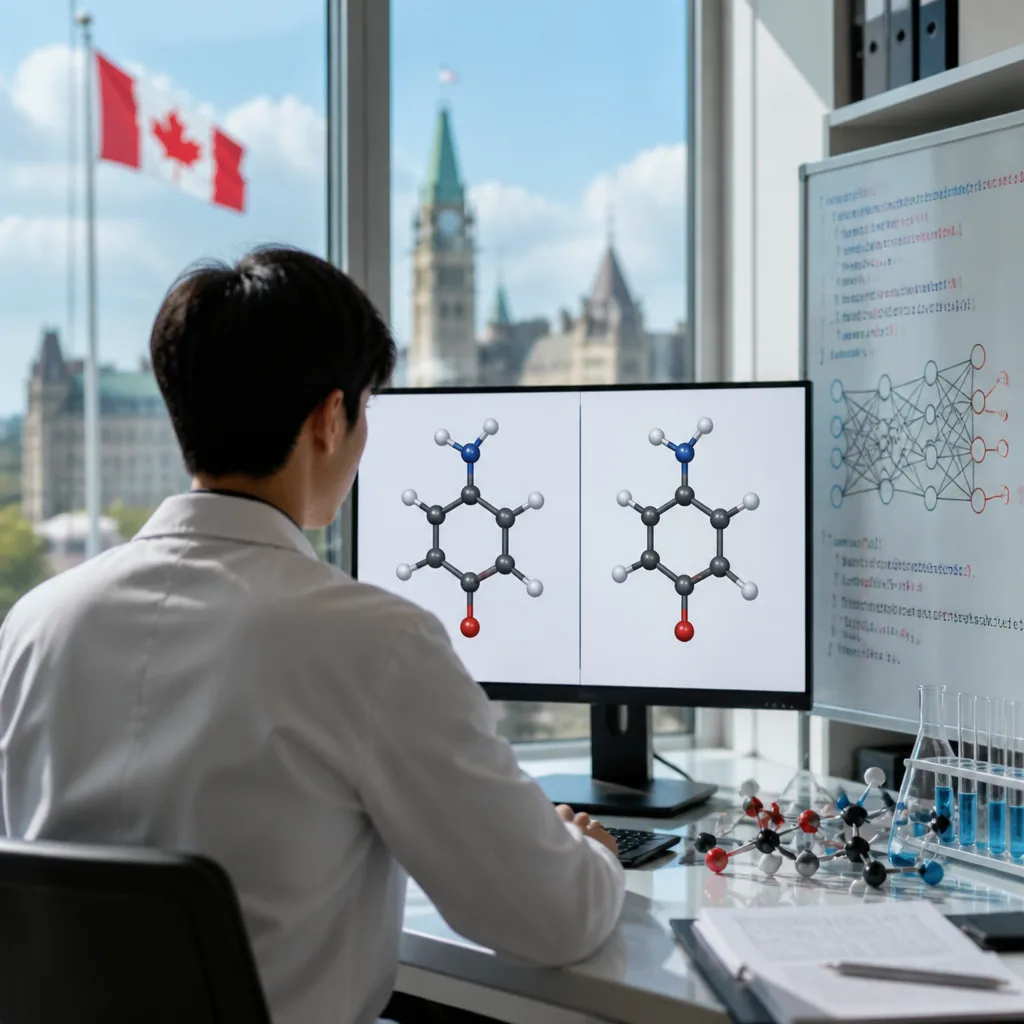
Many drug‑like molecules exist as two or more tautomers, forms that differ only by the position of a hydrogen atom and the corresponding bonding arrangement. Although those differences are minute on the scale of a molecule, they can substantially alter binding to biological targets, and therefore influence predictions made in molecular modelling and structure‑based drug discovery.
“Although this may seem like a small change, different tautomers of the same molecule can alter how a molecule interacts with a protein target,” said Yingkai Zhang, professor of chemistry at NYU and the study’s senior author.
The NYU team trained their model to learn chemical patterns linked to stability and used it to predict the most stable tautomeric forms. Their work, published in Chemical Science, tackles a persistent problem in computational chemistry: reliably and rapidly assigning tautomers for large libraries of candidate molecules.
Limits of current approaches
Experimental repositories commonly used in biomolecular research, such as the Protein Data Bank, typically lack reliable hydrogen positions for small molecules because standard structural methods — particularly macromolecular X‑ray crystallography — do not resolve hydrogen atoms well. As a consequence, researchers often have to infer hydrogen locations and tautomeric states, an uncertain step that can propagate errors through downstream modelling.
Other established methods have shortcomings when scaled up. Quantum mechanical calculations can provide accurate tautomer energetics but are computationally expensive and impractical for screening entire libraries. Conventional machine learning approaches are hampered by a scarcity of experimentally characterised tautomer datasets in solution; such datasets historically contain only a few hundred molecules, limiting model generality.
What the model offers
The NYU model learns chemical stability patterns and predicts hydrogen positions, helping to identify the dominant tautomer for drug‑like molecules. By reducing uncertainty about tautomeric assignment, the tool could make molecular docking, virtual screening and other structure‑based design steps more reliable and faster.
- Addresses a data gap: the model compensates for limited experimental hydrogen‑position data in repositories such as the Protein Data Bank.
- Computational efficiency: offers a practical alternative to resource‑intensive quantum mechanical methods when screening large compound libraries.
- Improves modelling fidelity: more accurate tautomer assignment can change predicted interactions with protein targets and influence compound prioritisation.
That combination matters because misassigning a tautomer can mislead ligand docking, virtual screening hit lists and structure‑activity interpretations — errors that are costly in time and resources during drug discovery campaigns.
Implications and next steps
The model is a step toward closing a practical gap between experimental structural data and the needs of computational chemists. By automating a previously uncertain decision — which hydrogen goes where — the approach could be integrated into existing modelling pipelines, improving the quality of early‑stage predictions without imposing the heavy computational cost of quantum chemistry across massive libraries.
However, limitations remain. The published work highlights the scarcity of experimentally validated tautomer data as a constraint on training and benchmarking. Broader adoption will depend on further validation across diverse chemical classes and integration with downstream workflows used in both academic and industrial drug discovery.
| Issue | Current challenge | Model contribution |
|---|---|---|
| Hydrogen placement | Often unresolved in X‑ray structures | Predicts likely hydrogen locations |
| Scalability | Quantum methods too costly for libraries | Computationally practical for screening |
| Training data | Limited experimentally characterised tautomers | Learns chemical patterns to generalise |
For Canadian researchers and the domestic biotech sector, tools that reduce uncertainty in molecular modelling can lower discovery costs and accelerate lead optimisation. As AI continues to augment chemistry workflows, the community will watch for how well such models generalise beyond their training sets and how seamlessly they plug into the software chemists already use.
Published in Chemical Science, the NYU study provides a practical advance rather than a cure‑all: it refines a precise, technical step that sits at the interface of experimental structural biology and in‑silico drug design.