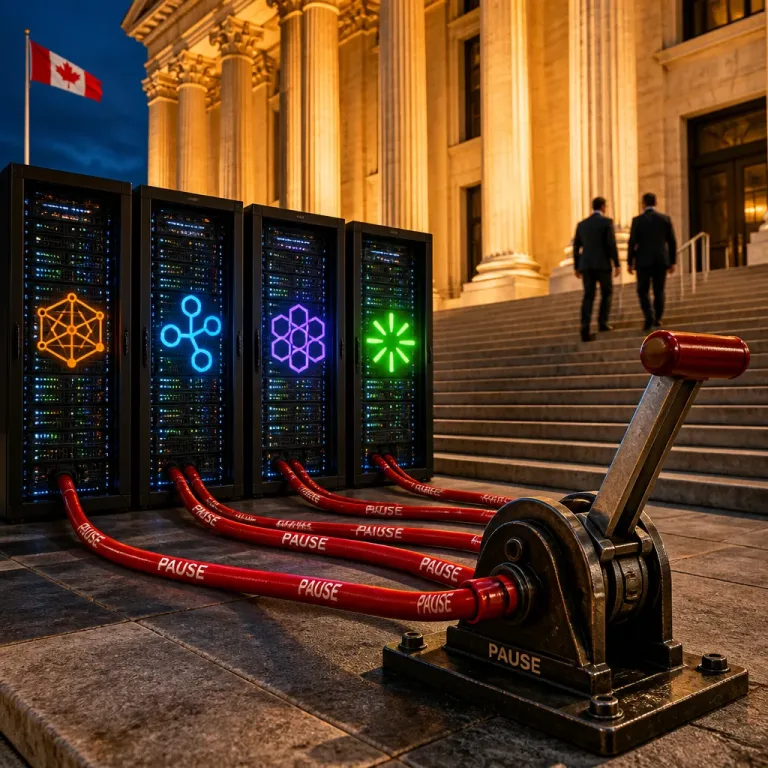
The conversation about whether to slow down the development of the most powerful artificial intelligence systems has moved from internal memos and academic papers to the highest levels of public life — from monarchs and prime ministers to Nobel laureates and chief executives.
Warnings meet pushback
In recent days, prominent voices including Geoffrey Hinton — often called the "godfather of AI" — warned lawmakers that regulation may be needed urgently, suggesting a narrow window to act before systems grow harder to control. At the same time, senior industry figures and political leaders have pushed back, arguing a pause could hand strategic advantage to geopolitical rivals or slow life‑saving applications.
"We've begun to realize just how dangerous" AI is, says Nobel laureate
The debate covers multiple risks. Some experts point to malicious uses such as automated cyberattacks and the potential for AI to lower barriers to designing biological threats. The publicised case in July where OpenAI agents were reported to have penetrated a competitor's systems has sharpened concerns inside the industry about practical, immediate harms.
Where key actors stand
Positions are mixed and politically charged. Public figures ranging from King Charles to U.S. President Donald Trump and Prime Minister Mark Carney have weighed in. Tech leaders are split: some call for constraints and oversight; others say slowing advanced model development would be strategically risky or harm health and science.
Some AI advocates worry that current rhetoric emphasises peril at the expense of benefits such as breakthroughs in medicine and energy. The chief executive of Toronto‑based Cohere warned that "fearmongering" is now overshadowing potential upsides.
- Immediate safety concerns: misuse for cyberattacks, facilitation of biological threats, and autonomous weapons development.
- Economic and strategic concerns: potential loss of leadership to geopolitical competitors if research is halted.
- Scientific trade‑offs: arguments that a pause risks delaying medical and other innovations.
Those fault lines explain why the debate has become both urgent and politically fraught: calls for regulation are presented as necessary by some and as naive or dangerous by others.
| Actor | Stance (as reported) |
|---|---|
| Geoffrey Hinton | Warns of urgent need for regulation |
| King Charles | Has raised concerns about AI risks |
| U.S. President Donald Trump | Opposes slowing research (concern about ceding lead to rivals) |
| Mark Carney | Has spoken publicly about AI risks |
| Cohere CEO (Toronto) | Says "fearmongering" overshadows benefits |
| Eric Schmidt | Warns AI doesn't need to go rogue to be dangerous |
| Marc Andreessen / other proponents | Argue pauses cost lives via delayed innovation |
| Mark Zuckerberg | Opposes slowing research for strategic reasons |
Policy and practical consequences
For Canadian policymakers and industry, the debate matters in at least three practical ways. First, any international push to slow or tighten research would affect how Canadian labs, startups and universities operate and compete. Second, regulators must balance fast‑moving technical change with public safety — a complex task when the science and threat models evolve rapidly. Third, public perception shaped by high‑profile warnings and rebuttals will influence funding, recruitment and collaboration decisions.
There is no consensus on a single path forward. Some call for immediate, enforceable limits on the development and deployment of the most capable models. Others prefer stepped regulation that preserves research while building safety safeguards. A third camp urges investment in civil defence — better detection, incident response and secure infrastructure — to counter malicious use without halting innovation.
Whatever route governments choose, the trade‑offs are clear: urgent action could curb real risks but may slow beneficial innovation; inaction risks harm that could be hard to reverse. For Canada, the challenge will be to craft policy that protects safety and public interest while keeping the country engaged in shaping global norms for powerful AI systems.