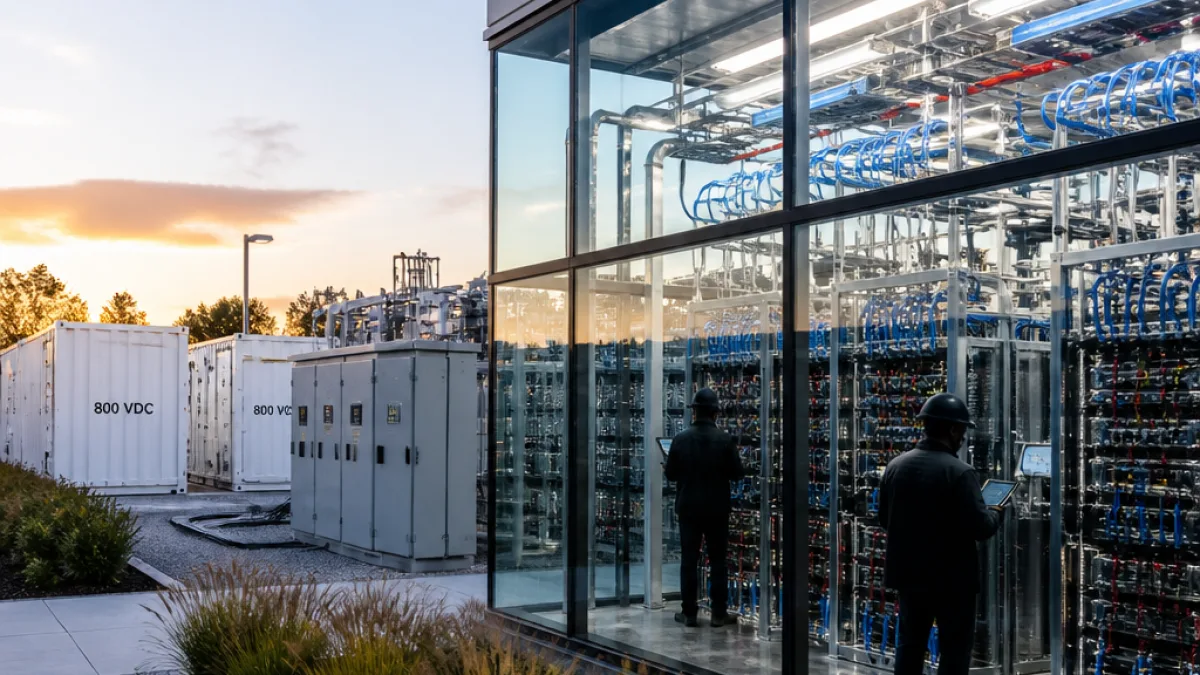
Delta Electronics outlines integrated power and cooling for AI factory builds
Delta Electronics on Sept. 17 unveiled a packaged energy-to-compute offering intended to accelerate deployment of AI factories built on the NVIDIA DSX platform. The announcement framed the company's portfolio as a physical bridge connecting onsite energy and facility power through to rack- and chip-level cooling and power delivery.
Speaking in a release from Fremont, California, company executives emphasised the need to design power, cooling and compute as a unified system when scaling dense GPU-based workloads. The Delta systems pair 800 VDC power delivery — which the company rates at up to 98 per cent conversion efficiency — with liquid-cooling technology that the company says can scale to 3 megawatts per configuration.
"AI factory economics begin with a simple question: how much intelligence can be produced from every available megawatt?"
The remark came from Austin Tseng, president of Delta Electronics Americas, who said achieving that productivity requires engineering across power quality, GPU load transients and heat removal "all the way into the rack."
What the offering includes
Delta positioned the portfolio as a set of integrated building blocks to shorten time-to-first-token and raise token output per megawatt for operators adopting the NVIDIA DSX reference platform. In its description, the company ties together:
- onsite energy and energy storage systems,
- medium-voltage distribution and solid-state transformers,
- 800 VDC row-level delivery and rack-to-chip liquid cooling, and
- chip-level thermal and power solutions aligned with GPU workload swings.
Vladimir Troy, vice-president of AI infrastructure at NVIDIA, is quoted in the release as stressing that AI factories must be designed as complete systems, with power, cooling and compute working in concert. He said Delta's expertise in high-voltage DC delivery and liquid cooling will help customers deploy DSX-based AI factories faster and extract more performance from each megawatt.
Technical highlights at a glance
| Capability | Claimed figure |
|---|---|
| Power delivery | 800 VDC |
| Conversion efficiency | up to 98% |
| Cooling scale | up to 3 MW |
The release describes the NVIDIA DSX AI Factory Platform as an assembly of reference designs, open software, accelerated compute systems, facilities infrastructure and partner technologies co-designed to guide AI factory design, deployment and operations. Delta and NVIDIA said their collaboration pairs systems-level hardware and facility planning to reduce friction in bringing dense GPU deployments online.
Local implications and broader context
On the West Coast, where hyperscale data centres and specialised AI facilities are growing, innovation in power architecture and cooling is receiving increased attention from operators, utilities and regulators. Delta's packaged approach highlights two recurring challenges for high-density compute: aligning transient power demand with distribution systems and removing heat efficiently at the rack and chip level.
For municipalities and planners, these are practical constraints when siting AI or data-centre projects: electricity capacity, transformer sizing, energy storage integration and cooling water or closed-loop refrigerant strategies can influence project timelines and approvals. Delta's pitch is that better-coordinated hardware and infrastructure will reduce those barriers by delivering tested building blocks rather than bespoke engineering for every site.
Delta Electronics' announcement does not specify customer names or concrete deployment schedules. It positions the company as an infrastructure partner to save time in the design-to-deployment cycle for organisations adopting the NVIDIA DSX framework.
The unfolding race to scale AI compute over the next several years will keep power and thermal engineering at the centre of facility planning. For communities weighing new technology builds, the trade-offs between local grid impact and potential economic activity will continue to be a key part of public discussion.