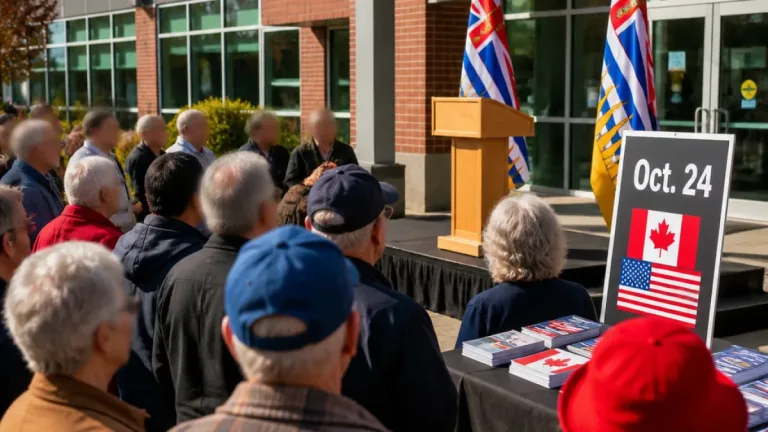
British Columbia is entering a campaign season in which the identity of its official Opposition is in flux. With the province set to vote on Oct. 24, both the New Democratic Party and the B.C. Conservatives are working quickly to define — and in some cases redefine — what the Conservatives stand for after a leadership rupture that lasted less than four months.
Quick repositioning after a turbulent leadership
Kerry-Lynne Findlay’s brief tenure as Conservative leader, during which she sought to frame the party around “faith, family and freedom,” ended with her resignation. Her style — a low profile with traditional media and a visible turn to conservative influencers — and controversial tactics such as an AI social media video depicting NDP Leader David Eby in stark, polarizing terms have left the party at a crossroads.
“the bully south of the border”
Within hours of the election call, interim Conservative leader Lorne Doerkson, installed by the party on Sunday, made a point of distancing the party from U.S. politics. Speaking with caucus members, he described U.S. President Donald Trump as “the bully south of the border,” an attempt to blunt criticism from the NDP that the Conservatives were soft on American-style politics.
That line of attack is precisely what NDP Leader David Eby emphasised when he framed his decision to call a snap election. Eby told voters the vote was necessary to build a firewall against what he called “Trump-style politics.” The exchange sets up an early theme for the campaign: national identity, outside influence and the character of provincial conservatism.
Return and realignment: who is coming back?
In the immediate aftermath of Findlay’s departure, several former Conservatives moved to re-embrace the party. Notably, Peter Milobar rejoined the Conservatives on the Tuesday after quitting, describing his return as a reinvigoration of a party focused on “progressive-ideas, conservative-values.” A’a:liya Warbus, one of a small number of Indigenous MLAs in Victoria, was among a group of seven CentreBC members who rejoined the Conservative fold, calling Findlay’s exit an opportunity for a “responsible, progressive-conservative approach.”
- Interim leader: Lorne Doerkson
- Former leader: Kerry-Lynne Findlay (resigned after less than four months)
- Notable returns: Peter Milobar; A’a:liya Warbus among seven CentreBC members
How the messaging battle may shape the campaign
The NDP has seized on the narrative that the Conservatives were flirting with an American-style populist politics, using the prospect of a federal-provincial relationship strained by U.S. trade disputes as a key reason for the snap election. For the Conservatives, the immediate priority has been to blunt that portrayal and present a version of conservatism that is pragmatic and centred on local values rather than transborder culture wars.
Doerkson’s public rebuke of U.S. influence is a tactical move to neutralize Eby’s firewall argument. It also signals an internal effort to move away from the combative imagery and influencer-driven communications that marked Findlay’s short leadership.
What this means for voters
For voters, the upheaval raises questions about stability and clarity of purpose. The Conservatives have to answer whether the party under new interim leadership will offer distinct provincial policies on housing, health care and the economy, or whether it will continue to be defined by national cultural flashpoints and personality-driven tactics.
For the NDP, the Conservative infighting offers an electoral advantage: it allows the governing party to frame the choice as one about protecting B.C. from destabilizing outside influences and hardline politics. How effective that line will be remains to be seen — campaigns can be rapid cat-and-mouse games, where leadership changes and messaging pivots alter momentum quickly.
Snapshot
| Item | Detail |
|---|---|
| Election day | Oct. 24 |
| Conservative interim leader | Lorne Doerkson |
| Former leader | Kerry-Lynne Findlay (resigned after less than four months) |
| Notable returns | Peter Milobar; A’a:liya Warbus among seven CentreBC members |
The short window to Oct. 24 means both parties must sharpen their appeals quickly. Conservatives need to make a coherent case for how they will govern differently at the provincial level without appearing captive to U.S. style populism. The NDP must translate its warnings about influence and instability into concrete policy contrasts that matter to British Columbians.
As the campaign unfolds, attention will focus on whether the Conservatives can stabilise their messaging and leadership long enough to present a credible alternative, or whether their internal divisions will hand the NDP a clearer path to renewed mandate. Either way, the debate over the direction of conservative politics in B.C. is now front and centre — and will be a defining theme of the election campaign in the weeks ahead.