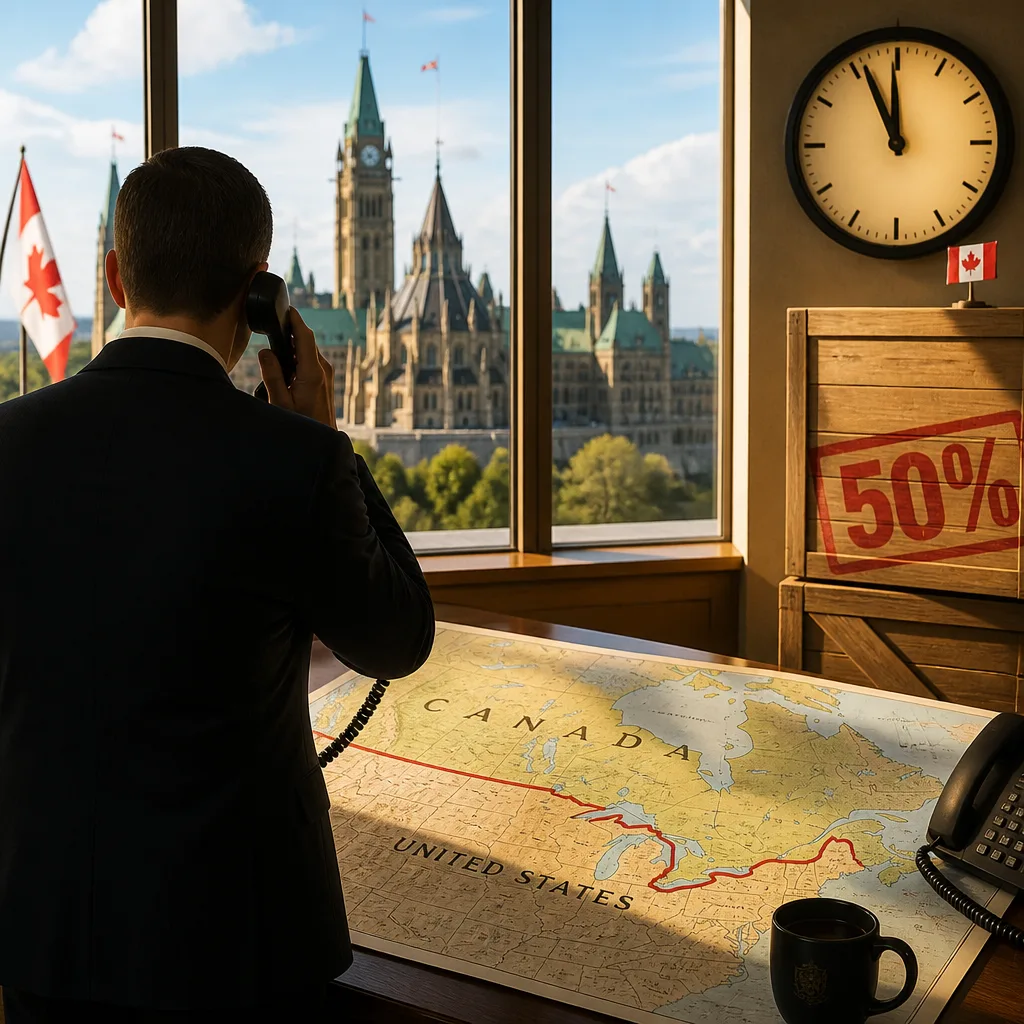
Prime Minister Mark Carney spoke by telephone with U.S. President Donald Trump on Monday as Ottawa intensified efforts to respond to an executive order that would impose punitive duties on a range of Canadian exports. The measure, which includes a 50 per cent tariff, is scheduled to come into force just after midnight on Wednesday, Aug. 19, CTV News confirmed.
High-level talks and quiet diplomacy
While the Prime Minister’s Office verified the call took place, it declined to provide details on the conversation’s content. The exchange follows high-level meetings between Canadian and U.S. trade officials in Washington earlier Monday — a sign Ottawa is pursuing urgent diplomacy at multiple levels.
Federal Trade Minister Dominic LeBlanc and chief trade negotiator Janice Charette met with U.S. Trade Representative Jamieson Greer and Commerce Secretary Howard Lutnick as part of the drive to avert or mitigate the incoming tariffs.
“Very intense and delicate.”
The Prime Minister characterised negotiations with the United States in those terms, and, speaking in French, said Ottawa had plans in place to
“cover all eventualities.”Beyond those broad reassurances, Canadian officials have so far been tight-lipped about specific bargaining positions or countermeasures.
Scope and immediacy of the tariffs
The executive order identified a suite of Canadian-made products that would be subject to the duties, including building materials and sporting goods. Among the examples frequently cited are cement and hockey sticks. The short window before the tariffs are due to take effect heightens the urgency for both diplomatic and domestic responses.
| Item | Detail |
|---|---|
| Tariff rate | 50% |
| Effective | After midnight, Aug. 19 |
| Some affected goods | Examples include cement and hockey sticks |
Domestic implications and options
A 50 per cent tariff on targeted Canadian exports would carry immediate consequences for affected sectors, supply chains and the firms that rely on cross-border trade with the United States. With the U.S. market accounting for the vast majority of Canadian exports, businesses and provinces with concentrated exposure to the identified goods face particular risk.
Federal officials have begun contingency planning; however, public statements have been deliberately measured. Ottawa’s options include pursuing exemptions, negotiating phased measures, seeking recourse through international dispute mechanisms, or preparing domestic supports for industries and workers. The extent to which any of these avenues will be pursued — or succeed — remains unclear.
- Canada’s senior trade officials engaged U.S. counterparts in Washington on Monday.
- The Prime Minister confirmed a phone call with President Trump but the PMO provided no details about the discussion.
- Ottawa says it has plans to deal with multiple outcomes should the tariffs be implemented.
As the deadline approaches, businesses, provincial governments and trade groups will be watching for both immediate exemptions and the longer trajectory of Canada-U.S. economic relations. The coming days are likely to test the resilience of the bilateral trade framework and the capacity of diplomatic channels to prevent sudden economic disruption.
Reporting from The Canadian Press contributed to this dispatch.