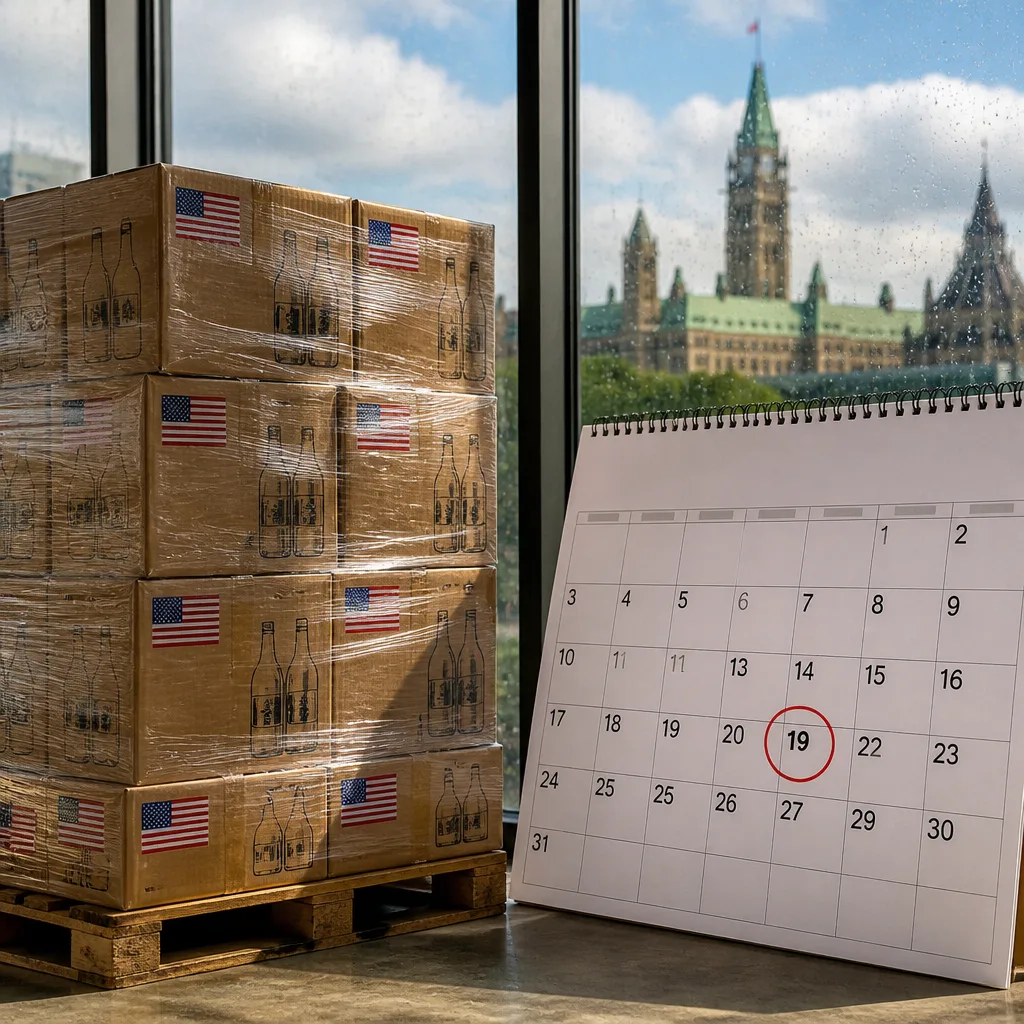
As the clock ticks down to a 50 per cent tariff on certain Canadian goods, U.S. alcohol sales in Canada have become a prominent bargaining chip in trade discussions taking place in Washington. Analysts and industry representatives say the dispute is as much about political pressure as it is about lost revenue — and that Canadian consumers and provincial boycott policies are central to the leverage at play.
Economic weight meets political pressure
Last month, U.S. President Donald Trump announced an additional round of 50 per cent tariffs, pointing to what the White House described as “discriminatory” measures by Canada. Those tariffs, the source says, were justified in part by provincial and territorial boycotts of American alcohol products, and are scheduled to take effect on Aug. 19.
Economists and business groups frame the situation as a political as much as an economic contest. Andrew DiCapua, principal economist at the Canadian Chamber of Commerce, told reporters that lawmakers in the United States are hearing concerns from local businesses about a significant drop in sales to Canadian customers.
“There seems to be some political angst in the United States from those senators and members of Congress hearing from their local businesses that these sales are down significantly. Canadians are the number one customer,”
DiCapua added that the decline in sales is a point of leverage for U.S. legislators and could influence the political calculus in Washington. That perspective underscores how consumer-facing measures in Canada — including provincial and territorial boycotts of U.S. booze — have acquired outsized importance in negotiations that also encompass larger tariff disputes.
Domestic politics complicate Canada's options
Within Canada, the issue has sparked a range of political responses. According to the source material, Conservative Leader Pierre Poilievre criticised Prime Minister Mark Carney for allegedly making concessions to U.S. demands, warning against further compromises such as urging provinces and territories to restore American alcohol to their shelves. Poilievre framed such concessions as capitulation to U.S. pressure.
Public opinion appears largely supportive of the provincial boycotts: the majority of Canadians — based on recent polling reported by the source — favour keeping U.S. alcohol off store shelves for now. That public backing complicates federal pressure on provincial decision-making and narrows Ottawa’s room to manoeuvre if it wants to avoid domestic backlash.
Industry and consumer stakes
Retail and industry voices stress that while some consumers may be inconvenienced, many accept the higher national stakes. Karl Littler, senior vice-president of public affairs at the Retail Council of Canada, observed that aficionados of U.S. spirits and wines may be upset but suggested most consumers understand the broader economic implications.
“If you are an absolute devotee of Kentucky bourbon or wines from the Willamette Valley in Oregon, then you might be a bit grumpy about it,”
He added that the negotiations are “a pretty existential set of negotiations for the Canadian economy, at least for the near term,” and that public support for the boycotts is broadly intact, according to the source.
- Tariff rate: 50 per cent
- Effective date: Aug. 19
- Main lever: Provincial and territorial boycotts of U.S. alcohol products
| Element | Detail |
|---|---|
| Tariff announced by | U.S. President Donald Trump |
| Rate | 50 per cent |
| Scheduled implementation | Aug. 19 |
For Ottawa, the dilemma is delicate: pressing provinces to reverse boycotts may ease pressure from some U.S. constituencies but could provoke domestic political fallout. Conversely, maintaining the boycotts signals Canadian resolve but risks deepening economic pain for U.S. suppliers and might harden Washington’s response.
As negotiations unfold in the coming weeks, Canada will have to balance economic calculus with domestic political realities, while monitoring how consumption patterns and industry lobbying in the United States influence U.S. lawmakers’ positions. The outcome will shape not only alcohol shelves across the country but also the broader tenor of Canada-U.S. trade relations at a critical juncture.