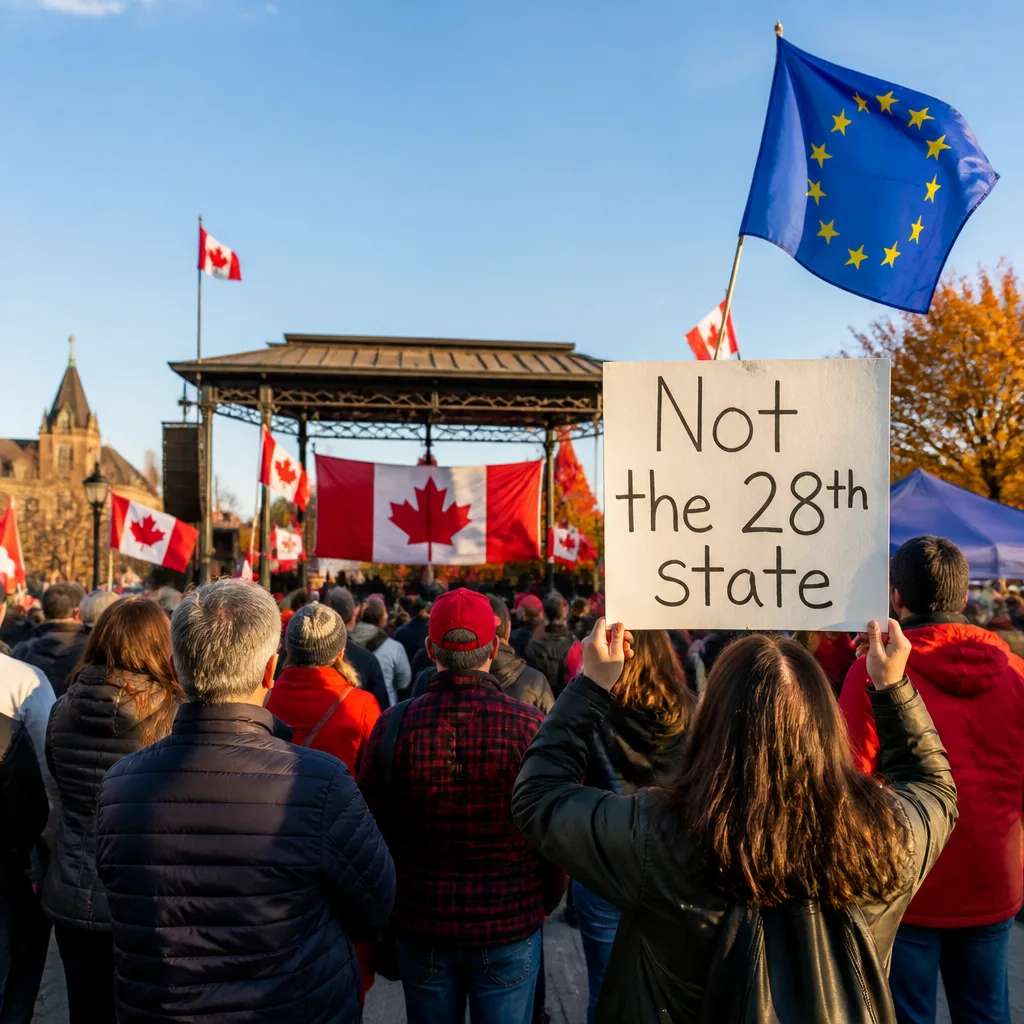
BRANTFORD — Conservative Leader Pierre Poilievre on Sunday forcefully rejected the idea of Canada taking on an institutional relationship with the European Union that he characterised as ceding national control, saying Canada will "never be the 28th state" of the EU.
Opposition uses EU idea to underscore sovereignty concerns
Speaking at a rally in Brantford, Ont., Poilievre framed his objection as a defence of Canadian decision-making. He argued Canada already maintains robust economic and security ties with Europe — including a free-trade agreement and co-operation through NATO — but said he opposed adopting European laws, taxes or immigration approaches he described as "reckless European-style" policy.
"Canada will never be the 28th state of the European Union."
His remarks come as Prime Minister Mark Carney pursues deeper links with Europe amid heightened tensions with the United States — an effort prompted in part by comments from European Commission President Ursula von der Leyen, who recently suggested she wanted Canada to become the EU's first "associate member." Carney has expressed openness to a strengthened partnership, while details of any arrangement remain to be worked out and would require debate and a vote in the House of Commons.
International reaction and wider context
The debate has attracted attention beyond Ottawa. U.S. President Donald Trump said last week that if Canada moved toward associate membership in the EU it could be seen as a "hostile act." Asked about Trump’s comments, Carney and visiting Norwegian Prime Minister Jonas Gahr Store emphasised the benefits of closer ties among NATO allies.
Carney argued that closer links with European partners would strengthen NATO and make member states more resilient. He noted that Canada can be a stronger global partner if its economy is more independent and equipped with a broader web of international relationships — an idea he framed positively as bolstering shared security and economic objectives.
Policy flashpoints and political dynamics
The emerging discussion raises several practical and political questions that Ottawa will have to address:
- What legal and institutional form would an "associate member" relationship take, and how would it affect Canada's sovereignty over laws and regulations?
- How would such an arrangement intersect with existing commitments, including free-trade agreements and NATO obligations?
- What are the domestic political ramifications for the governing party if Parliament is asked to endorse a new international partnership?
Carney has promoted expanding ties in areas such as youth mobility and financial services integration, saying these areas present tangible gains; however, the precise shape of any formal relationship with the European Union remains undefined and would require significant negotiation.
Poilievre’s intervention places the question squarely into partisan politics, framing the debate around national autonomy and democratic control. His appeal to voters emphasises that decisions affecting Canada should be made in Ottawa rather than abroad, insisting on a sceptical view of transferring authority to supranational bodies.
Next steps
The federal government has not presented a detailed proposal to Parliament. Carney has signalled interest in exploring options, but any substantive move toward an EU association would involve diplomatic negotiations and domestic consultation, and ultimately a Commons debate and vote.
| Actor | Position |
|---|---|
| Mark Carney | Open to deeper ties with EU; sees potential benefits for economy and NATO co-operation |
| Ursula von der Leyen | Proposed Canada as a potential first "associate member" of the EU |
| Pierre Poilievre | Opposes EU association; warns against adopting European laws, taxes and immigration policies |
| Donald Trump | Suggested such a move could be considered a "hostile act" |
With international actors and domestic opponents already weighing in, Ottawa faces a politically charged process if it pursues formalised ties with the European Union. The coming weeks are likely to produce further debate in Parliament as Canadians and their representatives consider the trade-offs between deeper international links and preserving national decision-making.