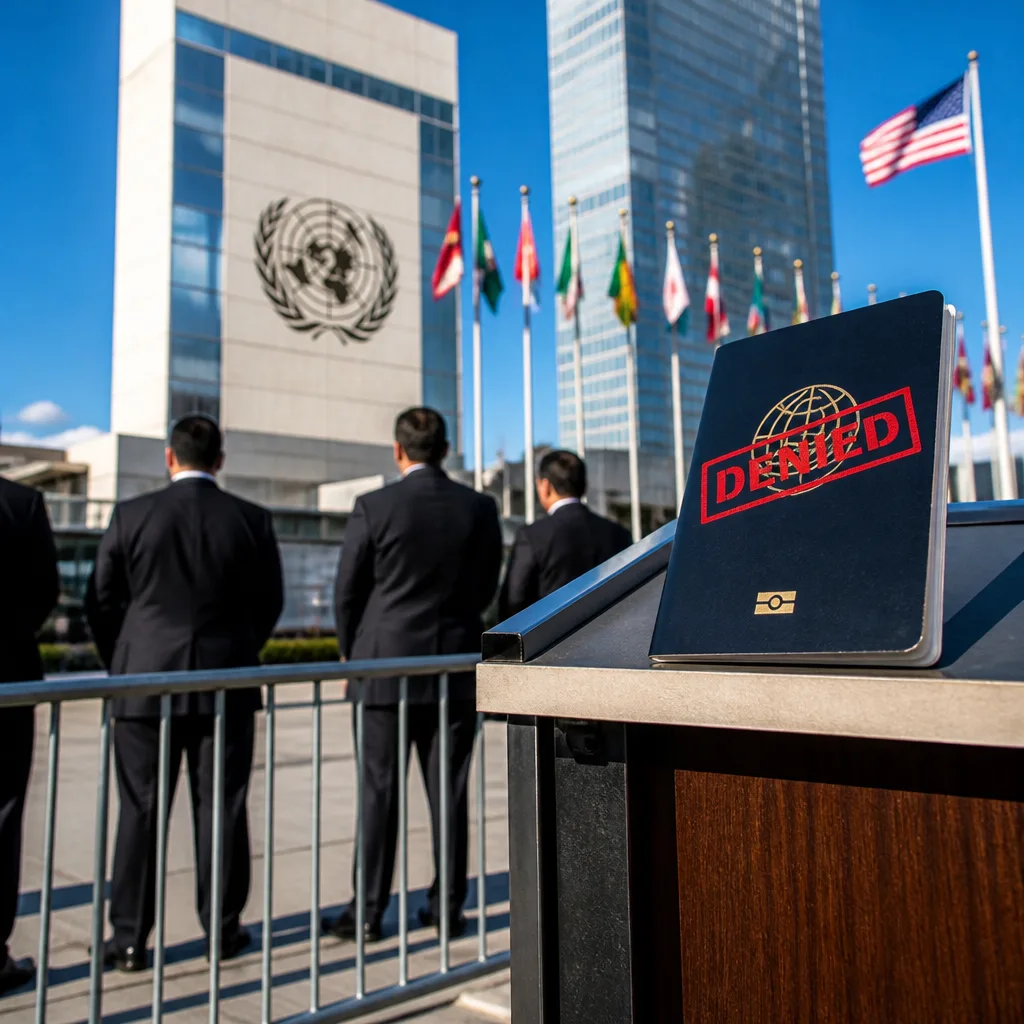
The United States has denied visas to a high-level Palestinian delegation — including Palestinian President Mahmoud Abbas — who sought to attend next week’s United Nations General Assembly in New York, the State Department said, marking the second consecutive year Washington has blocked Palestinian leaders from entering the country for the annual gathering.
U.S. cites failures to comply with prior commitments
In a written statement released on Wednesday, the State Department said Palestinian Authority (PA) officials had not lived up to commitments made in earlier agreements with the United States. The department said the PA had pursued legal action against Israel at the International Court of Justice and the International Criminal Court, and had maintained payments to the families of prisoners convicted of attacks on Israelis. It also singled out figures tied to the Palestine Liberation Organization (PLO).
"As a consequence of their failure to reform, contrary to their commitments to the United States, and their ongoing activities that undermine the prospects for peace, the United States will extend sanctions that deny visas to PLO members and PA officials."
The statement framed the visa denials as part of an effort to hold the PA accountable for actions the U.S. says erode the chances for negotiated peace. Washington has indicated these measures are being taken under existing U.S. law, extending sanctions that specifically target PLO members and Palestinian Authority officials.
Second consecutive year; implications for the UN session
This is the second year in a row that Palestinian leaders have been denied access to the United States for the General Assembly. The move complicates diplomatic engagement at the annual U.N. meeting, where heads of state and government typically address the General Assembly and pursue bilateral meetings on the sidelines.
U.S. officials pointed to a combination of legal and financial actions by the PA as the rationale for the renewed restrictions. The approach contrasts with the usual U.S. role as host of the U.N. gathering, and it has drawn criticism from some world leaders and observers who say barring national leaders from the Assembly undermines the forum’s purpose as a neutral diplomatic stage.
- Who is affected: Palestinian Authority officials and PLO members, including President Mahmoud Abbas.
- Reason cited: Pursuit of cases at the ICJ and ICC and continued payments to families of prisoners convicted of attacks on Israelis.
- Action taken: Extension of sanctions that deny U.S. visas to targeted Palestinian leaders.
Context and consequences
By linking visa denials to legal action at international courts and fiscal practices, the United States is signalling it views such moves as contrary to the commitments it expects from Palestinian counterparts in the peace process. The sanctions mechanism used by Washington operates independently of U.N. procedures and relies on domestic legal authorities to deny entry to individuals viewed as undermining U.S. policy goals.
For Canada and other nations attending the U.N. session, the development raises questions about how bilateral diplomacy with Palestinian officials will proceed in New York. With leaders unable to enter the host country, some encounters must be rearranged or take place in neutral venues — complicating a week of intense, often last-minute, diplomacy that depends on face-to-face access.
The decision also underscores the wider tension between unilateral national measures and the multilateral aims of the United Nations. Critics argue that preventing leaders from addressing the Assembly weakens the inclusiveness and legitimacy of the forum. Supporters in Washington contend the measures are a lawful response to activities they see as obstructive to negotiated peace.
Details on how Palestinian diplomats and allies will alter plans for the General Assembly this year have not been disclosed in the U.S. statement. The broader diplomatic fallout — including reactions from other states and whether the measures will shift PA behaviour — remains to be seen as the Assembly approaches.
For now, the State Department’s announcement makes clear that the U.S. intends to continue using visa denials as a lever in its policy toward the Palestinian leadership.