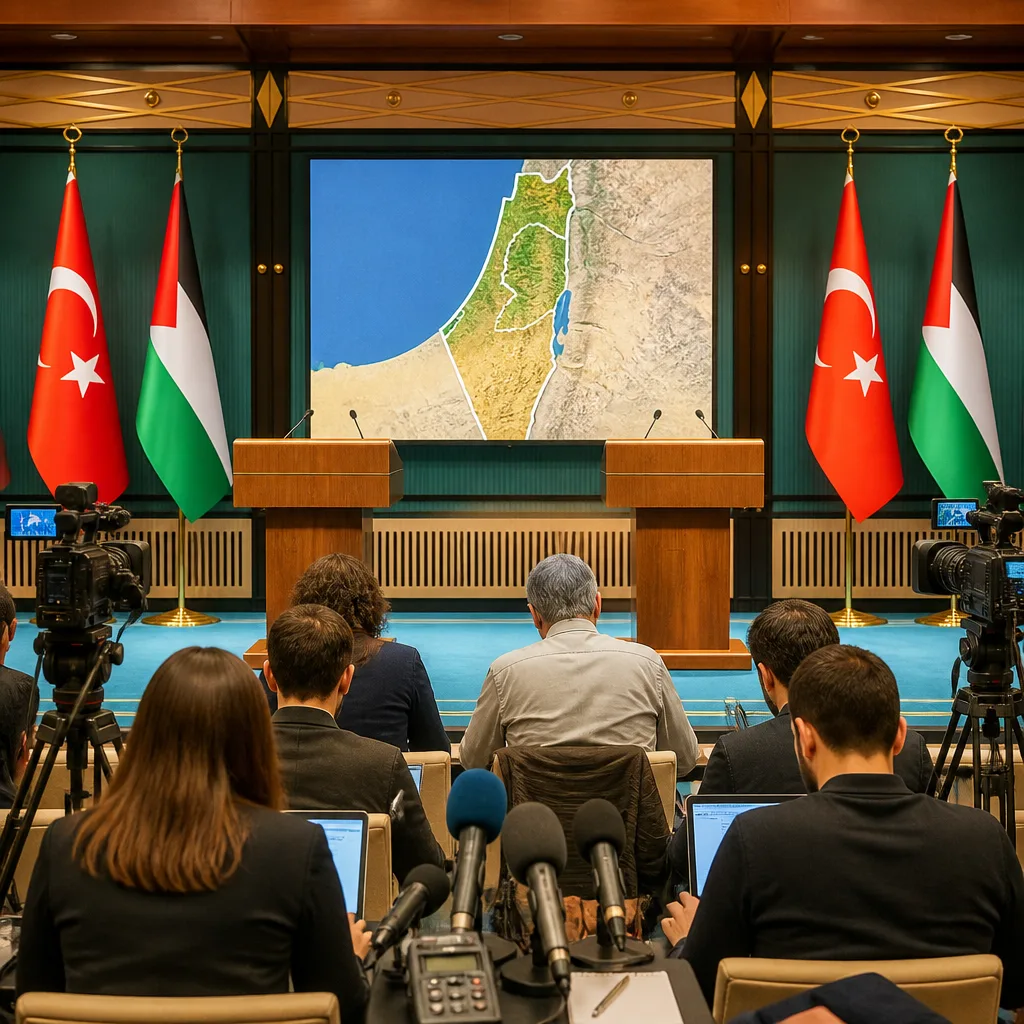
Turkish President Recep Tayyip Erdoğan on Wednesday pledged that Türkiye would persistently defend the Palestinian cause after meeting Palestinian President Mahmoud Abbas in Ankara for talks focused on Gaza, the West Bank and the prospect of an independent Palestinian state.
Erdoğan accuses Israel of undermining Palestinian statehood
Speaking at a joint news conference following the meeting, Erdoğan accused the Israeli government of carrying out what he described as unlawful measures in the West Bank and Jerusalem, including settlement expansion, demolitions and forced displacement. He cited United Nations figures indicating roughly 3,800 Palestinians displaced in 2026 as a result of settler violence, demolitions and evictions, and about 100 Palestinians killed.
“Whatever they do, they will not succeed,”
Erdoğan warned that Palestinian statehood is being eroded and said the international community could not ignore the developments. He said support for Palestinians should be a shared responsibility, particularly among Muslim-majority countries.
Two-state solution and regional implications
The Turkish president reaffirmed Ankara’s backing for a two-state solution, calling for the establishment of an independent Palestinian state on the basis of the 1967 borders, with East Jerusalem as its capital and with territorial continuity. Erdoğan also welcomed the decision to hold Palestinian legislative and presidential elections, saying such steps could help reconciliation and bolster unity among Palestinians.
He said Ankara works with Palestinian leaders to advance their cause in international fora and reiterated opposition to altering the status quo at key religious sites, naming in particular the Al-Aqsa Mosque compound in Jerusalem and the Ibrahimi Mosque in Hebron.
What Erdoğan says Türkiye will do
- Press for Palestinian statehood on international platforms.
- Oppose attempts to change access or control of Muslim and Christian holy sites.
- Support Palestinian elections aimed at reconciliation and unity.
He accused the Israeli government of seeking to benefit from instability while diverting international attention from the Palestinian issue. Erdoğan vowed that Türkiye would continue to support the Palestinian cause “on every platform.”
| Metric | Figure (2026, cited by Erdoğan) |
|---|---|
| Palestinians displaced (settler violence, demolitions, evictions) | ~3,800 |
| Palestinians killed | ~100 |
Context and potential consequences
The Ankara meeting signals Türkiye’s intention to remain a visible and vocal player on the Israeli–Palestinian file. Erdoğan’s emphasis on international responsibility and his invocation of United Nations figures are likely to resonate with governments and organisations advocating a renewed diplomatic push for a negotiated two-state outcome.
For regional diplomacy, Türkiye’s stance could reinforce alliances with Palestinian leadership and other countries pressing for stronger international responses to settlement activity and displacement. Erdoğan’s public remarks, and his insistence that attempts to change the status quo at holy sites will be resisted, also underline the sensitivity of religious and territorial disputes in any future negotiations.
Domestically, Erdoğan’s rhetoric frames his government as a defender of Palestinian rights — a position that carries weight in Turkish public opinion and across much of the Muslim world. Internationally, the remarks add pressure on nations that seek to mediate or influence developments in the occupied Palestinian territories to address both humanitarian conditions on the ground and the political question of statehood.
While Erdoğan praised the plan for Palestinian elections as a potential route to unity, the practical path to a negotiated settlement remains fraught: competing claims over territory and Jerusalem, ongoing settlement expansion cited by Erdoğan, and violence that has displaced thousands all complicate prospects for a durable peace.
By reaffirming support for a Palestinian state based on 1967 lines with East Jerusalem as its capital, Türkiye joins a chorus of governments and institutions that view those parameters as the foundation for a viable two-state arrangement — but turning that diplomatic backing into an actual political settlement will require sustained international engagement and concessions from the parties involved.