
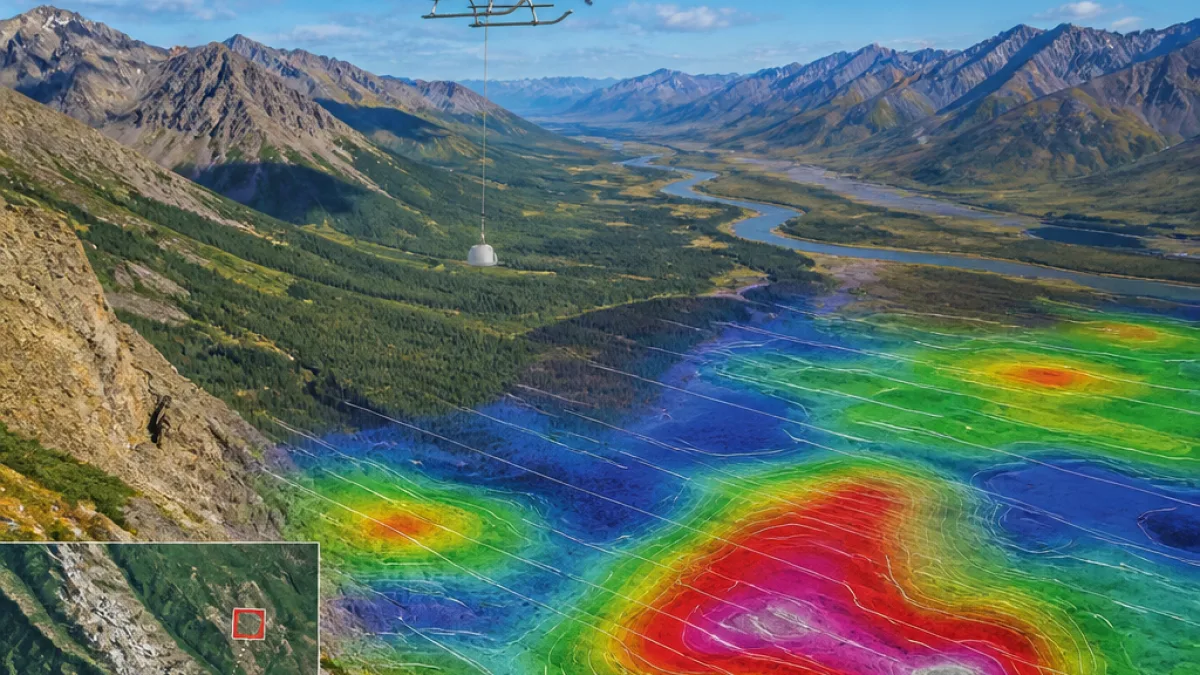
Whitehorse — Gold Strike Resources Corp. says final data from an airborne geophysics programme over its Gold Strike One (GS1) property in Yukon has revealed magnetic anomalies that the company considers promising targets for further exploration near Snowline Gold Corp.'s Valley deposit.
Survey scale and immediate findings
The company completed a helicopter-borne survey covering 286.71 line-kilometres with a 100-metre line spacing in mid-August. The programme combined magnetics and radiometrics to build a geophysical picture intended to augment geological and geochemical mapping of GS1.
Gold Strike’s technical review highlighted a magnetic high coincident with a roughly 100-metre by 100-metre intrusion its field crew located in the southeast portion of the property. That intrusion lies less than 1.5 kilometres from Snowline Gold’s Valley deposit, a nearby target of interest for regional explorers.
"Data from this survey is encouraging, as it reveals a geophysical signature to our newly discovered intrusion at GS1 along with other similar geophysical signatures that may or may not be exposed at surface," said Peter Miles, CEO of Gold Strike.
What the magnetic data show
The processed magnetic results, presented as reduced-to-pole total magnetic intensity (RTP TMI), reveal a number of features the company flagged for follow-up:
- Distinct magnetic high coincident with the newly discovered intrusion in the southeast of GS1.
- Magnetic lows with signatures comparable to those mapped over the Valley deposit.
- Linear magnetic features interpreted as potential faults or dykes.
Gold Strike overlaid the new RTP TMI data with its 2026 and prior geochemical sampling, and compared drone-derived magnetic imagery from the adjacent Valley deposit to contextualize anomalies.
Why this matters locally
Exploration companies in Yukon have increasingly focused on reduced intrusion-related gold systems (RIRGS), which often occur in clusters. Proximity to an identified deposit — in this case Snowline’s Valley — raises the prospect that GS1 may host similar mineralizing systems, whether exposed at surface or concealed beneath shallow overburden.
For communities and stakeholders in Yukon, new targets can mean more field seasons, increased engagement with First Nations and regulators, and the potential for longer-term economic activity tied to exploration and, if warranted, development. The company has not announced any new drill programmes or timelines in connection with these geophysical results.
Data at a glance
| Parameter | Value |
|---|---|
| Survey type | Airborne magnetics and radiometrics |
| Line-kilometres | 286.71 |
| Line spacing | 100 m |
| Notable feature | ~100 m × 100 m intrusion (SE GS1) |
| Proximity to Valley deposit | < 1.5 km |
Next steps and context
The company says the survey helps prioritise targets for follow-up work. Magnetic highs and lows, and linear features suggesting structural controls, will typically guide targeted ground mapping, soil sampling and ultimately drill testing. Gold Strike’s release did not include a timetable for such activities.
Exploration around Snowline’s Valley deposit has attracted interest because RIRGS-style mineralization can cluster, producing multiple nearby targets. Using airborne magnetics and radiometrics alongside geochemical sampling and drone magnetics is a common approach to find buried or subtle expressions of intrusive bodies and related alteration that can host gold.
Any future fieldwork on GS1 would proceed in a regulatory and permitting environment that involves Yukon government oversight and consultation with affected First Nations and local stakeholders, consistent with territorial practices for mineral exploration.
Gold Strike trades on the TSX Venture Exchange under the symbol GSR and on the OTC Pink market as GDSRF. The company provided figures and maps in its technical figures comparing the GS1 RTP TMI imagery with prior sampling and drone-derived magnetic data from the Valley area; those figures form the basis for its interpretation of the new anomalies.
As the northern field season winds down, companies operating in Yukon typically assess survey data and plan winter or next-season follow-up. For GS1, the final magnetic dataset adds a new layer of information for exploration planning and for conversations with partners, communities and regulators about the property’s potential.