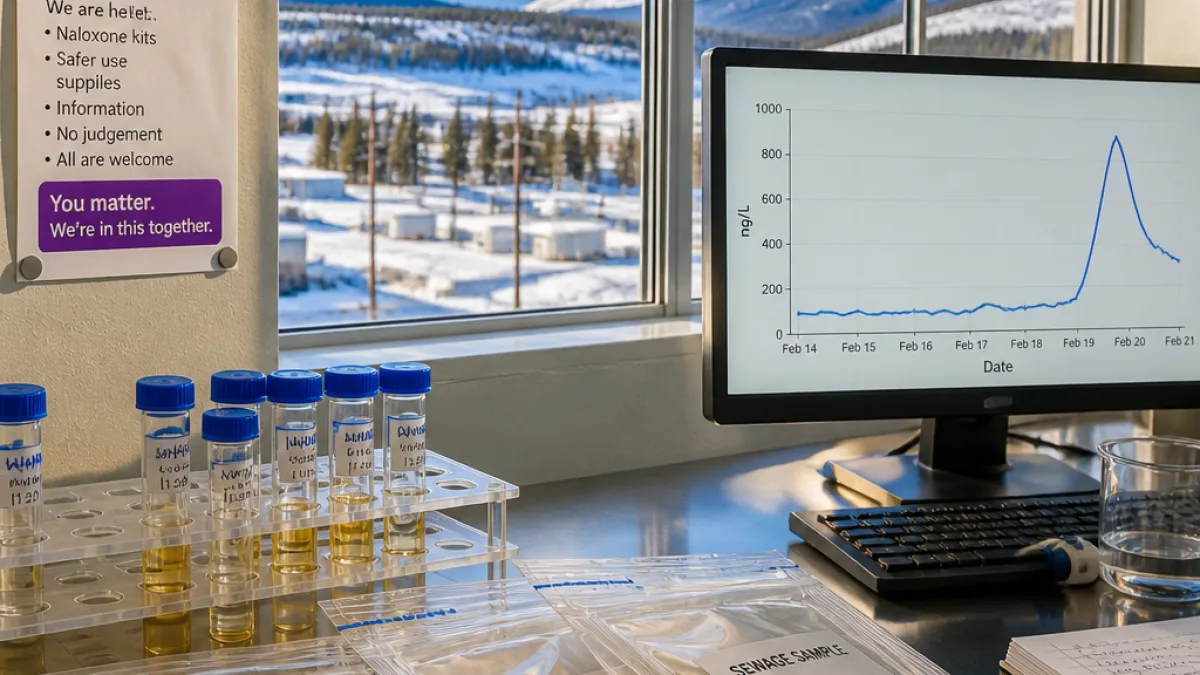
Wastewater surveillance in Whitehorse has flagged the presence of a potent synthetic opioid, drawing attention from community health advocates and public-health officials. The Blood Ties Four Directions Centre issued a public notice after the compound cychlorphine was detected in local wastewater, and advocates believe the drug may be linked to several recent severe overdoses in the territory.
How the detection was made
The detection was made possible through the Canadian Wastewater Intelligence Platform, a program administered locally by the One Yukon Organization. One Yukon’s chief operating officer, Carlina Koutras, said the program — which launched in 2023 — uses wastewater epidemiology to monitor population-level public-health indicators without requiring individual testing.
“So essentially, what it allows us to do is to anonymously capture population-level data on any biological targets as well as chemical signals like the toxic drugs without requiring individuals to seek care or to be tested for something specific,” Koutras said.
Koutras described the Whitehorse program as among the most sophisticated of its kind in North America, noting that One Yukon conducts its own testing and partners with advanced laboratories for detailed analysis.
Laboratory partners and capabilities
One Yukon told the News it works with outside laboratories to confirm and characterise findings. Among its partners is the University of Calgary’s Advancing Canadian Water Assets laboratory, described by Koutras as a leading lab for detecting toxic drugs, and the Public Health Agency of Canada’s National Microbiology Lab in Winnipeg.
| Organisation | Role |
|---|---|
| One Yukon Organization | Local program administration and primary sampling/analysis |
| University of Calgary — Advancing Canadian Water Assets lab | Advanced toxic-drug detection and laboratory analysis |
| Public Health Agency of Canada — National Microbiology Lab | Reference laboratory collaboration |
Why wastewater matters to harm reduction
Wastewater epidemiology provides anonymized, population-level signals of emerging threats — from infectious diseases to illicit-drug contaminants. Those signals can give harm-reduction groups and public-health agencies early warning about changes in the drug supply, allowing them to focus outreach, distribute naloxone, update testing advice and inform clinicians and first responders.
Local advocates who issued the public notice say the detection of cychlorphine is consistent with clinical reports of unusually severe overdoses, although formal links between the wastewater finding and individual cases require further investigation.
Community implications and responses
For Whitehorse residents and service providers, the wastewater finding underscores the unpredictability of the unregulated drug supply. The detection does not identify who used a substance or where, but it signals presence at a population level. Public-health messages that follow such detections typically encourage vigilance, safer-use practices and readiness to respond to overdoses.
- What the detection means: Population-level evidence that cychlorphine is present in Whitehorse wastewater.
- What it does not mean: It does not identify individuals, point to purchase locations or prove cause of individual overdoses without clinical correlation.
- Potential next steps: Confirmatory lab work, targeted harm-reduction outreach and coordination with health services and first responders.
One Yukon emphasises its capacity to pick up both biological targets, such as respiratory pathogens, and chemical signals like toxic drugs, which makes the platform useful to a range of public-health and harm-reduction needs.
Broader context
Wastewater monitoring has expanded in many jurisdictions since the COVID-19 pandemic to track infectious disease trends and other public-health threats. In the Yukon, One Yukon’s platform has been operating since 2023 and positions Whitehorse among jurisdictions using wastewater intelligence as part of routine surveillance.
Local service providers and advocates have increasingly leaned on these data to inform messaging and services. The recent alert from Blood Ties Four Directions Centre is an example of community organisations using wastewater results to warn residents about an apparent change in the drug supply.
Officials have not released further laboratory data or a timeline for follow-up testing. One Yukon and its lab partners are expected to continue analysis to better understand the scale and duration of cychlorphine presence in Whitehorse wastewater.
As public-health and harm-reduction partners examine the finding, community members and frontline workers are being urged to take standard precautions when responding to suspected overdoses and to stay informed through local health channels.