Air quality varies across North Vancouver as PM2.5 edges above WHO guideline
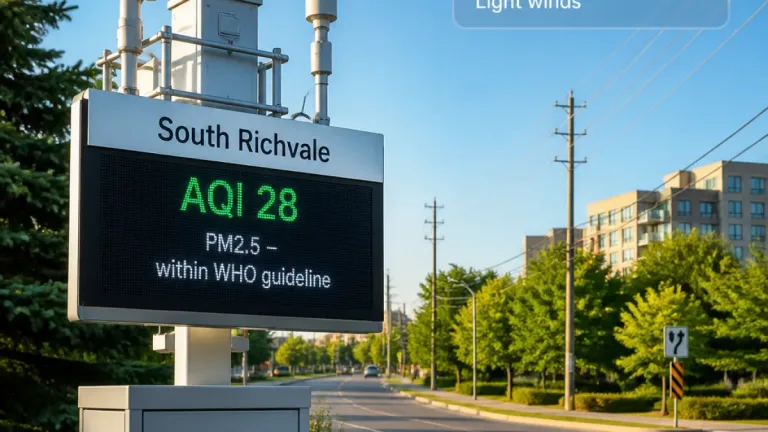
North Vancouver residents saw mixed air-quality readings in the latest IQAir update, with some monitoring sites reporting moderate measurements while the broader PM2.5 concentration registered at levels above the World Health Organization's annual guideline. The dataset, drawn from real-time stations across the city, shows differences of more than 40 points between the highest and lowest station AQI⁺ values.
The aggregated figure noted that the local PM2.5 concentration was approximately 1.3 times the WHO annual guideline at the time the data was published. Hourly and short-term forecasts for the coming days show fluctuations in the Air Quality Index, with projected daily AQI values rising through the weekend.
IQAir's hourly forecast listed the following city-level outlook:
- Today: AQI⁺ US 34, temperatures around 21°/16°, wind about 9 km/h, humidity 65%
- Saturday: AQI⁺ US 47, temperatures near 19°/12°, wind about 16 km/h, humidity 74%
- Sunday: AQI⁺ US 51, temperatures near 15°/13°, wind about 11 km/h, humidity 81%
These short-term projections indicate a trend toward higher AQI numbers over the weekend, which could affect sensitive groups if particulate matter concentrations increase further.
Local stations show a spread in AQI values
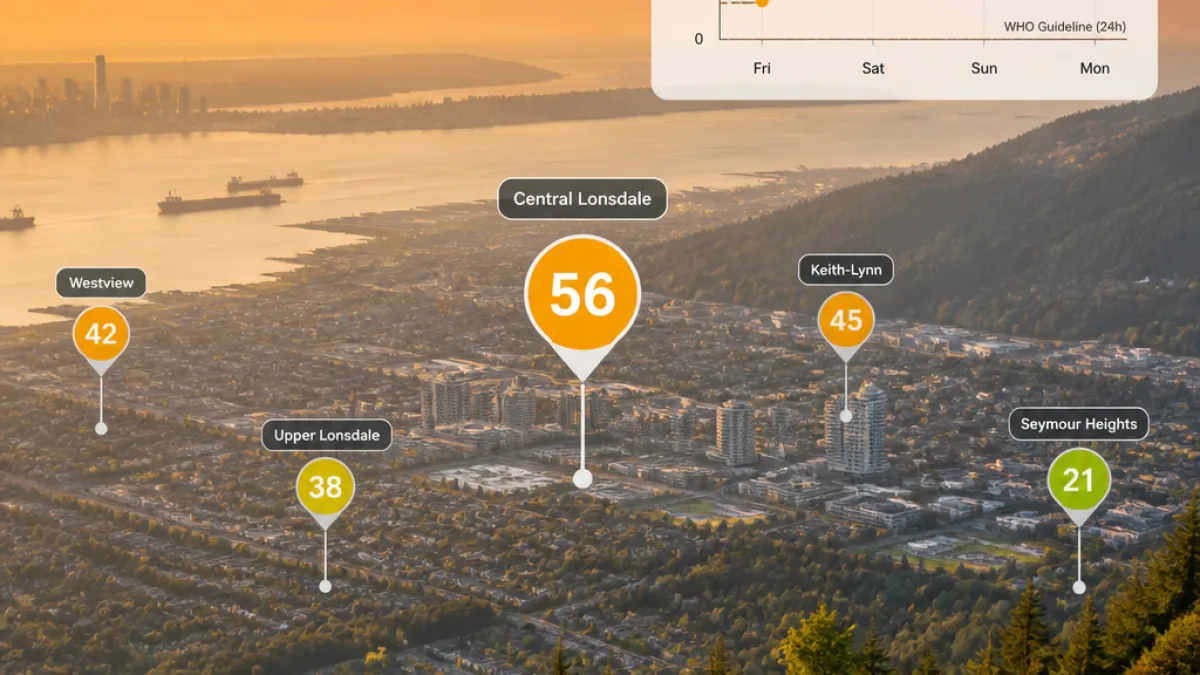
Real-time station rankings supplied by IQAir outline notable differences across monitoring locations within North Vancouver. The highest reported station value was at Briarlynn Park, with an AQI⁺ US of 56, while other stations showed substantially lower readings.
| Station | AQI⁺ US |
|---|---|
| Briarlynn Park | 56 |
| Second Narrows | 47 |
| 1802–1840 16th St E | 40 |
| 14th Street West | 38 |
| Capilano & Paisley | 36 |
| Harold Road | 36 |
| Hastings–Sunrise | 29 |
| North Vancouver | 27 |
| Capstone | 21 |
| North Vancouver, BC | 13 |
The range reflects local variations in emissions sources, topography and wind patterns across neighbourhoods. A station reading in the mid-50s falls into the moderate category, where some people who are unusually sensitive to air pollution may experience health effects.
"Historic air quality" graphs in the IQAir dataset showed North Vancouver at an AQI⁺ US of 36 at one recorded hour, classified as 'Good' during that period.
Where North Vancouver sits in the national context
On a Canada-wide city ranking from the same IQAir snapshot, North Vancouver did not appear among the highest-polluted cities. The top city listed in that national ranking was Lévis, Quebec, with an AQI⁺ US of 68. Several Quebec and Ontario communities featured in the top 10, while Port Moody was the highest-ranked city in British Columbia at 50.
For residents, the practical takeaway is to monitor local station readings if they have respiratory conditions or other health concerns. The IQAir data provides real-time station detail and short-term forecasts that can help people decide whether to adjust outdoor plans.
Local authorities and health professionals commonly advise that those in at-risk groups — including young children, older adults and people with lung or heart conditions — consider limiting prolonged or heavy exertion outdoors when particulate matter levels rise. Keeping windows closed and using filtration indoors are typical mitigation steps when AQI numbers increase.
North Vancouver's coastal setting and varied microclimates mean air quality can shift quickly; residents should consult up-to-date sources and station-level data before planning extended outdoor activities.